Live data from Hacker News

The mid in fake midcentury modern

nplusonemag.com

91–100 of 512 posts

Re: The mid in fake midcentury modern

#91

I don't know, it might just be me but if you're going to write an article (a really long one) bemoaning how everything is ugly you need to provide more than one picture. I want picture proof, not long descriptions that leave me to imagine. Pictures paint a thousand words and all that!

The problem with the word ugly is its completely an opinion. There is no right or wrong ugly.

The author would have done much better to forego the word ugly and replace it with hyper conformity.

Re: The mid in fake midcentury modern

#92
post #23

World Wars 1 & 2 happened, shattering the remaining sense of aesthetic unity we had that was followed by modernism which purity spiraled into the ubiquitous glass box, which was then followed by a post-modernist surface-level, purely negative rejection of modernism the post-modernists were unable to return to any pre-modern sense of aesthetics due to their ideological commitment to the ur modernist impulse of pride (…

To latch on to this great post there are a couple of other worthwhile discussion points: We're still in a nuclear war mental model. We can't build beautiful things if we think they'll be destroyed in a war. We still have a societal level PTSD from World War I, World War II, Korea, Vietnam, the Soviet Union, and other things. World War I veterans came back with horrific problems. That's why architects like Frank Lloyd…

How is it that America can still be traumatised from the world wars architecturally but europe is not? I don't really buy the argument that america builds badly because of fear of destruction. It's more that we are an utterly utilitarian culture. We have nothing old, and cannot imagine that anything might become old. Our goals are to maximize profits while minimizing cost, so we end up building $10m houses out of shitty plywood and fake bricks glued on the fascade.

I don't think the ugliness is anything philosophical either. We are simply an unsophisticated culture, with an education system that never exposes people to art or architecture. We're a nation of Nouveau riche pseudo-sophisticated country people who think that money = culture.

Re: The mid in fake midcentury modern

#93

Earlier quoted context omitted.

A lot of people responsible for 20th century architecture believed more or less that beauty is Literally Fascism, so that's another component. The ugliness isn't always accidental.

Even before there was the idea that ornamentation was ultimately a waste of resources and is incompatible with the promise of efficiency that brings about the modern world. https://en.wikipedia.org/wiki/Ornament_and_Crime

Still, the Looshaus was rather ornamental for present day standards.

https://en.wikipedia.org/wiki/Looshaus

There's also a considerable difference in modernist/brutalist architecture and current blandness. Speaking of Vienna, compare the same lot, Rathausstraße 1, Harry Glück, 1980 [1], and current replacement [2]. (It's not just the US.)

[1] former computation center of the city of Vienna: https://de.wikipedia.org/wiki/Datei:Rechenzentrum_Harry_Glüc...

[2] commercial replacement: https://images.app.goo.gl/1S6Xjnk6XLmZ9XqbA

(BUWOG, as seen on top of the mall-like structure, is the former housing cooperative for federal officers, now privatized and mostly selling off the apartments. For the better or – as may be feared – the worse, the replacement building is literally a temple to residential building.)

Re: The mid in fake midcentury modern

#94
I think there are plenty of beautiful things in the world today.

The theory in art history is that beauty became relegated to other factors after WWI and II. I believe this can capture the mood of the period, but it is a bit simplistic. IMO there has always been many factors, and never was beauty the only aspect of all art.

Re: The mid in fake midcentury modern

#95
post #23

World Wars 1 & 2 happened, shattering the remaining sense of aesthetic unity we had that was followed by modernism which purity spiraled into the ubiquitous glass box, which was then followed by a post-modernist surface-level, purely negative rejection of modernism the post-modernists were unable to return to any pre-modern sense of aesthetics due to their ideological commitment to the ur modernist impulse of pride (…

To latch on to this great post there are a couple of other worthwhile discussion points: We're still in a nuclear war mental model. We can't build beautiful things if we think they'll be destroyed in a war. We still have a societal level PTSD from World War I, World War II, Korea, Vietnam, the Soviet Union, and other things. World War I veterans came back with horrific problems. That's why architects like Frank Lloyd…

I used to have to deal with some Brutalist structures. Ghastly things, look like they were built by some kind of enormous alien wasp-like creatures that spit out a paste of concrete. Unfriendly interiors. Stairwells almost deliberately vertiginous. Floors with the warmth and charm of a Detroit loading dock. A building which does not learn, its unfortunate inhabitants must adapt to it.

Re: The mid in fake midcentury modern

#96
The author keeps referencing "cardboard modernism" but really should just use the word "postmodernism" to describe the era we are still in when it comes to construction, furniture, etc.

The reason things look and feel "cardboard" is because in a postmodern world, many objects are approximations of the objects we associate them with. So, for instance a vinyl window is made to look like a wood window which was designed in such a way because of the limits of the material in addition to the function of the object. And example being window moldings on a sash window. For a wooden window they had a functional purpose (enclose the weights and ropes) which has been lost but approximated in a postmodern vinyl window because "that's how windows look".

Materials in general have changed so much as well. So much furniture is made out of engineered wood instead of wood for example. But this shouldn't be a condemnation of our postmodern times necessarily. These types of materials, manufacturing, and assembly have made things accessible to many more people. If you want high quality objects made from fine materials and craftsmanship it is still out there. It's just extremely expensive. It's a huge gap from builder grade to quality to custom.

Re: The mid in fake midcentury modern

#97
post #89

Earlier quoted context omitted.

I'm not sure anyone thinks the Eiffel Tower is a masterpiece of beauty. More like a hyper-marketized symbol of Paris. And frankly the area would probably be nicer if it wasn't there at all.

Ah, but now you've delved off into opinions. I'd have to say the article itself is just a gigantic opinion piece. Ugly is the wrong word. Conformity is. If you consider conformity ugly, you will see it as ugly, if you do not, it will not be ugly. It's all subjective.

No, I don’t think it’s just “all subjective” or “that’s just your opinion, man”, but actually discussing aesthetic topics to a deeper level requires more expertise and has less immediate implications (than say, civil engineering) that people are just content to be intellectually lazy about it.

Re: The mid in fake midcentury modern

#99
After spending some time living in Europe, I simply cannot go back to North America (except for the few areas built with Old World charm). There's something so comforting about the beauty of European and other traditional architectural styles. (Modern/Postmodern?) glass boxes feel jarringly cold, hostile, and alienating.

Re: The mid in fake midcentury modern

#100

There's so much in this essay to unpack, it's all over the place -- more of an extended rant than any particularly cohesive argument. But one of the early points is "why is everything so gray instead of colorful?" Which is easy to answer -- when all your cars and buildings are super-colorful, they clash. They become garish and ugly and screaming for attention. Thank god we've moved to more neutral tones that actually…

The rational explanation why the majority of items are neutral tones/grey is because this maximizes the market. This can be seen on automobiles, where silver is the most common color because it’s easier to sell second hand, so manufacturers learned to optimize for this.

White is the best selling used color by the way, followed by black and then silver but your point stands.

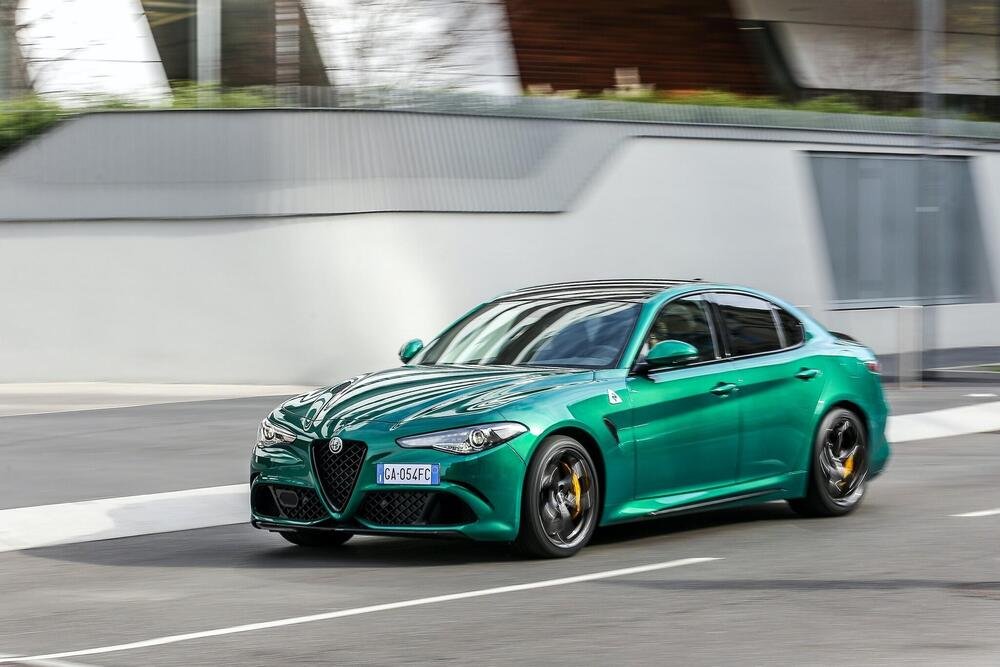
I kind of miss the times were people had colorful cars, and I don't understand this argument of screaming for attention. Looking at beautiful cars like the Alfa Giulia being black rather than Alfa red [1] or Quadrifoglio green...again?

[1]https://i.pinimg.com/564x/4b/4b/16/4b4b16277ab1652775cd5c7de...

[2]https://cdn-img.automoto.it/images/22002933/1000x/20200507-1...

Post reply on HN