Live data from Hacker News

Lab-Grown Meat Is Safe to Eat, FDA Says

smithsonianmag.com

481–490 of 493 posts

Re: Lab-Grown Meat Is Safe to Eat, FDA Says

#481
post #179

Earlier quoted context omitted.

In practice, artificial FBS or FBS-free medium can be very tricky to use successfully. It's definitely not a solved problem yet.

It is a solved problem, UPSIDE (and I believe one other company) now have animal-component-free medium.

These products have existed for decades (I know because I’ve used some of them), but it is not a solved problem. For all but the easiest cell cultures, growing cells without FBS is extremely tricky. I know that marketing materials (and some publications almost certainly by the manufacturer) say otherwise, but that’s marketing for you.

Not every type of cell or tissue has the same requirements, and things get difficult very quickly as soon as you deviate from the most common cultures. Tissues and non-cancerous (or in technical jargon: non-immortalized) cell lines are usually much, much, much more difficult.

And even if you manage to grow your cells, “serum-starving” will likely happen due to some unknown missing nutrient / factor, which will stress your cells and alter their phenotype. Even if they don’t lose their adherence, undergo apoptosis, or some pathologic autophagy, they may produce all sorts of extracellular vesicles.

FBS is really expensive, and quite mysterious. Nobody really knows what’s in there exactly. [1] Researchers would love to be able to stop using it, because it could mean more reproducible results, and at scale, fewer expenses. Unfortunately, FBS is also unreasonably effective, so we continue to use it still.

[1] This is only a slight exaggeration, but it’s approximately true. Trust me, I know this sounds like a preposterous claim. But this is an absolutely-insane rabbit hole where a lot more research is very-needed. A full characterization of FBS and its effects on cells does not exist, and is much more complex than it probably sounds.
Re: Lab-Grown Meat Is Safe to Eat, FDA Says

#482
post #8

Yeah I’m going to let other folks experiment with that for 10 or so years and see where it goes. I’m sure the meat is fine, it’s just a matter of not contaminating it during the process that I’m concerned about. The FDA is really poor at enforcing the health and safety aspects of manufacturing and processing. They simply don’t have enough inspectors and the inspectors don’t fine big offenders enough

If you put cattle on farmland, and utilize regenerative agriculture techniques, it costs a bit more, because yields aren't artificially boosted while destroying the topsoil. In return you actually capture carbon into the grasses from the atmosphere. That would normally just rot, but the herbivores digest it and make it bioavailable for the fungi and bacteria in the soil, where the carbon accumulates. The herbivores a…

What you're describing is a fantasy. There simply is not enough natural grassland out there for the entire human race to grow enough meat to eat this way. That's why the Amazon is being chopped down to make more land for grazing.

Lab grown meat is a step in a direction that allows us to not use so much land for livestock.

Re: Lab-Grown Meat Is Safe to Eat, FDA Says

#483

Am I ignorant or would it be hugely inefficient to grow meat in a lab energy wise? I understand the whole methane issue but using up non renewable energy sources to make something that could be done with renewable resources seems a little silly unless the plan is to do this with renewables. Or is this about the ethics of consuming meat?

> I understand the whole methane issue but using up non renewable energy sources to make something that could be done with renewable resources seems a little silly unless the plan is to do this with renewables. The source of power to the lab feels like a separate issue. It would be a very intense stance to take that having your city grid on non-renewable resources means any product made in that city is bad for the en…

> The source of power to the lab feels like a separate issue. It would be a very intense stance to take that having your city grid on non-renewable resources means any product made in that city is bad for the environment!

That's not what I'm proposing. Nature is very efficient so I imagine the energy that it takes to create a pound of flesh naturally (with grass) is alot less than that to required to do it in the lab.

From a little googling and back of the envelope calculations I just did it turns out methane is really that bad for global warming. At least in the short term.

To produce a cow worth of fake meat you would have to displace more than 16 tons of C02 before it becomes a less efficient way to produce meat from a global warming perspective. This assumes the cow has been raised using ancient methods. However this is in the short term. C02 lasts longer in the atmosphere.

Re: Lab-Grown Meat Is Safe to Eat, FDA Says

#484
post #476

Earlier quoted context omitted.

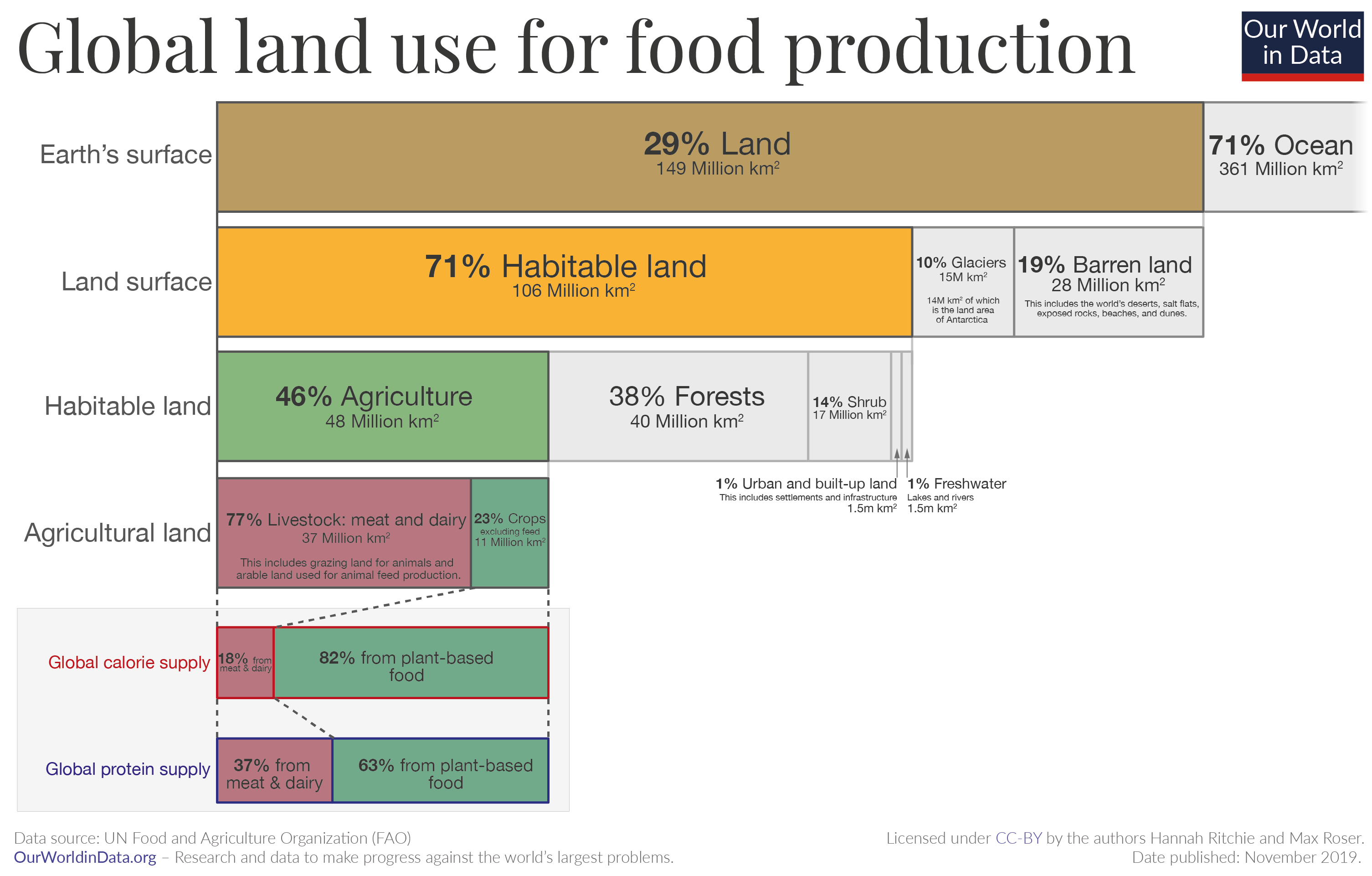
Not suitable , but used for plant-based food. Other arable land is used for animal feed production, and together with grazing land represents the other 77% of agriculture land (37 mil. km2), which supplies only 18% of global calories and 37% of proteins. Those 23% (11 mil. km2) of agriculture land, crop land, is currently producing 82% of global calories and 63% of proteins. https://ourworldindata.org/uploads/2020/01…

> Other arable land is used for animal feed production, and together with grazing land represents the other 77% of agriculture land Right, and since we're only talking about cropland, that 77% has no relevance to the discussion. That it keeps coming up is rather bizarre. Indeed, if you keep pounding a square peg into a round hold hard enough it may eventually go in, but one sure does look silly for doing it in the fi…

You're the only one in this discussion talking about crop land. To focuse solely on crop land and ignore pastures is misleading.

> Eloff: ... won't need to raise animals or food for animals ... we could rewild huge parts of the Earth

> randomdata: probably not ... 36% of the cropland is used for animal food ...

Even if we kept all the arable land for human consumption (to compensate for missing meat, assuming the lab-grown meat will take some time to scale) we'd have 3.3 billion hectares of pastures to rewild/reforest. Or we could reforest those 35% of arable land we use for growing animal feed and instead use a fraction of pastures for nuts/fruit production.

https://ourworldindata.org/grapher/global-pasture

Forests cover 40 mil. km2, and animal agriculture takes 37 mil. km2. Majority of plant-based foods is produced on 11 mil. km2. By switching to plant-based we could increase forest cover from 40 mil. km2 to 70+ mil. km2.

"We might even address the very real disaster scenarios presently threatening the world with questions like these: "What if you could make a simple and compassionate change in your life that would increase available farmland, increase available clean water, reduce rainforest destruction, reduce greenhouse gas production, reduce the threat from antibiotic-resistant bacteria, decrease land and waterway pollution, prevent creation of ocean dead zones, end your participation in the deaths of sentient individuals and increase overall human health by switching to a plant-based diet? Would you do it?” This is the reality we actually live in, and this is the choice each one of us faces."

https://yourveganfallacyis.com/en/vegans-would-eat-meat-on-a...

OFF-TOPIC: we should reforest some deserts/barren areas as well

Re: Lab-Grown Meat Is Safe to Eat, FDA Says

#485
post #470

Earlier quoted context omitted.

You can't really make packaging materials from tough cellulose-y things like bean stalks because mice eat it, you can't really make building materials from it because it goes on fire, and because it's tough and made of cellulose it doesn't really break down well in a compost heap. Do you know what composts that stuff like crazy, though? Feeding it to cows. And even better, it reduces methane and carbon dioxide emissi…

>And even better, it reduces methane and carbon dioxide emissions, because you're turning all that carbon into cows instead of just letting bacteria emit it as gas. Cows don't work as carbon sinks if you're killing them every 2 years to eat them. You're just reintroducing that carbon in the form of sewage, transportation, and food waste. They need to be allowed to live all 20 years of their lives for the carbon effic…

Nothing really works as a carbon sink in the long term.

Bear in mind that cows do not actually generate carbon - as with humans, they just move it around.

Re: Lab-Grown Meat Is Safe to Eat, FDA Says

#486
post #144
post #79

Earlier quoted context omitted.

86%[0] of livestock feed is inedible by humans. They consume forage, food-waste and crop residues that could otherwise become an environmental burden. 13% of animal feed consists of potentially edible low-quality grains, which make up a third of global cereal (not total crop) production. All US beef cattle spend the majority of their life on pasture and upcycle protein even when grain-finished (0.6 to 1). [0] http://…

A lot of inedible feed is going to be stuff like alfalfa, which is specifically grown as feed and whose farming has massive negative effects like starving the Colorado river of water [0]. [0] https://www.theguardian.com/environment/2022/sep/12/colorado...

It's very easy to say "we should stop growing this and feeding it to animals, and grow that instead and feed it to humans", but it's a lot harder to make that work in reality.

Not everything grows particularly well in a given location.

Re: Lab-Grown Meat Is Safe to Eat, FDA Says

#487
post #479

Earlier quoted context omitted.

> Other arable land is used for animal feed production, and together with grazing land represents the other 77% of agriculture land Right, and since we're only talking about cropland, that 77% has no relevance to the discussion. That it keeps coming up is rather bizarre. Indeed, if you keep pounding a square peg into a round hold hard enough it may eventually go in, but one sure does look silly for doing it in the fi…

That 77% CONTAINS crop land. https://www.renewmethod.com/post/what-is-arable-land "Arable land is classified as land that can be plowed for the purpose of growing crops." Please, look at the graph one more time.

Arable land includes meadows, pastures, etc. Animals can (and do) eat from those lands, but cropland is more specific. Your weird tangent has no relevance.

Re: Lab-Grown Meat Is Safe to Eat, FDA Says

#488
post #479

Earlier quoted context omitted.

That 77% CONTAINS crop land. https://www.renewmethod.com/post/what-is-arable-land "Arable land is classified as land that can be plowed for the purpose of growing crops." Please, look at the graph one more time.

Arable land includes meadows, pastures, etc. Animals can (and do) eat from those lands, but cropland is more specific. Your weird tangent has no relevance.

> Probably not without radically changing how we grow plants for human consumption ...

Wrong.

> ~60% of the soybeans are intended for direct human consumption and ~40% for animal consumption. I imagine that is not atypical

Wrong.

> around 35% of the output ... for animal consumption, which is effectively what the real world data also shows ...

Wrong.

> Nowhere near 50% of the world's land area is suitable for cropland.

Wrong.

> Your own link suggests that only 23% of agricultural lands are suitable for cropland.

Wrong.

> Arable land includes meadows, pastures, etc. Animals can (and do) eat from those lands, but cropland is more specific

Wrong (in the context of) https://ourworldindata.org/uploads/2020/01/Global-land-use-g...

> Your weird tangent ...

It's called logic. I give up.

Re: Lab-Grown Meat Is Safe to Eat, FDA Says

#489

Earlier quoted context omitted.

Given the topic of animal suffering here, what does the full picture of an animal used for this purpose look like? Are they treated any different to animals intended for direct consumption?

My assumption is that the animals will lead the same life. While this is something that'd cut down direct consumption I doubt that's ever eliminated. So it becomes a math game. Either this cow produces the 700lbs of meat in a normal lifetime or with lab meat it produces n tons of meat (depending on how much meat can be produced per sample). Who knows, maybe this ends up with a few cows living long lives since it's no…

> it's not their meat that matters but rather the quality of the stem cells they produce.

Note that we are talking about the growth medium here, which is used to grow the stem cells into the final product. So it should be the quality—or much rather the quantity—of the extracted serum from the animal (specifically the animal’s fetus or womb).

Re: Lab-Grown Meat Is Safe to Eat, FDA Says

#490
post #428

Earlier quoted context omitted.

?? We are not carnivores. We are literally some line between herbivores and omnivores. Carnivores have to kill or they will most likely starve to death. Vegtables and fruits are the natural foods of earth for herbivores and omnivores and some carnivores. You are not killing when you eat plants and fruits. Fruits and vegtables want to be eaten for their seeds to spread. It is not a question of concious vs unconcious.…

You are killing when you eat plants and fruits. Are you foraging in the woods for these things? Or are you buying them from the supermarket, from an orchard where the farmer killed a thousand acres of native flora and all the fauna dependent on that flora to grow these fruits and nuts fit for shipping across a continent? Everything has a cost, and we should be conscious of them so we can work on mitigating them, no m…

You are still conflating killing animals for food & growing plants/vegtables/grains as if they can be equivocated. These are 2 drastically different things especially when it comes to morality and ethics.
Post reply on HN