Live data from Hacker News

Resolving the great undo-redo quandary

github.com

11–20 of 247 posts

Re: Resolving the great undo-redo quandary

#11

Alternatively, use Vim undotree: https://github.com/mbbill/undotree

Or the earlier / later commands which function exactly as the article describes and are part of vanilla vim. You can even give them a time argument, for example :earlier 10m to go back ten minutes.

Re: Resolving the great undo-redo quandary

#15
Many times I want to undo to a previous state, but then apply again a few of the changes I just reverted, basically cherry-picking from the future (from the redo stack).

It would be interesting to be able to see all edits as individual patches/diffs that you can commit/discard individually. Like a mini automatic git inside the editor, automatic in the sense that every "edit" creates a commit, undo/redo move HEAD.

This would be entirely optional, you can continue using Undo/Redo as usual, but if you need to do a more complex history operation you can open this "git" view and operate on the edit tree directly.

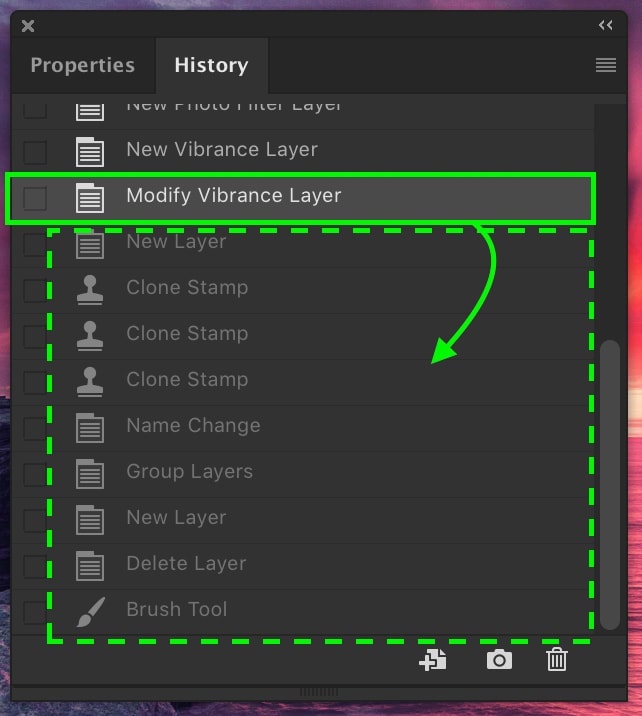
Photoshop has this nice undo panel where you can see individual edits and click your way to the desired point in history:

https://www.bwillcreative.com/wp-content/uploads/2020/08/how...

One can imagine such a view in a text editor, where each entry shows a diff of what that step did.
Re: Resolving the great undo-redo quandary

#16
post #15

Many times I want to undo to a previous state, but then apply again a few of the changes I just reverted, basically cherry-picking from the future (from the redo stack). It would be interesting to be able to see all edits as individual patches/diffs that you can commit/discard individually. Like a mini automatic git inside the editor, automatic in the sense that every "edit" creates a commit, undo/redo move HEAD. Thi…

Use local history in any JetBrains IDE.

Re: Resolving the great undo-redo quandary

#18
post #15

Many times I want to undo to a previous state, but then apply again a few of the changes I just reverted, basically cherry-picking from the future (from the redo stack). It would be interesting to be able to see all edits as individual patches/diffs that you can commit/discard individually. Like a mini automatic git inside the editor, automatic in the sense that every "edit" creates a commit, undo/redo move HEAD. Thi…

Agreed.

When I write "foobar", delete the last three characters (so that now I have "foo", then I write a "t", I would like to be able to undo the previous deletion (giving me "footbar"), not just adding the last character.

Seems to me that would work especially well in editors that have the concept of verbs + objects, like vim's "delete until the end of the line" or "replace current word with...", but maybe it would work with all kinds of editors?

Re: Resolving the great undo-redo quandary

#19
You can do this with a tree-based persistent/functional data-structure, too.

For instance the single writer (per resource) in the evolutionary, append-only database system[1], I'm working on in my spare time, can simply revert the whole resource (resource is like a table in the relational DB jargon) to a past revision. Once a new commit is issued a new revision gets appended and the whole history in-between is preserved. Thus, you can, for instance, retrieve individual changes and cherry pick these from the revisions in-between.

[1] https://github.com/sirixdb

Re: Resolving the great undo-redo quandary

#20
post #15

Many times I want to undo to a previous state, but then apply again a few of the changes I just reverted, basically cherry-picking from the future (from the redo stack). It would be interesting to be able to see all edits as individual patches/diffs that you can commit/discard individually. Like a mini automatic git inside the editor, automatic in the sense that every "edit" creates a commit, undo/redo move HEAD. Thi…

Agreed. When I write "foobar", delete the last three characters (so that now I have "foo", then I write a "t", I would like to be able to undo the previous deletion (giving me "footbar"), not just adding the last character. Seems to me that would work especially well in editors that have the concept of verbs + objects, like vim's "delete until the end of the line" or "replace current word with...", but maybe it would…

Should it be “footbar”? Or “foobart”? I could see a case being made for either.
Post reply on HN