Live data from Hacker News

Monumental (if correct) advance in number theory posted to ArXiv by Yitang Zhang

news.ycombinator.com

121–130 of 439 posts

Re: Monumental (if correct) advance in number theory posted to ArXiv by Yitang Zhang

#121
post #67

Earlier quoted context omitted.

I think it's fair to say that this could lead to certain new things becoming known about the distribution of primes. This could have implications for cryptographic algorithms that depend on prime numbers being hard to find.

Careful, prime numbers are not hard to find. Like, try openssl prime -generate -bits 2048 Congratulations, you just found a prime that is big enough for every cryptographic protocol that uses prime numbers (not counting unusual and non-deployed post-quantum proposals). Some number theory research may impact the security of cryptosystems, but not all results do.

Yeah, sorry perhaps I shouldn't have made such a specific sounding claim. I'm not an expert on this topic, but was pretty sure I had heard from reputable sources in the past that the Riemann Hypothesis had some bearing on the distribution of prime numbers. And it feels safe to say that this could have practical implications for cryptography. But maybe I should just leave it to the experts :).
Re: Monumental (if correct) advance in number theory posted to ArXiv by Yitang Zhang

#122

Earlier quoted context omitted.

I think Zhang's previous result was good enough to rebuff Hardy's claims. Actually I think Math is more or less a young people's game is because whence someone be super successful and famous it's kinda difficult psychological to retain the previous mental state and push out similar results.

Might come off as political, but Americans need need to throw off the yoke of British intellectual affectations, especially pre WWI ones.

I think you're conflating Hardy's thoughts as a mathematician, with the politics of his country of origin. The two, as far as I know, weren't really connected

Re: Monumental (if correct) advance in number theory posted to ArXiv by Yitang Zhang

#124

Earlier quoted context omitted.

Small correction: cryptographic algorithms don't depend on "prime numbers being hard to find", as they are not hard to find. Say you want to sample a 1024-bit prime. Then if you sample a random 1024-bit integer, it will be prime with probability 1/1024, roughly. This is a consequence of the prime number theorem [1] Some crypto (namely, RSA) depends on on composite numbers being hard to factor, which is a different pr…

RSA depends on large prime factors being hard to recover from their product.

Yes, that is what "factoring a composite number" means, and that's what I said in the last sentence.

Re: Monumental (if correct) advance in number theory posted to ArXiv by Yitang Zhang

#125

Two additional notes: 1. Zhang posted an attempt at solving this problem in 2007 that he later more or less admitted was flawed: https://mathoverflow.net/questions/131221/yitang-zhangs-2007... . But speaking with mathematicians who are intimately familiar with Zhang's previous work, there seems to be good reason to be optimistic nevertheless. First, the idea behind Zhang's proof is similar to the zero-repulsion ideas…

It's also worth noting that the average life expectancy has increased by roughly 20 years since G.H. Hardy first published that claim, so it would extra worrisome if we didn't have any counterexamples.

Re: Monumental (if correct) advance in number theory posted to ArXiv by Yitang Zhang

#126

Earlier quoted context omitted.

Small correction: cryptographic algorithms don't depend on "prime numbers being hard to find", as they are not hard to find. Say you want to sample a 1024-bit prime. Then if you sample a random 1024-bit integer, it will be prime with probability 1/1024, roughly. This is a consequence of the prime number theorem [1] Some crypto (namely, RSA) depends on on composite numbers being hard to factor, which is a different pr…

RSA depends on large prime factors being hard to recover from their product.

If it were just that, it would be trivial to break. It's the fact you generate the key after a modulus operation that makes it difficult to recover.

Re: Monumental (if correct) advance in number theory posted to ArXiv by Yitang Zhang

#127
post #78

Math used to be a young person game, but it now requires so much knowledge just to get to the frontiers of human knowledge, not to speak of making a dent into uncharted territory, that results are being obtained later and later in life. When mathematicians have had time to accrue sufficient knowledge while still being sharp enough to make the intellectual leap. The sad part is that as the trend continues we may reach…

"The sad part is that as the trend continues we may reach a point where a mathematician's intellectually productive life is not sufficient to contribute anything novel, statistically speaking." People talk about this a lot. While I think it could happen for certain subdisciplines (it already takes essentially an entirely PhD's worth of time to learn all the necessary background to be an algebraic geometer, so most al…

I’m not so sure. The same argument would apply to theoretical physics in 1960. Circa 2023, there are remarkably few shallow parts of physics.

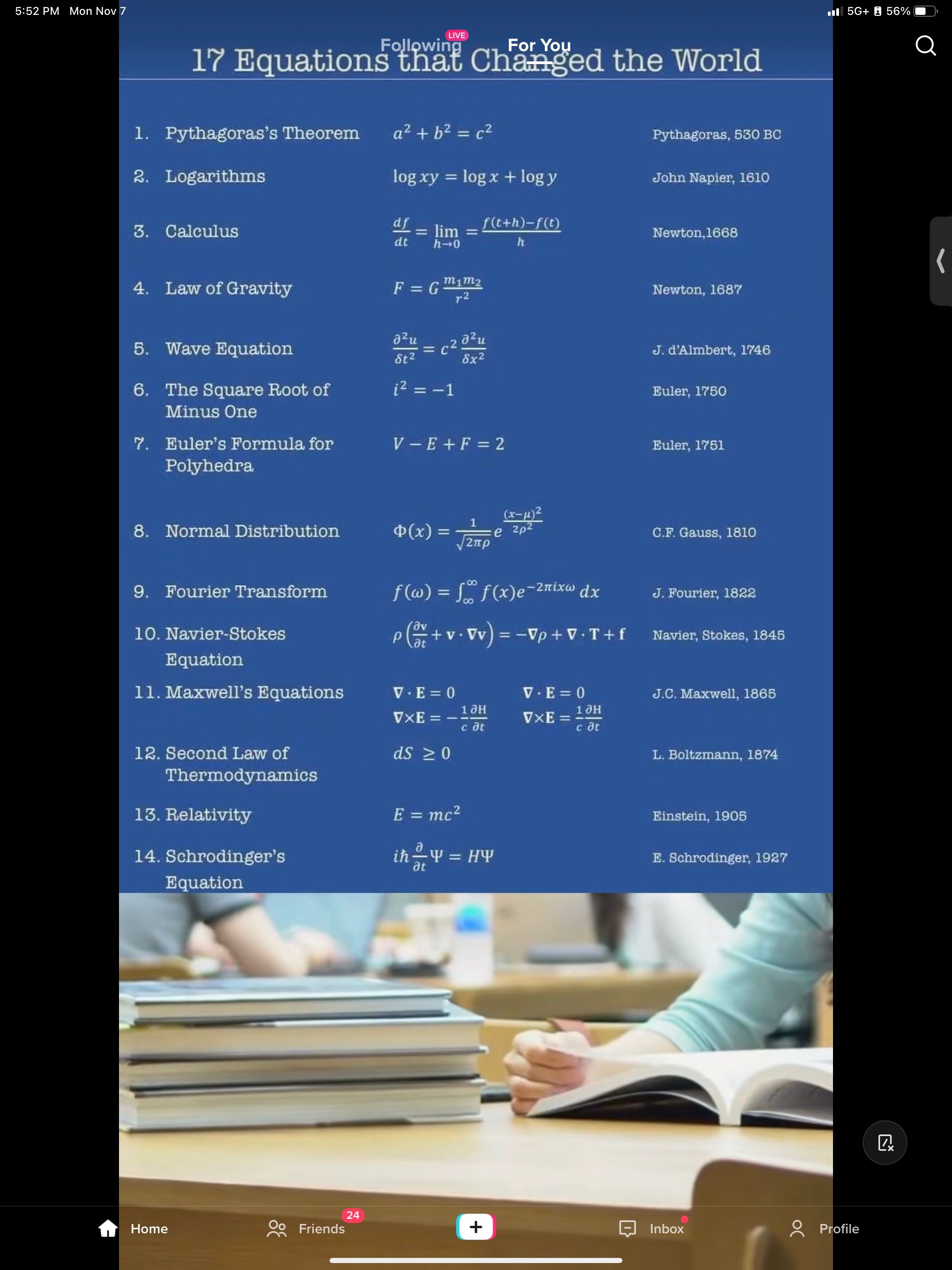
Math as a whole may last longer, but this list reminds us how far we’ve come in a mere few millennia: https://usercontent.irccloud-cdn.com/file/SaI50Q1d/166786520...

On the timescale of civilization, it seems less and less likely that lone mathematicians can revolutionize the field.

We’re fortunate to have been born so early, relatively speaking.

Re: Monumental (if correct) advance in number theory posted to ArXiv by Yitang Zhang

#128
post #98
post #78

Math used to be a young person game, but it now requires so much knowledge just to get to the frontiers of human knowledge, not to speak of making a dent into uncharted territory, that results are being obtained later and later in life. When mathematicians have had time to accrue sufficient knowledge while still being sharp enough to make the intellectual leap. The sad part is that as the trend continues we may reach…

>Math used to be a young person game, but it now requires so much knowledge just to get to the frontiers of human knowledge, not to speak of making a dent into uncharted territory >The sad part is that as the trend continues we may reach a point where a mathematician's intellectually productive life is not sufficient Hmm. I had never thought of it like this. Is it possible for human knowledge to become so advanced in…

Here is a short story that covers that idea: https://slatestarcodex.com/2017/11/09/ars-longa-vita-brevis/

Re: Monumental (if correct) advance in number theory posted to ArXiv by Yitang Zhang

#129
post #78

Math used to be a young person game, but it now requires so much knowledge just to get to the frontiers of human knowledge, not to speak of making a dent into uncharted territory, that results are being obtained later and later in life. When mathematicians have had time to accrue sufficient knowledge while still being sharp enough to make the intellectual leap. The sad part is that as the trend continues we may reach…

"The sad part is that as the trend continues we may reach a point where a mathematician's intellectually productive life is not sufficient to contribute anything novel, statistically speaking." People talk about this a lot. While I think it could happen for certain subdisciplines (it already takes essentially an entirely PhD's worth of time to learn all the necessary background to be an algebraic geometer, so most al…

> If one part of math gets too deep, you can always go somewhere else, where the water is still "shallow."

Yes, but the shallow areas aren't very interesting, which is why people work in the deep areas.

Re: Monumental (if correct) advance in number theory posted to ArXiv by Yitang Zhang

#130
post #98

Earlier quoted context omitted.

>Math used to be a young person game, but it now requires so much knowledge just to get to the frontiers of human knowledge, not to speak of making a dent into uncharted territory >The sad part is that as the trend continues we may reach a point where a mathematician's intellectually productive life is not sufficient Hmm. I had never thought of it like this. Is it possible for human knowledge to become so advanced in…

This is a growing problem in many fields, IMHO. I've been wondering for awhile if it's an inherent flaw in knowledge in that if knowledge can't supplant older knowledge in a high compressed reduced form as things progress, we're just building so much information/knowledge for any given field that at some point, it may be quicker to simply rediscover the process than to search the knowledge for the prior work.

Even with optimal compression, there is still a finite minimum size.
Post reply on HN