Live data from Hacker News

NASA finds super-emitters of methane

smithsonianmag.com

341–350 of 387 posts

Re: NASA finds super-emitters of methane

#341

And now what ? Anyone knows what actions will be taken based on this data ?

My plan is to move a bit north before the wet bulb temperatures in the southern US get too bad. I'm thinking ruralish Michigan for my retirement.

The Great Lakes area is a good place to be to shield yourself from natural disasters of any kind, including any extreme climate events to come, other than maybe another ice age.

For what it's worth, I live in the Gulf Coast, which is home to some of the highest wet-bulb temperatures in the country; and temperatures here appear to be moderating, if anything. The average temperature in the state of Mississippi, for example, remained virtually constant over the last century, rising by 0.1ºF, compared to the nationwide average of 1.8ºF.
Re: NASA finds super-emitters of methane

#342
post #300

To put this in perspective, the 18300kg per hour from the Permian site is equivalent (over a 100 time horizon global warming potential) to a 500 Megawatt coal power plant's CO2 emissions (~1kg of CO2 per kWh of electricity) burning 24/7. Or, to put it another way, it accounts for the same emissions as about 0.3% of the entire US electricity grid.

It's even worse than that, since that's the effect over 100 years and we don't have 100 years. Over 20 years, 1 ton of methane is equivalent to about 80 tons of CO2 (compared to ~25 tons over 100 years), so about 3x worse than your numbers.

By what parameters do you think we don't have 100 years? When I read the IPCC reports, it seems that during the next 50 years, we may see moderate increases in temperatures (1-3C, depending on scenario). While this may be bad in some areas, it's nothing compared to the worst case scenarios for 2200-2300 (up to 12C).

A temperature increase of ~2C may at worst be comparable with a large pandemic or even WW2, just with the damage spread out over 2-3 generations. 12C, on the other hand, will leave large parts of the globe uninhabitable without technological assistance, and could wipe out a non-trival fraction of humanity if our tech doesn't keep up (still less hostile than Mars or Venus, though).

But for the scenarios that go 150+ years into the future, methane is a pretty small contributor compared to CO2.

Re: NASA finds super-emitters of methane

#343
post #24

Several questions ask to contextualize this measurement. Here's a highly-cited paper in Nature (including some of the researchers quoted in the OP) that describes how an earlier survey of California methane emissions went: https://www.nature.com/articles/s41586-019-1720-3 If I remember right, the state of CA asked for this survey. It was carried out by an instrument similar to that of the OP, but airborne, not on ISS…

Green bins for food waste don't work if you have Airbnb nearby.

Re: NASA finds super-emitters of methane

#344

Earlier quoted context omitted.

Is there a way to IDK 3d earthen print a geodesic dome over the site and capture the waste methane (natural gas) into local tanks? TIL about CBG: Cleaner Burning Gasoline From https://twitter.com/westurner/status/1564443689623195650 : > In September 2021 we covered a new "green gasoline" concept from @NaceroCo [in Penwell, TX] that involves constructing gasoline hydrocarbons by assembling smaller #methane molecules f…

I hear what you are saying, and there is a ton of room in the E&P space for improvements of all kinds. You would be shocked at how incredibly we are behind technologically (I remember just last year over hearing someone say, "We just figured out our cloud strategy."). In terms of a dome over fields or units to collect stray methane, that may be an issue. We are loathe to construct "enclosed spaces" for gases as that…

So there only needs to be a bit of concrete in a smaller structure that exceeds bunker-busting bomb specs and 'funnels' (?) the natural gas to a tank or a bladder?

Are there existing methods for capturing methane from insufficiently-capped old wells?

Are the new incentives/fees/fines enough to motivate action thus far in this space?

OpenAPI is one way to specify integrable APIs. An RDFS vocabulary for this data is probably worthwhile; e.g. NASA Earth Science (?) may have a schema that all of the state APIs could voluntarily adopt?

Presumably the CophenHill facility handles waste methane? We should build waste-to-energy facilities in the US, too

FWIU Carbon Credits do not cover methane, which is worse than CO² for #ActOnClimate

Re: NASA finds super-emitters of methane

#345
post #300

Earlier quoted context omitted.

It's even worse than that, since that's the effect over 100 years and we don't have 100 years. Over 20 years, 1 ton of methane is equivalent to about 80 tons of CO2 (compared to ~25 tons over 100 years), so about 3x worse than your numbers.

By what parameters do you think we don't have 100 years? When I read the IPCC reports, it seems that during the next 50 years, we may see moderate increases in temperatures (1-3C, depending on scenario). While this may be bad in some areas, it's nothing compared to the worst case scenarios for 2200-2300 (up to 12C). A temperature increase of ~2C may at worst be comparable with a large pandemic or even WW2, just with…

Sorry, I shouldn't have written it like that. I suppose what I really mean is that it makes sense to look at the CO2 equivalent over a 100 year period when thinking about long-term climate change, but we're going to see large effects in the coming decades. The full sentence I should've written is something like, we don't have 100 years before we start seeing major changes, so the short-term impact should be a part of the conversation.

Re: NASA finds super-emitters of methane

#346
post #219

Earlier quoted context omitted.

> In LA, for example, the LADWP is test-driving a program where food scraps - vegetables, but also meats and fats - are diverted into green bins Moved to SF from LA area. Sf does the green bins and it’s actually surprisingly nice to separate the compostable scraps out of the other trash. It keeps the trash bin much cleaner and much less stinky. If I moved back to an area that didn’t require it, I’d still keep them se…

We have compostable bin pickup twice a week in my hometown in Italy, a ton of things are compostable with industrial composters these days which you could not easily compost at home, also thanks to regulations (e.g. shopping bags, tea bags, some food packaging etc), so the other bins stay pretty empty.

I see entire apartment complexes that don’t have recycling options at all, whatsoever.

Re: NASA finds super-emitters of methane

#347
post #21

Earlier quoted context omitted.

Methane is a much more potent greenhouse gas compared to CO2, but also stays in the atmosphere much less long (on the order of a few decades).

The way methane "exits" the atmosphere is by becoming CO2, so it's strictly worse.

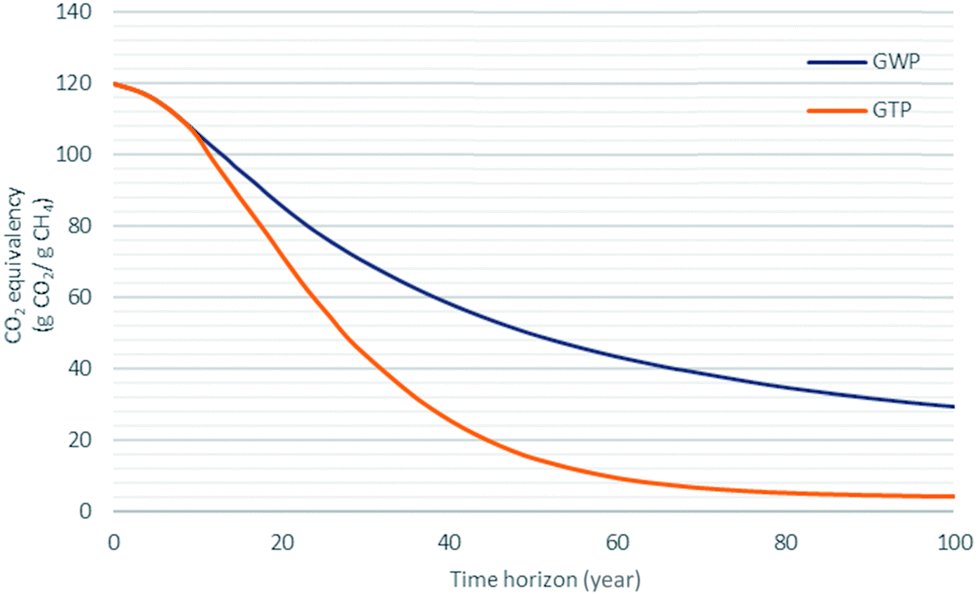
When methane is released, each molecule casues 120x more warming than a CO2 molecule. As it decays (with a half life of ~10 years), it falls exponentially towards a floor of 2-4x worse than CO2 (it's 4x after 100 years and continues to decay from there). This is called Global Temperature Potential (GTP).

Even after 50 years, it's "only" 10x worse than CO2.

GWP is the average for all years, compared to CO2. For methane, most of this is contributed within the first 20 years after release. GWP is primarily useful for estimating the effect of constant steady state emissions. For instance, if we emit both methane and CO2 at constant rates from now to 2122, the heating from the methane is about 25x worse than from CO2. (CWP100=~25). (calculating this gives the same integral as averaging over 100 years).

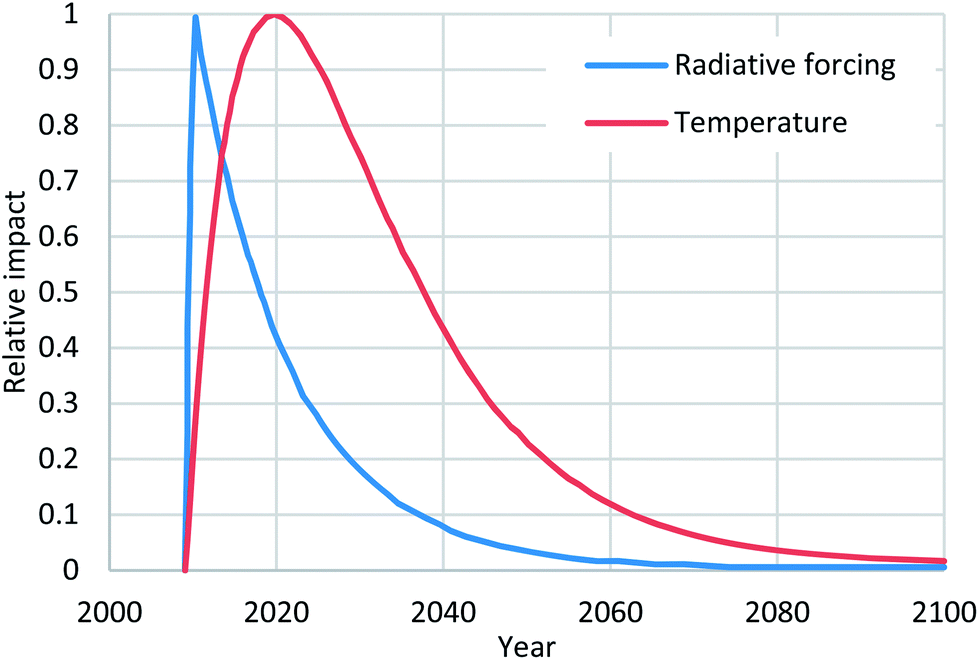
However, if we're not looking at constant emissions, but instead large bursts where all the gas is released at once, it makes more sense to use the GTP curve.

Here is a nice plot that visualizes this: https://pubs.rsc.org/image/article/2018/EM/c8em00414e/c8em00...

Edit: strictly speaking, the above reasoning assumes the Earth cools rather quickly. Actual cooling once heat has been trapped can be 10-20 years, however, meaning the maximum temperature is reached about 10 years after the release, and it will take 20+ years for all the heat to escape Earth after the methane itself is gone.

https://pubs.rsc.org/image/article/2018/EM/c8em00414e/c8em00...

Re: NASA finds super-emitters of methane

#348

Earlier quoted context omitted.

The government would only publicize the emissions that benefit us politically, which are likely the primary polluters we already know about (China, India, etc).

Corporations are multinational. The atmosphere doesn't care if that methane plume came from a plant in the US or a US-owned plant in Nigeria. Or on an rig in the North Sea.

Corporations are multinational, but politics still plays favorites.

Re: NASA finds super-emitters of methane

#349

Earlier quoted context omitted.

My plan is to move a bit north before the wet bulb temperatures in the southern US get too bad. I'm thinking ruralish Michigan for my retirement.

The Great Lakes area is a good place to be to shield yourself from natural disasters of any kind, including any extreme climate events to come, other than maybe another ice age. For what it's worth, I live in the Gulf Coast, which is home to some of the highest wet-bulb temperatures in the country; and temperatures here appear to be moderating, if anything. The average temperature in the state of Mississippi, for exa…

Yep, South Texas here, but I wouldn't call it the Gulf Coast, though I do go fishing there once in awhile. I'm sick of the humidity and locally speaking we break temperature records nearly every summer now. The Great Lakes are my best bet for the future, yes.

Re: NASA finds super-emitters of methane

#350

Earlier quoted context omitted.

What is meant by 25% of today's global warming? 25% from what baseline? From what median? From what time period?

It is somewhat deceptive framing, because methane can not accumulate in the atmosphere the way CO2 does. Its levels in the atmosphere will break down relatively quickly if we reduce output, unlike CO2. But the present level of methane in the atmosphere basically captures about 30% as much heat as the present level of CO2. That still leaves CO2 as significantly larger immediate problem and the much larger future probl…

Don't forget what methane breaks down into... Water vapour and co2. So it's not like it breaks down and is no longer an issue n
Post reply on HN