Live data from Hacker News

NASA Confirms Its First Planet in Habitable Zone of Sun-like Star

nasa.gov

71–80 of 120 posts

Re: NASA Confirms Its First Planet in Habitable Zone of Sun-like Star

#71
post #36
post #18

Earlier quoted context omitted.

We are in a new space race, since we are also rapidly approaching the day that our Earth will be inhabitable.

Excuse me, uninhabitable? I don't think our planet is going to become uninhabitable, not by a long shot.

In the long run, our sun will age, and could expand to a red giant phase where our planet would become uninhabitable.

Scientists believe this will happen in billions of years, but it could happen tomorrow.

Re: NASA Confirms Its First Planet in Habitable Zone of Sun-like Star

#72
post #49

Earlier quoted context omitted.

I heard theory that there will be no other sentient creatures on Earth because humans will destroy them. I read this theory from article about Birutė Galdikas ( http://en.wikipedia.org/wiki/Birut%C4%97_Galdikas ) who is studying orangutans. Let's not forget neanderthals as well in this context.

Actually given that dogs score better than chimps, wolves and human infants in tests of social cognition would lend credence to the fact that humans are actually inadvertently creating sentience. Similarly dogs are the only non-primate species to look at the right side of a persons face to gauge their emotion and state, but unlike primates and humans, they don't do this with other species or dogs. Evidence points to…

Having lived with the "best friends" of humans (cats and dogs) for many years, I am no longer sure what "sentience" is because I find the difference between us and them in everything to be a matter of degree.

We're _better_ at being 'sentient' than they are, but I can't find anything that we do that they don't. I'm serious here. You totally hit the nail on the head when you talk about anger and empathy.

They can learn, they can feel, they can teach their offspring, they can empathize, they can demonstrate their emotional and physical needs, and they can communicate both with us and amongst themselves. They know right from wrong (keeping in mind that in reality there are no moral absolutes and right and wrong very much relative concepts even to humans, and even on what we consider to be an axiomatic basis).

What's left? I honestly would like to know.

Re: NASA Confirms Its First Planet in Habitable Zone of Sun-like Star

#73
post #2

Kepler has certainly made a lot of discoveries. It should be fairly clear to us now that planetary systems are pretty common and, by extension, sentience must (by sheer odds) be out there too. But I have to wonder how many assumptions go into this so-called "habitable zone". Doesn't it greatly depend on the atmospheric composition? With a different atmosphere, couldn't Venus be habitable (actually it might be in our…

I find these questions interesting too, when the Global Warming group argues that we have to fix it because climate change caused a great die off, one wonders if we're in the 'habitable zone' for our Sun or if we're in the conditionally habitable zone if the planetary chemistry is correct. The latter would seem to both widen what could be habitable, and narrow the probability that somewhere is habitable (have to both…

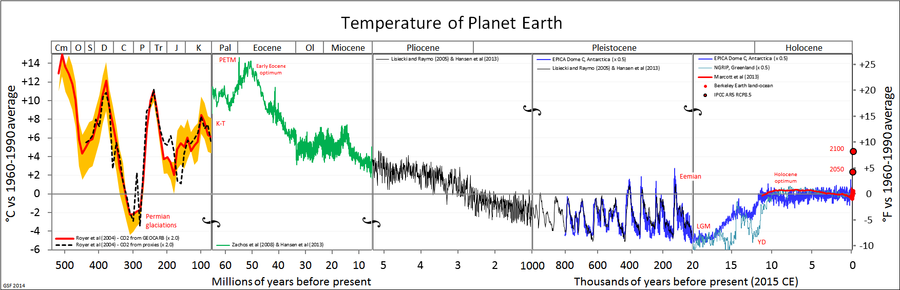
Skipping the "Global Warming" argument all together the Earth very much in a cold spell in the palaeontological sense[0]. It has been much, much warmer for very long periods of time and really only slightly colder. We're far closer to another ice age than we are to the long term average temperature of the planet, let alone its normal maximum temperature. Generally, the warmer periods have given rise to large ecological growth. Maybe human's won't like it, but consider the amount of diversity that would exist with a near rain forest climate across nearly the entire earth.

Note: the horizontal scale is VERY awkward [0]http://upload.wikimedia.org/wikipedia/commons/thumb/f/f5/All...

Re: NASA Confirms Its First Planet in Habitable Zone of Sun-like Star

#74
post #2

Kepler has certainly made a lot of discoveries. It should be fairly clear to us now that planetary systems are pretty common and, by extension, sentience must (by sheer odds) be out there too. But I have to wonder how many assumptions go into this so-called "habitable zone". Doesn't it greatly depend on the atmospheric composition? With a different atmosphere, couldn't Venus be habitable (actually it might be in our…

Planet mass is usually a parameter that we have, even though it does not influence the position of the habitable zone (so Mars is out).

The simplest calculation does not involve an atmosphere and just looks at radiative balance from black body radiation and is probably the kind of calculation they're talking about in the article. For getting the real temperature many parameters play a role and most are not available, so they just use a first guess for the habitable zone.

An atmosphere will change this radiation balance, with absorptive gases and aerosols blocking radiation (both in- and outgoing) and by distributing the heat more evenly. Atmospheres can be detected if the planet's orbit is good, and it is possible to get an idea about the composition (mainly water, methane and CO2 so far), as well as see changes which are probably due to weather. The method used is to look at the center star's light that travelled through the atmosphere of the planet when it traverses; it's also possible to look at the atmosphere's reflection when the planet is almost behind the star. I can go find some spectra if you're interested.

Another important parameter in the equations is albedo ("ability to reflect radiation"). Warmth left from the planet's creation and radioactive decay as well as gravitational effects from other bodies (eg the effect Jupiter has on it's moons) are the other possible energy sources. Geological activity of bigger planets could lead to aurora and allow detection that way, but the instrumentation is not up for that yet..

In our solar system, some moons are considered candidates for life, being covered with a thick layer of ice and possibly containing water underneath and they're not in what is considered the habitable zone of the system. The concept is more of a guideline at this point, really, and also only looks at water (arguably the best candidate for life, but not the only one).

In case you want more information about anything in particular I can find some papers or overviews.
Re: NASA Confirms Its First Planet in Habitable Zone of Sun-like Star

#75
post #49

Earlier quoted context omitted.

> Sentience just happens to be an evolutionary trait that was beneficial to us ... but that isn't really how evolution works. Actually that is how evolution works. Evolution results in species acquiring traits that are beneficial to them. Of course you could make a counter-case that perhaps sentience is only beneficial to us in particular, and not so much to other species -- To which I would completely disagree. Ther…

I heard theory that there will be no other sentient creatures on Earth because humans will destroy them. I read this theory from article about Birutė Galdikas ( http://en.wikipedia.org/wiki/Birut%C4%97_Galdikas ) who is studying orangutans. Let's not forget neanderthals as well in this context.

>no other sentient creatures on Earth because humans will destroy them. ... Let's not forget neanderthals as well in this context.

True and false. The most "advanced" humans of any given time have destroyed and will be attempting to destroy the competition. Neandethals fell victim to Cro-Magnon, and the Cro-Magnon [ie. current "humans", we] will in its turn fall victim to the next human species. ( My previous comment http://news.ycombinator.com/item?id=3126716 )

Re: NASA Confirms Its First Planet in Habitable Zone of Sun-like Star

#76
post #2

Kepler has certainly made a lot of discoveries. It should be fairly clear to us now that planetary systems are pretty common and, by extension, sentience must (by sheer odds) be out there too. But I have to wonder how many assumptions go into this so-called "habitable zone". Doesn't it greatly depend on the atmospheric composition? With a different atmosphere, couldn't Venus be habitable (actually it might be in our…

I've read this argument a few times and the part I don't follow is how you can figure out the odds for an event (the spontaneous occurrence of life) that has only happened once to our knowledge. For all we know the odds are 1e100 to one.

Re: NASA Confirms Its First Planet in Habitable Zone of Sun-like Star

#77

Earlier quoted context omitted.

Actually given that dogs score better than chimps, wolves and human infants in tests of social cognition would lend credence to the fact that humans are actually inadvertently creating sentience. Similarly dogs are the only non-primate species to look at the right side of a persons face to gauge their emotion and state, but unlike primates and humans, they don't do this with other species or dogs. Evidence points to…

Having lived with the "best friends" of humans (cats and dogs) for many years, I am no longer sure what "sentience" is because I find the difference between us and them in everything to be a matter of degree. We're _better_ at being 'sentient' than they are, but I can't find anything that we do that they don't. I'm serious here. You totally hit the nail on the head when you talk about anger and empathy. They can lear…

my greatest personal epiphany was when i saw that while we're longing for other intelligence and looking for it out there, there is an other intelligence right near with us.

on related note: http://news.ycombinator.com/item?id=2666839

Re: NASA Confirms Its First Planet in Habitable Zone of Sun-like Star

#78
post #49

Earlier quoted context omitted.

I heard theory that there will be no other sentient creatures on Earth because humans will destroy them. I read this theory from article about Birutė Galdikas ( http://en.wikipedia.org/wiki/Birut%C4%97_Galdikas ) who is studying orangutans. Let's not forget neanderthals as well in this context.

>no other sentient creatures on Earth because humans will destroy them. ... Let's not forget neanderthals as well in this context. True and false. The most "advanced" humans of any given time have destroyed and will be attempting to destroy the competition. Neandethals fell victim to Cro-Magnon, and the Cro-Magnon [ie. current "humans", we] will in its turn fall victim to the next human species. ( My previous comment…

> the Cro-Magnon [ie. current "humans", we] will in its turn fall victim to the next human species.

I don't think so, at least not in a violent way. Like something Nietzsche said in TSZ, "man is something to be surpassed, but only a buffoon thinks that man can be overleapt."

Re: NASA Confirms Its First Planet in Habitable Zone of Sun-like Star

#79

Earlier quoted context omitted.

>no other sentient creatures on Earth because humans will destroy them. ... Let's not forget neanderthals as well in this context. True and false. The most "advanced" humans of any given time have destroyed and will be attempting to destroy the competition. Neandethals fell victim to Cro-Magnon, and the Cro-Magnon [ie. current "humans", we] will in its turn fall victim to the next human species. ( My previous comment…

> the Cro-Magnon [ie. current "humans", we] will in its turn fall victim to the next human species. I don't think so, at least not in a violent way. Like something Nietzsche said in TSZ, "man is something to be surpassed, but only a buffoon thinks that man can be overleapt."

>I don't think so, at least not in a violent way.

Well, it is really hard to imagine how something/somebody can surpass Cro-Magnon in the ways of violence. On the other side, only violence can keep the Cro-Magnon at bay as Cro-Magnon willn't allow to be peacefully surpassed.

>"but only a buffoon thinks that man can be overleapt"

yep, the 20th century history is littered with such failed over-leap attempts. Curious time we live at - the previous attepts of "leap"-type [necessarily forced] transformations of humans and society are finished and no new is initiated yet. Is it quiet before the storm? I don't believe that we learned the lesson.

Re: NASA Confirms Its First Planet in Habitable Zone of Sun-like Star

#80
post #17

I remember when Carl Sagan's "Cosmos" series was first shown on PBS; the episode when the Drake equation was covered was one of my favorite, although even as a teen I understood how small were the chances of finding other sentient life as we hadn't found a single extrasolar planet at the time, let alone in the Goldilocks zone of a star. Planetary discoveries (like this one) in the past few years are so cool to me.

I love the "Big Bang" episode where Howard raises the topic of the Drake equation. Sheldon immediately rattles it off, first the equation itself, then a rapid-fire explanation of each term in the equation. Sheldon loves that thing. Of course it turns out that Howard has adapted the equation to his own purposes, namely determining how many sentient human females willing and able to mate with Howard exist within the greater Los Angeles metro area.
Post reply on HN