Live data from Hacker News

Inflation is at a 40 year high. What can history teach us?

yarn.pranshum.com

311–320 of 550 posts

Re: Inflation is at a 40 year high. What can history teach us?

#311
post #134

It may also help to see the cumulative inflation picture: https://totalrealreturns.com/s/USDOLLAR?normalize=end (disclosure: my side project) The 1974 and 1980 peaks from the article correspond to the steeper slope regions in those same years on my graph. (I'm plotting 1/[CPI-U price level], while the article is plotting d/dt [CPI-U price level]) On my y-axis is the purchasing power of a US dollar, relative to curren…

Yeah but that’s not the whole picture… in 1962 the ford truck was $2000 now is around 40,000 so while a new one is better you still have to earn 2x as much to get the most basic one available

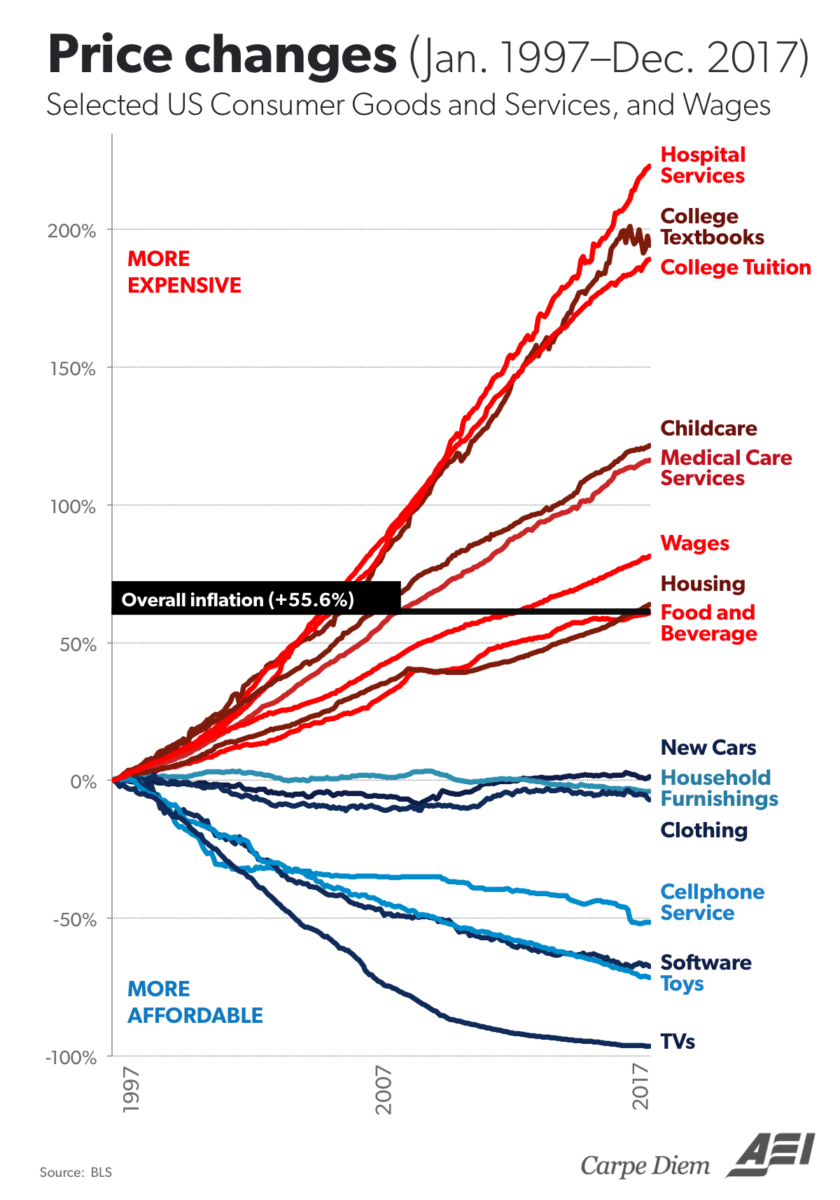
You can't just pick one single item and consider it 'representative' of inflation. [1] Some things cost more than they used to, some less. Cars happen to have tracked very well.

[1] https://ritholtz.com/wp-content/uploads/2018/02/pricechanges...

Re: Inflation is at a 40 year high. What can history teach us?

#312

Earlier quoted context omitted.

That doesn't make sense though. You can't create energy by printing money. You just redistribute the value of your money. Maybe that's good - not clear to me why it's better to use inflation, which risks destabilizing the currency and punishes people who saved money, rather than straightforward taxes.

> You can't create energy by printing money. Yes but the energy crisis isn't evenly distributed across the world. NA, for example, is still doing relatively well. While Europe is being hit relatively hard by the shortage and will likely have to import from more expensive sources than previous years to make it through the winter.

How would European governments printing more of their own currencies to give handouts to their citizens, resulting in inflation, resulting in their currencies becoming weaker, help buying energy from NA?

Re: Inflation is at a 40 year high. What can history teach us?

#313

Earlier quoted context omitted.

> Of course, that is almost a tautology Inflation lags the money printing, so it isn't a tautology. > So what do you do to get that sweet spot of about 1-2% inflation? I'm amazed that propaganda of a sweet spot gets so heavily embedded into the popular wisdom. If there is a sweet spot for inflation, it's 0%. Note that the US had net 0% inflation from 1800-1914, while growing from subsistence farming to superpower.

^Became a superpower in the 1940s gearing up for WWII and then the only country left standing with brand new factories.

[deleted]

Re: Inflation is at a 40 year high. What can history teach us?

#314

Earlier quoted context omitted.

Quoted post unavailable.

Then try getting paid outside of civilized society. Unemployment will never be zero. An economy can't be 100% efficient. Taking care of those who cannot find work due to an imperfect system is a part of a civilized society.

Also, it would be inefficient to have an unemployment rate near 0. People in a good job market need to leave bad jobs, and sometimes that means that they are unemployed.

Re: Inflation is at a 40 year high. What can history teach us?

#315

Earlier quoted context omitted.

In Australia I don't think I've ever seen an ability to fix 100% of a mortgage. We tend to fix about 75% and variable the remaining.

That is wrong, you can fix 100%. However in Australia the fixed terms are shorter, typically 1-5 years.

really? for mortgages?

I've seen that for personal loans (done that myself) just never heard of or seen fixed term mortgages

Re: Inflation is at a 40 year high. What can history teach us?

#316
post #21

> But if the main driver of inflation is the demand side, or inflation expectations, history indicates that a painful recession could be the only way to curb inflation. That's certainly the expected path forward, at least in the circles I associate with. "When the tide goes out, you find out who's swimming naked" seems a reasonable guess as to what's going to happen. Both at larger bank/investment firm scale and at t…

I went into college during the dotcom bust. Everyone told me I would be making peanuts. I'm pretty happy where I am. I've lived my life trying to minimize the financial downsides. I want money for security, not to live the high life. I like my job, and don't feel the need to retire early - I would love to do it until I'm 6 feet under. I make a decent enough income, although not the level of many here. I bought a mode…

> We could afford our expenses on two minimum wage jobs if need be. And that's with 3 kids.

Let's assume a $15 minimum wage. The housing one can afford on two such wages is $1,560/mo. On a $700k home, assuming 20% down, to repay the principal alone is $1,556/mo. A mortgage calculator says $3,800/mo once you have interest in there — or 73% of your gross income. And that ignores insurance & taxes. And those 3 kids.

Re: Inflation is at a 40 year high. What can history teach us?

#317
post #270

Earlier quoted context omitted.

No, I didn't get it either. People will still need food, electricity, gas, clothing. Buildings will need maintenance. Are you saying people will decide to not eat because deflation? Or not fix their broken windows?

In deflation, prices are going down. So I know it will cost me less next week to fix that broken window than doing it today. So I wait a week. But the logic doesn't change - when next week comes, I'll wait another week to get a better price. Apply this across the board, and people mostly just buy what they need. Producers of goods stop producing. R&D disappears. Etc.

Seems more like a good thing you've turned upside down. As long as some R&D has an average payoff that outperforms the rate of deflation, people will be motivated to take the risk. Deflation would disproportionately hurt risky investments, whereas inflation causes worse and worse choices to become increasingly attractive. I'd say we already got way more stupid investments than we needed in the last few decades of low inflation.

Re: Inflation is at a 40 year high. What can history teach us?

#318

Earlier quoted context omitted.

I think you are misunderstanding fractional lending and collateral. Fractional lending seems a bit odd, but it's not like there is 'no collateral' - rather, there ends up being 'partial collateral'. As it turns out, that 'partial collateral' is enough - it's actually reasonable thing to do, because the vast majority of loans are repaid, it's not necessary to fully collateralize everything on the whole. Banks have to…

Rather bluntly, a central bank is central economic planning. Central economic planning always falls short of what free markets do. The idea that a central bank is able to control the financial markets better than free market forces is shown to be false (with actual data) by Friedman in "Monetary History of the United States". > The 'government' does not print money, the Central Bank does. I said "print money" as a eu…

Rather bluntly, this is just not true.

I think there is an erroneous understanding/implication in your statement, which is likely leading you to erroneous conclusion.

The Fed is not 'Central Planning' so much as it is actually trying to make the market more 'neutral' in normal cases.

We'll get to the 'crisis' cases in a bit.

If we just had a hard currency, like Gold (which 'feels' neutral) we'd get into trouble, because of deflationary issues. People would treat it like Bitcoin, and as prices fell slightly would be oriented a bit towards 'store of value' as opposed to currency.

The Fed 'targets' just a 'bit above zero' inflation by policy. That is basically 'neutral'.

That is not really 'central planning', it's more like 'central neutralization'.

As for 'crisis' situations, i.e. when the Fed does start to 'intervene' and does things which you might argue are 'central planning' - well - the government in many cases can absolutely do it 'better than free markets' because only the government has the scale to do it.

For example, 'free markets' could have not have created and executed the Highway road system of the 1950s. It was of a scale and scope far, far beyond any economic actor. That required 'strategic vision' on behalf of the government. Now - private contractors actually did the 'building' - which is how we want it because the government doesn't need to hire individual workers. But it's a government project by virtue of scale and other things.

The meltdown of 2008 was a very scary time - if the government did not intervene, the banks would have collapsed, and it would have taken down the entire economy.

It would be like a human having a 'heart attack' - the heart stops - everything stops.

So the government put together a plan and intervened. A lot of it had to do with 'confidence signals' and other things, extra regulation, but it worked.

There is of course the 'Too Big To Fail' argument i.e. moral hazard i.e. banks take on more risk knowing the 'gov will save' us - that said, the worst actors did definitely lose a ton of money. Also - the problem was not just the banks, it was a systemic failure in a number of sectors.

Basically - the US had an economic cancer and no individual organization was going to be able to contend with it.

So -> intervention. Much like a war, or pandemic.

Having a fiat currency allows that opportunity. If it were a 'Gold Based Economy' it would have fallen down like a house of cards.

Like a brick building during a rare earhtquake: brick 'feels' strong like Gold, but an earthquake will ravage it, which is why you need steel reinforcement - the steel can bend and absorb different kind of tensions.

Milton Friedman is wrong.

Yes, when there is hyperinflation, it's probably because some stupid government is printing too much money, but inflation is not just a function of money printing.
Re: Inflation is at a 40 year high. What can history teach us?

#319

Earlier quoted context omitted.

> You can't create energy by printing money. Yes but the energy crisis isn't evenly distributed across the world. NA, for example, is still doing relatively well. While Europe is being hit relatively hard by the shortage and will likely have to import from more expensive sources than previous years to make it through the winter.

How would European governments printing more of their own currencies to give handouts to their citizens, resulting in inflation, resulting in their currencies becoming weaker, help buying energy from NA?

Not everyone gets the same amount of money, so that poorer people benefit from the scheme while richer people are more affected by the increased inflation.

Re: Inflation is at a 40 year high. What can history teach us?

#320

It may also help to see the cumulative inflation picture: https://totalrealreturns.com/s/USDOLLAR?normalize=end (disclosure: my side project) The 1974 and 1980 peaks from the article correspond to the steeper slope regions in those same years on my graph. (I'm plotting 1/[CPI-U price level], while the article is plotting d/dt [CPI-U price level]) On my y-axis is the purchasing power of a US dollar, relative to curren…

Great stuff!

This is a nice demonstration of the variability of inflation and how under-trend we have been for many years. There was a strong push from some monetary policy people to move toward a longer term, average inflation targeting that would make the Fed have symmetric reaction functions to upside and downside inflation while attempting to keep a longer term average as the goal.

One interesting explanation for high inflation during the 1970s to early 1980s was that the monetary system and supply of real assets had to adjust to a massive influx of working age adults (babyboomers). A second wave from that population event started to enter the workforce over the last ten years. It might be interesting to normalize the data here against the size of the workforce.

Post reply on HN