Earlier quoted context omitted.
From the article: > Speed is one advantage of crypto payouts. Reach is another. Millions of talented freelancers live in countries where it’s hard, if not impossible, to open a local bank account. For example, a majority of the people in Djibouti, El Salvador, and Bhutan don't have bank accounts. With Stripe, freelancers in those countries are now able to receive funds via USDC in minutes. With the addition of USDC,…
I'm one of those, work remote from argentine is simply pay 90 tax becouse of a broken conversion rate technically, becouse you can pay 15 income tax and don't but have a company and return assets like bonds, is a mess . this is really useful and I trust stripe more than the competition
Expanding access to the future of work with crypto payouts
31–40 of 146 posts
Re: Expanding access to the future of work with crypto payouts
#32Earlier quoted context omitted.
I'm not sure where you got this info from but my relatives in the US sends money via Xoom. Nobody's touching crypto.
TransferWise, now just Wise works awesome too.
Have used Wise in the past because it's very convenient to use but they are just extremely expensive compared to P2P crypto.
Also they don't support many countries or only support one direction.
Not a crypto bro and very critical of crypto fads normally but this use case actually works for a regular person like me.
Going to try Xoom though and check their rates. Hadn't heard of them.
Re: Expanding access to the future of work with crypto payouts
#33Earlier quoted context omitted.
From my own experience, you can use a very popular exchange that has a huge P2P marketplace, precisely for this.
What is this marketplace named?
Re: Expanding access to the future of work with crypto payouts
#34My concern is that the organization is split into two entities: (1) Freelance Labs, which owns and controls the website.[1][4], and (2) A Panamanian Non-profit that "owns" the token.[2]
Stripe's copy: "And because it’s decentralized, the people that use Braintrust also own and operate the network: Talent keeps 100% of its earnings and clients can make their budgets go further by cutting out unnecessary middle men."
#The Braintrust Foundation has nothing to do with the website:
From the usebraintrust.com TOS[1]: "This Terms of Service (also referred to as the “Agreement”) is a contract between you (“you” or “User”) and Freelance Labs, Inc. (“Freelance Labs,” “we,” or “us”)."
#The website controls the operations of the network:
Also from the usebraintrust.com TOS[1]: "The Site is a marketplace where Clients and Freelancers can identify each other and advertise, buy, and sell Freelancer Services online. Subject to the Terms of Service, Freelance Labs provides the Site Services to Users, including hosting and maintaining the Site, facilitating Projects between Users,, and assisting Users in resolving disputes which may arise in connection with those Projects Users are required invoice and pay any amounts owed for any agreed upon Projects facilitated by the Site and/or Services."
#Users keep all their earnings, except for the 10% fees clients pay:
From the Braintrust whitepaper[3]: "Talent are charged no fees: they are paid their full contracted rate (whether that be per hour or per project). Clients are charged 10% of the total contract value, an amount that is significantly less than in other networks and consulting firms.
Client fees are collected in USD, converted into BTRST, and sent to the Braintrust DAO through the Fee Converter, a smart contract that was proposed, voted on, and implemented by the community in October 2021. This process makes it possible for client fees — in the form of BTRST tokens — to pay for network operations and to fund community programs"
#The token technically doesn't own anything:
Also from Braintrust's whitepaper[3]: "BTRST is not a share of stock, does not represent a claim on profits, dividends, equity, or debt in any company or organization, and is not a financial instrument. BTRST has been adopted by the Braintrust network and users for various activities on the network only, such as for staking, governance, voting, and educational purposes"
#The token has no claim to anything:
From a podcast with Adam Jackson: "We have a token instead of a share of stock. It does not represent any financial claims, any dividends or profit sharing, simply because there is no profit. The network is meant to run sustainably. It's meant to sustain itself. And so, it charges just enough fees to get by on, paying for hosting and maintenance and upgrades and that sort of thing."
Again, I still think it's a potential improvement on the alternatives, and they've built a lot of functionality, but I just worry that the website, seemingly the only way to contract on the network, isn't owned by the foundation.
Is the foundation contractually obligated to heed to any votes from the DAO? It's not very clear that they are.
They've built out a lot[6] that makes me hopeful their network will hold its value, but I just wish they could leave no doubt that their users own the network as well as the resources that power that network.
For example, what if once the network has gained enough value, the owners of Freelance Labs sell the usebraintrust.com website to UpWork? Can they, and if so, what happens then?
[1] https://www.usebraintrust.com/terms [2] https://www.sec.gov/Archives/edgar/data/1756245/000175624518... [3] https://www.usebraintrust.com/whitepaper [4] https://sec.report/CIK/0001759292 [5] https://www.hbs.edu/managing-the-future-of-work/podcast/Page... [6] https://info.app.usebraintrust.com/
Re: Expanding access to the future of work with crypto payouts
#35Earlier quoted context omitted.
From the article: > Speed is one advantage of crypto payouts. Reach is another. Millions of talented freelancers live in countries where it’s hard, if not impossible, to open a local bank account. For example, a majority of the people in Djibouti, El Salvador, and Bhutan don't have bank accounts. With Stripe, freelancers in those countries are now able to receive funds via USDC in minutes. With the addition of USDC,…
> For example, a majority of the people in Djibouti, El Salvador, and Bhutan don't have bank accounts > With Stripe, freelancers in those countries are now able to receive funds via USDC That is just people opening bank accounts, but with extra steps.
Re: Expanding access to the future of work with crypto payouts
#36Re: Expanding access to the future of work with crypto payouts
#37Earlier quoted context omitted.
TransferWise, now just Wise works awesome too.
I'm using Binance P2P. By far the cheapest way to transfer funds from rich to poor countries. Have used Wise in the past because it's very convenient to use but they are just extremely expensive compared to P2P crypto. Also they don't support many countries or only support one direction. Not a crypto bro and very critical of crypto fads normally but this use case actually works for a regular person like me. Going to…
Re: Expanding access to the future of work with crypto payouts
#38It is a massive mistake that Stripe is offering anything in the crypto space as everyone and Stripe knows it is full of fraud, money laundering, scams and it is completely unregulated. I look forward to the day that Stripe will get investigated for all of the above with this and end up like Paypal, eventually freezing or banning these accounts. Crypto does not offer anything new at all. EDIT: It seems Stripe and Cryp…
> It is a massive mistake that Stripe is offering anything in the crypto space as everyone and Stripe knows it is full of fraud, money laundering, scams and it is completely unregulated.
The argument is engaging in "everything is X" talk by blanketing an entire space as only engaging in negative impacts.
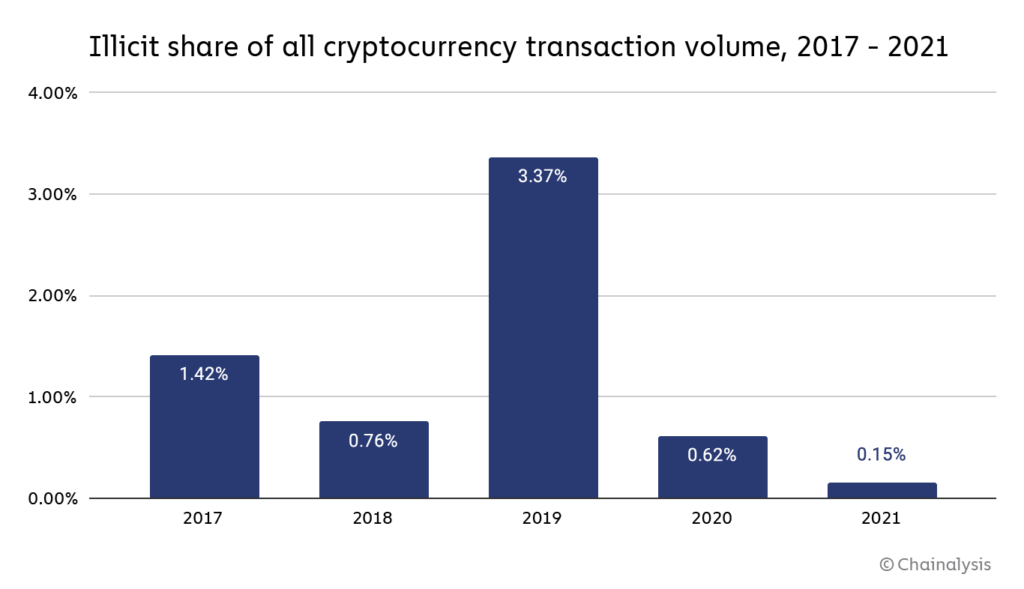
It should be noted that the percentage of crypto used in illicit activity is significantly less than 1%, compared to the estimated 2-5% of global GDP that is involved in money laundering alone within traditional financial ecosystems.
https://blog.chainalysis.com/reports/2022-crypto-crime-repor...
https://blog.chainalysis.com/wp-content/uploads/2022/01/char...
https://crsreports.congress.gov/product/pdf/IF/IF10873/3 (page 1)
Using the same argument, it could be said that cash should be banned because its private & semi-anonymous nature allows for its use in transactions for gambling, drug use, child porngraphy, assasinations, & slave trafficking.
Re: Expanding access to the future of work with crypto payouts
#39It is a massive mistake that Stripe is offering anything in the crypto space as everyone and Stripe knows it is full of fraud, money laundering, scams and it is completely unregulated. I look forward to the day that Stripe will get investigated for all of the above with this and end up like Paypal, eventually freezing or banning these accounts. Crypto does not offer anything new at all. EDIT: It seems Stripe and Cryp…
Total bitcoinization would be dystopian but as a lifeboat against the inexorable spread of the negative side effects of inflation and the skyrocketing price of assets due to the cantillon effect - it is remarkably effective.
Hate to be a parrot but... "zoom out".
Re: Expanding access to the future of work with crypto payouts
#40It is a massive mistake that Stripe is offering anything in the crypto space as everyone and Stripe knows it is full of fraud, money laundering, scams and it is completely unregulated. I look forward to the day that Stripe will get investigated for all of the above with this and end up like Paypal, eventually freezing or banning these accounts. Crypto does not offer anything new at all. EDIT: It seems Stripe and Cryp…
People seem to forget that 6 trillion dollars of liquidity was injected into the US monetary supply in 2020 (close to a 50% increase in the total USD monetary supply). The 2008 financial bailout popularized by "The Big Short" pales in comparison to what happened in 2020. While there are situations where creating liquidity via monetary policy is necessary - it sucks that it directly impacts the savings and wages of ev…
Crypto is hardly inflation-proof, with major cryptos having fallen 80% or more in the last 6 months putting it on pace with the Lira - if you then adjust it for inflation you lose another 10%. It's somehow managed to do all that in the single most inflationary period in 50+ years. I was pretty sure we'd given up on that silly narrative. Crypto is a high-beta speculative play on US dollar liquidity in the global financial system, not a hedge on inflation.
Wanna save money from inflation? Buy some I-bonds.
So uh, zoom back in ;)
[edit] Also, liquidity per (as defined by the size of the Fed's asset book) se isn't really correlated with asset prices, which is why we're doing interest rates. I recommend listening to the Odd Lots podcast with Kashkari in re: inflation.