Earlier quoted context omitted.
I tried contacting you through your blog, however when I try and submit my message, it redirects it to a 404 page.
Fixed. EDIT: And by "fixed" I mean it points to a new page. The old Contact page is essentially dead. Click on the link again.
The Trouble with Bright Kids
101–110 of 156 posts
Re: The Trouble with Bright Kids
#102I never overachieved in school, I think I was mostly bored but was always told I was "smart" and "bright." Jebus, that really hit a nerve.
Re: The Trouble with Bright Kids
#103Like others who have posted here, I have s story similar to this. By the sounds of it, I wouldn't call myself as "gifted" as some who have posted here but, relative to the environment I was in, I was "gifted". I grew up in three small towns. For the first 9 years, in a town of less than 1,000 where the 3rd and 4th grades (for example) were in the same class. When I was 8 I was doing the same work as the 7th graders w…
I can distinctly remember at age 10 reasoning out that God didn't exist Your logic was faulty. A God which does not interact with the universe is indistinguishable from a lack of God. (cf. Higgs Boson)
Re: The Trouble with Bright Kids
#104Earlier quoted context omitted.
That's interesting. So what you're saying is basically that if a kid is smart then he will be smart even without verbal acknowledgement of it. So it's better to keep hammering "you're really disciplined!" because then the kid will be smart AND disciplined. The latter of which is a learned trait, as opposed to raw smarts.
'Raw Smarts' is a slightly odd concept. I'm no psychologist, but I think that the majority of current research points towards the idea that ability in almost anything is essentially a consequence of practice and experience. I think the real issue is telling kids that they have an innate gift for anything . If you tell them they're smart, there's a natural assumption not to bother working. If you tell them they're dis…
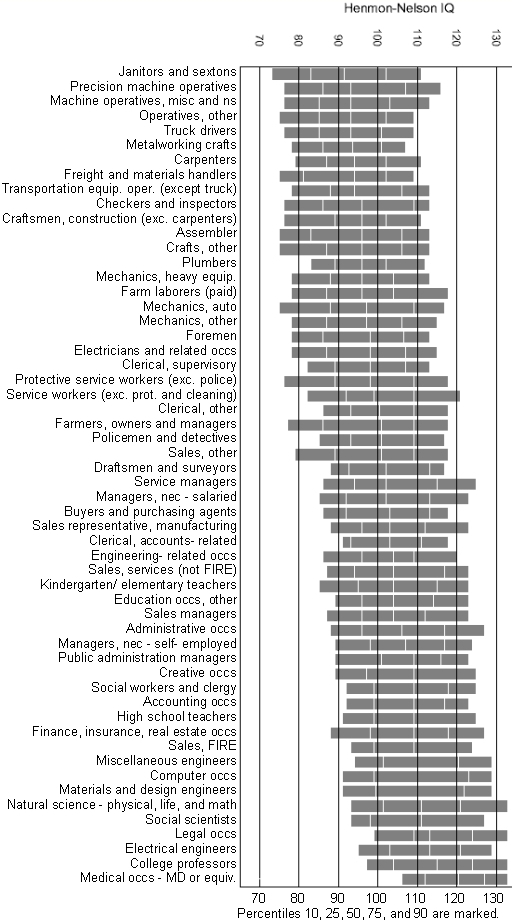
As far as I'm aware, ability is generally considered to be something along the lines of practice x innate talent. So while it's true that ability scales with practice, it's not true that talent doesn't matter.
Here is a rather famous chart which illustrates this: http://www.iqcomparisonsite.com/Images/OccsX.jpg
This was very apparent when I taught college. I had plenty of students who worked hard, but it just didn't pay off. I had students working 30 hours/week on my class and still failing, but no matter how hard they worked, they just couldn't come up with proofs. Similarly, there were quite a few who just showed up, read the book once, and could do it.
(Incidentally, because I fell into the latter category, I was pretty much incapable of helping people in the former category. Just one of the many reasons why researchers often make bad teachers.)
Ultimately though, optimising for the top end becomes expensive quite fast, and while it's important to keep pushing the boundaries, I'd much rather the investment was put into improving the state of education for everyone, rather than fine-tuning the path for those who will be at least OK regardless.
What benefit do you feel will be gained by improving education for everyone, as opposed to helping those at the top? I.e., why do you believe better educated plumbers will provide more benefit than better educated scientists, engineers, artists and business leaders?
Re: The Trouble with Bright Kids
#105Earlier quoted context omitted.
Thanks for sharing this. I have a bright five year-old and, having read articles like this one, my partner and I try praise effort as much as we can. Here's the problem. For nearly all of the tasks she's set in school, she doesn't need to expend much effort at all. We say, "nice work, you must have tried really hard!" and she replies, a little confused at us, "no". It sounds like you found everything too easy as well…
I would have loved for someone to point the numerous events going on for kids all over the world, like NASA summer schools and the like. Your kid is probably a bit young, but if you keep your eyes open, you can find the good stuff in time. As others said, focus away from school sounds good. The nice thing about these activities is that you meet other kids like you (giving you a better frame of reference and tons of a…
Re: The Trouble with Bright Kids
#106Like others who have posted here, I have s story similar to this. By the sounds of it, I wouldn't call myself as "gifted" as some who have posted here but, relative to the environment I was in, I was "gifted". I grew up in three small towns. For the first 9 years, in a town of less than 1,000 where the 3rd and 4th grades (for example) were in the same class. When I was 8 I was doing the same work as the 7th graders w…
I can distinctly remember at age 10 reasoning out that God didn't exist Your logic was faulty. A God which does not interact with the universe is indistinguishable from a lack of God. (cf. Higgs Boson)
Re: The Trouble with Bright Kids
#107Earlier quoted context omitted.
That's nuts. My sisters and brothers and I out-performed everybody at our rural school, throughout our primary/secondary education. We were being brought up on a farm. There was zero practice and experience at academic subjects - we did chores, milked cows(!), made hay. There HAS to be some nature-component to our successes (1 VP/Intel, 2 Directors at other tech companies, 2 researchers, 1 entrepreneur :)
Again, I'm not a psychologist, so this is only my (limited) interpretation of what I've read. I'm not saying that there is no nature-component. But , (AFAIK) there is no real evidence for something that would correspond to some idea of 'Raw Smarts' that (a) has a meaningfully large effect compared to practice and experience, and (b) generalises. What I've read suggests that, yes, there are a whole bunch of nature-com…
We didn't have books (2 in the house, gifts from older cousins), but we were fairly competitive. And our folks told us "You guys are smart; you'll all go to college". So we did.
Re: The Trouble with Bright Kids
#108Like others who have posted here, I have s story similar to this. By the sounds of it, I wouldn't call myself as "gifted" as some who have posted here but, relative to the environment I was in, I was "gifted". I grew up in three small towns. For the first 9 years, in a town of less than 1,000 where the 3rd and 4th grades (for example) were in the same class. When I was 8 I was doing the same work as the 7th graders w…
I can distinctly remember at age 10 reasoning out that God didn't exist Your logic was faulty. A God which does not interact with the universe is indistinguishable from a lack of God. (cf. Higgs Boson)
IF the Higgs Boson exists, it interacts with the “usual” matter. The main part of the interaction is the (apparent) mass.
The Higgs field is not constant, we can think about the irregularities in the field are particles, this particles are the Higgs’ Bosons.
The experiments in the LHC are trying to measure how this Higgs’ Bosons bounce with the “usual” particles, how the Higgs’ Bosons are created from “usual” particles and how the Higgs’ Bosons splits in a few “usual” particles.
The experiments try to get an isolated Higgs Bosons for a very small time, because they are not stable (perhaps 10^-20 seconds?). It is impossible to see it during that small time, so the experiments analyze the particles that are created after the Higgs Boson splits.
All the process is very difficult and noisy, so the experiments have to run for a few years. The equipments is new and they have to tweak them. So for a few years, the will be no interesting new, like “Higgs Boson tot found above 180GeV.”. It is a good sign, it is what is expected to happen.
But in about four years, IF the Higgs Boson exists, they will find it, we only have to wait.
Re: The Trouble with Bright Kids
#109Like others who have posted here, I have s story similar to this. By the sounds of it, I wouldn't call myself as "gifted" as some who have posted here but, relative to the environment I was in, I was "gifted". I grew up in three small towns. For the first 9 years, in a town of less than 1,000 where the 3rd and 4th grades (for example) were in the same class. When I was 8 I was doing the same work as the 7th graders w…
Re: The Trouble with Bright Kids
#110Like others who have posted here, I have s story similar to this. By the sounds of it, I wouldn't call myself as "gifted" as some who have posted here but, relative to the environment I was in, I was "gifted". I grew up in three small towns. For the first 9 years, in a town of less than 1,000 where the 3rd and 4th grades (for example) were in the same class. When I was 8 I was doing the same work as the 7th graders w…
That's interesting. So what you're saying is basically that if a kid is smart then he will be smart even without verbal acknowledgement of it. So it's better to keep hammering "you're really disciplined!" because then the kid will be smart AND disciplined. The latter of which is a learned trait, as opposed to raw smarts.