Quoted post unavailable.
>religious babble Why is religion held in such contempt when there is so much science that is just as much "babble", but held in high regard?
We don't know how the universe began, and we will never know
291–300 of 610 posts
Re: We don't know how the universe began, and we will never know
#292But, after all, who knows, and who can say Whence it all came, and how creation happened? the gods themselves are later than creation, so who knows truly whence it has arisen? Whence all creation had its origin, the creator, whether he fashioned it or whether he did not, the creator, who surveys it all from highest heaven, he knows — or maybe even he does not know. -- Nasadiya Sukta ( https://en.wikipedia.org/wiki/Na…
Okay, this is truly bizarre. I came here to share this exact quote (after reading a prior comment about how the universe itself may never know), only to find that someone already posted it... whose handle is the same one I use on other sites, because I share the same initials. Genuinely thought I'd gone crazy for a moment and posted this with an alternate account.
- It's common for desi names to start with A or K
- It's common for desis to use initials when referring to themselves
- Some desi surnames are over-represented in the population
- People with desi names are likely to come in contact with South Asian culture irrespective of their environment or if they speak the relevant languages. Or rather, they are more likely to have these avenues to begin with if they ended up with such a naming scheme.
- There are only so many foundational or well-known texts in any culture, so if there is a relevant passage, it has a high likelihood of being cited
It's not that different from a Jay Smith and a John Smith quoting a relevant C.S. Lewis or Biblical passage and having a jsmith handle.
Re: We don't know how the universe began, and we will never know
#293Earlier quoted context omitted.
That question assumes the default state is they didn’t exist already
But how does this "uncaused cause" add anything to our understanding of the cosmos, beyond adding one more entity? Why not say that God was created by God_1, who just already existed?
Re: We don't know how the universe began, and we will never know
#294Earlier quoted context omitted.
“Faith and reason are like two wings on which the human spirit rises to the contemplation of truth…” https://www.vatican.va/content/john-paul-ii/en/encyclicals/d...
Faith is the justification that people give when they believe something for no good reason. You can believe anything based on faith, therefore, it's not a reliable path to truth. Only reason is. The faster our civilization gets rid of faith, the better off we'll be.
Re: We don't know how the universe began, and we will never know
#295My strong opinions, weakly held: * God is not a good hypothesis for any secondary cause. The creation of space-time as we currently understand it must have had a secondary cause. Let's patiently keep looking for a scientific hypothesis (theoretical or empirical) that is an incremental improvement on what we already know. * Religious people who conceive of God as the creator, believing that the word 'creator' refers t…
> Religious people who conceive of God as the creator, believing that the word 'creator' refers to the creation of the universe at some point in the past, are completely misunderstanding the use of the word and need to do some more homework. Can you explain what you mean here - I couldn’t follow
There are two senses to understand the word creator. I'll illustrate both by analogies to the way 'we' create as people:
(1) A violinist is creating the music that you are currently hearing. Here and now in the present. (2) A painter created a painting in the 19th century, and you can see the artifact on the wall in a museum.
In the case of (1) the creator brings the song into being out of nothing. More or less, don't squabble over sound waves. :^). When the violinist stops playing, the music stops. Here and now in the present.
In the case of (2) the painter finished the work 'at some point in time' and we can have all sorts of interesting conversations about when exactly the artifact was created. Did the painter really paint it in the way some book said that he did? Does the painter maintain any connection to the painting after it's finished? etc.
You see, if the proper sense of the word creator is actually (1). Then all discussions about (2) are distractions.
So, it's important to remember that, for example, knowledgeable Christians refer to God as the creator in the sense of (1). There may or may not be some interesting discussions to be had about whether God is a creator in the sense of (2) but they are conversations about secondary causes, and very much irrelevant to God's existence and the role as the primary cause.
Re: We don't know how the universe began, and we will never know
#296If we will never know, then there should be some kind of proof that the beginning of the universe is un-knowledgeable, sort of like Godel's theory of incompleteness. But there is none, so the affirmation is incorrect: We don't know if we will never know.
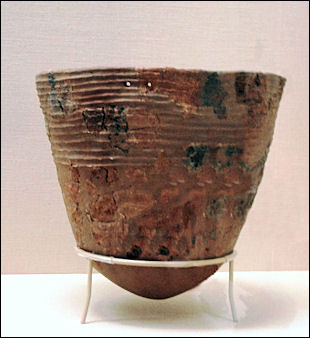
Given this 10k year old pot
https://factsanddetails.com/media/2/20120207-JomonPottery.JP...
What is the name of the person that created this pot, What day did they create it? Were they in a relationship at that time? Did they have children? How many siblings did they have?
There's no way to know. You can theorise time travel to find out or you can weasle into believing we'll somehow make machines in the future that can measure every facet of every atom related to the creation of the pot in such a way as to be able to trace their trajectories through time backward but both of those are grasping at straws, things that are unlikely to ever actually come to pass.
The reality is we'll never know the answers to those questions.
The same is true of how the universe began.
The best we can do is follow our theories of how the universe works backward and see where they lead and then try to create those initial conditions and see if we get the results we expect. It may be impossible to create those initial conditions though and even so, we'd be guessing at what those initial conditions actually were as we'd be assuming that running our calculations in reverse is true describe the actual initial conditions whereas they really only describe assumed initial conditions.
Re: We don't know how the universe began, and we will never know
#297Earlier quoted context omitted.
Our knowledge of the cosmos, in just a few hundreds of years, expanded from the Earth, Moon, planets and stars of the firmament, a kind of cozy neighborhood, to that of unfathomable numbers of galaxies stretching out to unimaginable distances of space and time. Strange that gods who were so occupied with matters on this planet, who live in a nearby heaven up by the firmament of stars, are also still credible candidat…
You’re taking an unbelievably literal interpretation of a faith you don’t believe in and literally projecting it on to the parent comment as a form of criticism. Safe to say that I don’t think you can expect a response from them.
Re: We don't know how the universe began, and we will never know
#298Earlier quoted context omitted.
The difference between the two claims is whether they are verifiable.
Tell me, how many scientific "claims" that you rely on a day to day basis, have you verified personally? Or How many such claims can be verified with a single average person's limited resource?
My second reply is that it’s important whether things derived from two different claims actually work.
Make two hospitals: one which follows standard Western medical practice, and the other which does not and instead performs prayers over its patients. I can predict which hospital will have better patient outcomes.
Re: We don't know how the universe began, and we will never know
#299Earlier quoted context omitted.
> Religious people who conceive of God as the creator, believing that the word 'creator' refers to the creation of the universe at some point in the past, are completely misunderstanding the use of the word and need to do some more homework. Can you explain what you mean here - I couldn’t follow
"misunderstanding the use of the word" Aka, I've used someone else's redefinition of the word away from the vernacular understanding, to redefine it to support my view of the world. See also "recession."
I tried to add clarity in the response above. Thanks!
Re: We don't know how the universe began, and we will never know
#300By analogy he describes how, due to the expansion of the universe, Milky Way residents 100 billion years from now will be unable to observe the cosmic background radiation or any galaxy but our own. Civilizations wil evolve, invent science, use the best tools possible, and incorrectly conclude that the universe consists of one single galaxy alone in a vast sea of empty space.
When we triply rewrite hard drives, we understand that information can be destroyed. Sometimes the universe does the samething. Sometimes information is irretrievably lost.