Live data from Hacker News

Oberon (2009)

ignorethecode.net

111–120 of 149 posts

Re: Oberon (2009)

#111
post #103

Earlier quoted context omitted.

Wouldn't smaller chips make the problem worse?

I think it jocularly meant "use something with fewer gates and a smaller cross section", not "use a smaller feature size". Or I could easily have misremembered: this was all last century.

> Or I could easily have misremembered: this was all last century.

Don't understate the difficulty of remembering. This was all last millennium.

Re: Oberon (2009)

#112
post #51

The Oberon book (by Wirth, updated in 2013) is excellent in that it describes the entire Oberon system, from the processor on up in a single volume. https://people.inf.ethz.ch/wirth/ProjectOberon/PO.System.pdf

For whatever reason, that PDF is incomplete. The ToC goes through Chapter 16, but the text includes only up to Chapter 9.

Part 2 is: https://people.inf.ethz.ch/wirth/ProjectOberon/PO.Applicatio...

Part 3 is: https://people.inf.ethz.ch/wirth/ProjectOberon/PO.Computer.p...

A fun point about the 3rd part. If you've ever been flummoxed by the basics of floating point math, part 3 discusses the fundamentals in 2 pages with a big fonts. One of the most succinct discussions I've seen on FP.

I can't seem to find the original 1992 edition in PDF. It feels like a lot of information (not just source code) is culled from the later versions (2005, 2013) of this book.

Re: Oberon (2009)

#113
post #42

The zooming reminds me of Prezi, except that Prezi is in 3D... (maybe Oberon is where they got their original idea from?). As interesting as it sounds and looks, I cannot imagine constantly zooming in and out (or panning) just to switch windows. Maybe I am so indoctrinated with the standard Windows task switcher concept that I don't want it to work in any other way. I was also completely lost when I tried to create a…

Instead of zooming I think a better approach is Windows-within-Windows. Or is that the same thing? You don't need to "zoom" so much as "enter" into a sub-desktop. Which is different than multiple desktops side-by-side. Smalltalk had/has this feature. You create a new "project-window". You can then "enter" it and within it you can open any number of windows including project-windows. This works really well with progra…

Up until the mid-2000s, a lot of complex GUI applications (such as Visual Studio 6) in the Windows world used a paradigm somewhat ambiguously named MDI (cf. https://documentation.help/Win32/MDI%20Frames.htm) which is what you describe sounds like. Unfortunately, UI design/HCI fashions turned against it hard and it went all but extinct; last I checked, few GUI toolkits even support it. Gtk was on the vanguard of the anti-MDI Bildersturm since its inception, and Qt's implementation (https://doc.qt.io/qt-6/qmdiarea.html) already suffered from bit rot when I checked it out some 10 years ago.

Re: Oberon (2009)

#114
post #108

Dangit. This is the sort of thing that's equal parts frustrating and exciting, in that I've had a lot of these ideas independently and this is the first time I'm discovering that someone has implemented them. Especially this infinite canvas idea, which I'm very confident would work wonders for me (and many other people) mostly owing to the power of "spatial memory," which I feel like is a wildly underused human featu…

Croquet's Greenlight app has the canvas idea in a web app. Also it is multi-user. Worth checking out.

Re: Oberon (2009)

#115
post #8

> Oberon is very much in active use at ETH Zürich. We used it as one of our main operating systems. The article being from 2009, this must've been an interesting period for the students, as back then the introductory programming course was using Eiffel, taught by Bertrand Meyer himself.

I remember a cooperation with some ETH people (Sjur Vestli and his master brain Roberto?) trying to use realtime oberon to enter the midsize league of robocup end of the 90s. Never happened to participate which was a pity.

Ah. Found some traces: https://www.ifr.mavt.ethz.ch/research/xoberon/

Re: Oberon (2009)

#116
Oberon was a mostly successful experiment in minimalism. Once when I was surprised by a compile error that I didn't think was correct, it didn't take me too long to pinpoint the line in the Oberon compiler source (written by Wirth) which was causing it and understand why it was the way it was. You cannot do this with any 'modern' system today.

Re: Oberon (2009)

#117
post #85

Earlier quoted context omitted.

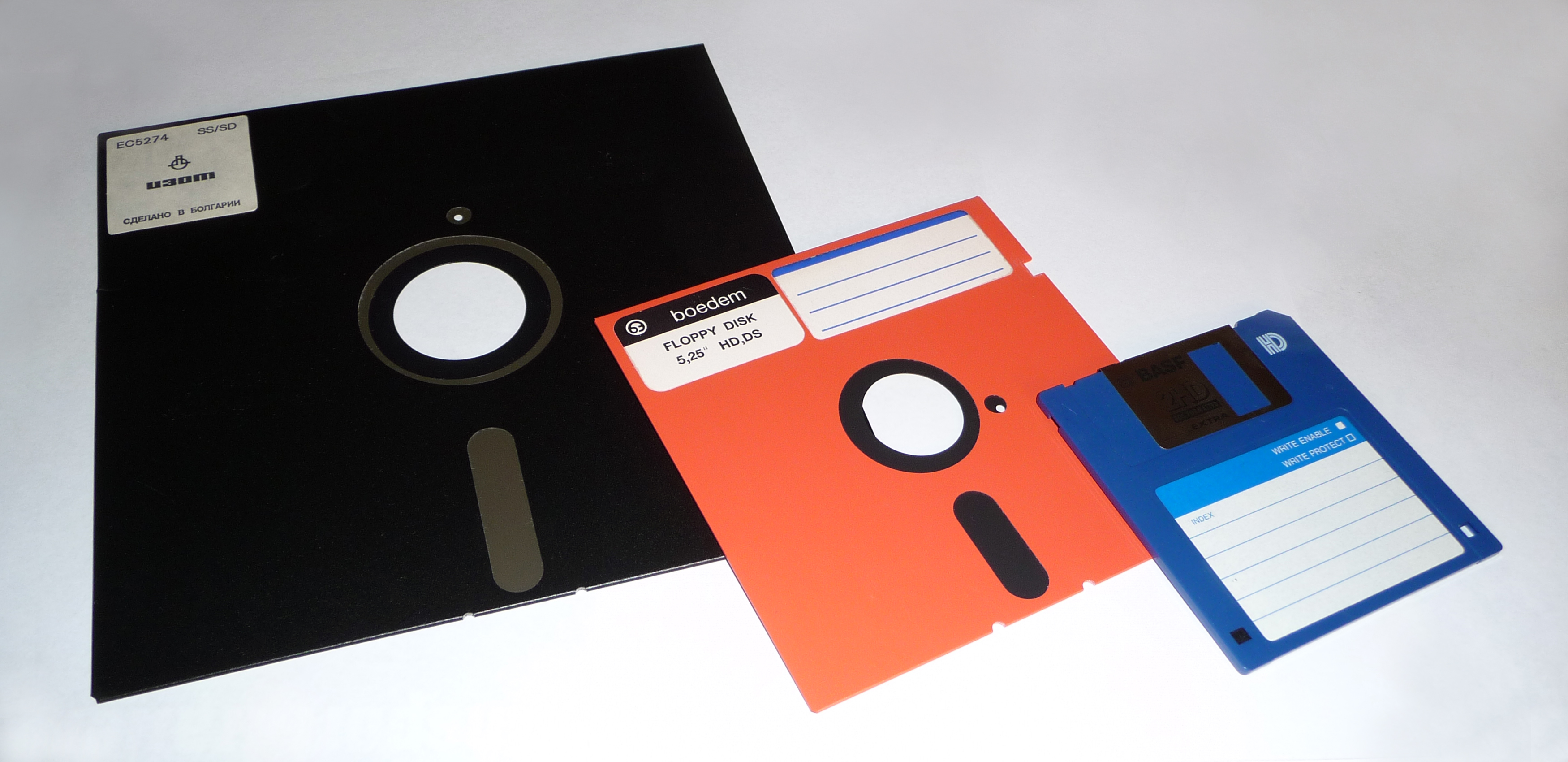
I think you meant it fit on 3.5” floppy drive (1.44 MB). Fitting on a 1.44 foot floppy disk would be much less impressive :P

Bigger is better! I'd love to see that disk. Maybe you'd wheel it out on one of those TV carts all my teachers had.

I think they did make 14" WORM optical disks at some point:

https://i.redd.it/dgvtw0tmgxk81.png

Re: Oberon (2009)

#118
post #85

Earlier quoted context omitted.

Bigger is better! I'd love to see that disk. Maybe you'd wheel it out on one of those TV carts all my teachers had.

I think they did make 14" WORM optical disks at some point: https://i.redd.it/dgvtw0tmgxk81.png

8 inch floppies for the rest of us Phillistines

https://upload.wikimedia.org/wikipedia/commons/a/aa/Floppy_d...

Re: Oberon (2009)

#119

Earlier quoted context omitted.

I think it jocularly meant "use something with fewer gates and a smaller cross section", not "use a smaller feature size". Or I could easily have misremembered: this was all last century.

> Or I could easily have misremembered: this was all last century. Don't understate the difficulty of remembering. This was all last millennium .

Important not to also understate that some of us spent more time in the former than the current.

Re: Oberon (2009)

#120

I am interested in alternative GUI tech. If you find this interesting you might find my declarative frontend idea interesting called additive-guis https://GitHub.com/samsquire/additive-guis The idea is you define how the GUI should appear by describing it. The GUI changes in real time based on what you describe. And I also designed a GUI primitive I called GUI thunking, inspired by Haskell. The idea is you can chain…

You might be interested in Acme and Rio from the Plan9 system! It had some interesting UI paradigms like 3 button clicking and highlight to instantiate.

Additive guis seems like a really cool approach that I wish we had more of these days given that everything seems to be web-based anyway. Most interfaces sadly want to be a mishmash of MacOS and a catch-all mobile operating system.

https://en.wikipedia.org/wiki/Rio_(windowing_system)

https://9p.io/wiki/plan9/Using_acme/index.html

Post reply on HN