Live data from Hacker News

Korea shatters its own record for world’s lowest fertility rate

bloomberg.com

251–260 of 643 posts

Re: Korea shatters its own record for world’s lowest fertility rate

#251

Earlier quoted context omitted.

Not to detract, but "one kid" would only make the problem worse because a woman needs to give birth to at least two children in order for population counts at large to maintain parity. That is, one kid per woman halves the population. If the axiom is at least maintaining, ideally growing the population, every woman needs to give birth to at least two and ideally three or more kids. Of course, this isn't to say I'm te…

I don't understand. How is 1 biological kid worse than 0 biological kids? It sounds like decafninja is likely planning on having 0 biological kids.

Within the wider context of population decline due to low birth rates, both are bad because both lead to population decline anyway. 2 kids is a hard minimum for maintaining population count, 3 or more kids for increasing population.

As for what decafninja (or any individual for that matter) decides upon in the bedroom, that's for him to decide and his business alone. I'm not going to comment because it's none of my business.
Re: Korea shatters its own record for world’s lowest fertility rate

#252

Something has deeply deeply changed in society for a fertility rate to go from 6 to 0.8 in 60 years, the living memory of a single life. Before, society grew with the average working age person only needing to half support an elderly retiree. Now, that same working age person will need to support more than 2 elderly retirees themselves, over 4 times the resources. Has it occurred to people that, maybe, modern fertili…

Apologies for ranting but this topic resonates too much. Housing prices are 9x salary vs 4.5x salary in the 70s and it takes a while to save up. Personal data point: it took me winning an IPO lottery to start thinking about having kids for real. Having kids while earning minimal wage? Terrifying, especially in the US where getting yourself or your kid sick could bankrupt you in the blink of an eye - and if you want m…

I agree with you on the latter point, but I want to also point something out on the former. Many people who are of no "proper" means to do so continue to have children. And they make it work, even if it may be uncomfortable and require sacrifice. So the issue is not one of finances, but priorities. Winning an IPO lottery being the baseline where you feel comfortable for having children doesn't mean that such is the inherent baseline, but that you simply prioritize comfort and wealth over raising a family. And that is okay.

This nuance is important; it emphasizes the real issue is not economics, but culture! We've created a society that values the pursuit of wealth and comfort more than family, and it's likely this system is not sustainable. Not everybody can be wealthy, because wealth is relative and mediated by what exists. If 30% of people want something and there's only enough for 3%, then it doesn't matter what the relative wealth is among these people: 90% of people won't be able to "afford" it, and that will never change. A post-scarcity society will never exist alongside consumerism; we'll simply take what we can have for granted and lust over the new scarcities.

Re: Korea shatters its own record for world’s lowest fertility rate

#253

Something has deeply deeply changed in society for a fertility rate to go from 6 to 0.8 in 60 years, the living memory of a single life. Before, society grew with the average working age person only needing to half support an elderly retiree. Now, that same working age person will need to support more than 2 elderly retirees themselves, over 4 times the resources. Has it occurred to people that, maybe, modern fertili…

>>In 1960, Pakistan had 45m people compared to South Korea's 25m. Now, Pakistan is forecasted to reach 450m in our lifetime as South Korea implodes. That looks like our future.

Social factors are not considered enough. As societies get more materialistic, and socio-economically advanced, there seems to be more individualistic, privacy[in the wrong way, escalating to extreme isolationism], lack of social interaction and bonding etc.

I myself felt odd during the time I stayed in the US, the whole concept of individualism and privacy was taken too far, and everybody felt lonely in their own way. People moved around in fixed schedules and paths, almost like an open air prison. Given limited social interaction outside work[where you can't even sneeze without offending some one]. This really felt like passion and purpose in life was slowly fading away. I can imagine how a society with this sort of a lifestyle could fare on the longer run. People would want lesser and lesser people around them, and interact with them even lesser as time would proceed.

Countries like India and Pakistan definitely have third world infrastructure, but the social infrastructure is very strong and likely to remain, this is due to socio-religious reasons. For this reason, people get married and have 2+ kids.

Re: Korea shatters its own record for world’s lowest fertility rate

#254

Earlier quoted context omitted.

> Something has deeply deeply changed in society for a fertility rate to go from 6 to 0.8 in 60 years, the living memory of a single life. Women gained financial freedom and the ability to choose when they get pregnant. Societies will now find out the market price for birthing children (as well as women finding out the price for not birthing children).

How do you respond to this comment? seems an environmental factor is at play as well. https://news.ycombinator.com/item?id=32580631#32588473

[deleted]

Re: Korea shatters its own record for world’s lowest fertility rate

#255

My wife and I are Korean-American, albeit with many ties to our country of origin. Something I've noticed is that many couples that do want a child have a very difficult time conceiving. People are having kids at a later age on average, but even younger couples seem to have a hard time. Various gynecological disorders seem to be very common too - fibroids, endometriosis, adenomyosis, amongst others, all of which affe…

I find this topic very interesting. My observation (anecdata-lly, but I would love to see RCTs or perhaps a cleanly designed ANOVA study) is that these symptoms of infertility are particularly (world-wide) prevalent in people who have (usually undiagnosed) metabolic syndrome & low cholecalciferol.

In almost all South-east Asian countries in particular, I have noticed high levels of sucrose consumption so I am curious if Korea is the similar to SEA, or if either of these factors apply to either of you?

Koreans have famously long working hours, but as you are not there, those stress factors should likely not apply to you.

Another point to note is that I have heard adoption is at least as difficult as IVF, emotionally & financially speaking, although there's less physical pain. At least IVF can point you to where the problem lies (the knowledge of that can be disconcerting) providing you perhaps avenues to mitigate/ameliorate those factors, which could improve your overall QoL and also lead to better health-outcomes.

Re: Korea shatters its own record for world’s lowest fertility rate

#256

My wife and I are Korean-American, albeit with many ties to our country of origin. Something I've noticed is that many couples that do want a child have a very difficult time conceiving. People are having kids at a later age on average, but even younger couples seem to have a hard time. Various gynecological disorders seem to be very common too - fibroids, endometriosis, adenomyosis, amongst others, all of which affe…

father of twins (10 Y/O) via medical help here. 10 years ago our doctor said, "30 years ago the natural rate of twins was 3 sets per 1000 births. Now it's 3 sets per 100 births". After a quick search I couldn't find any data supporting a 10x increase in twins over the past 40 years but plenty of articles showing something closer to a 2x increase in the rate of twin births. I suspect the rate of twins amongst our peer…

WOW. that is a huge jump. what is going on? twins are generally not favored in Korean culture I believe, not sure what the attitude is outside of it.

Re: Korea shatters its own record for world’s lowest fertility rate

#257

Earlier quoted context omitted.

Talking about “developed countries” here, not SK specifically. Is declining fertility really such a societal and evolutionary danger when we’re talking 1.4-1.5? If you think of us all as one race, the human race, the fact that a few corners of the world are declining in fertility is arguably an environmental victory that could soften some crises’s in the future. We are like 99.9% genetically similar, why risk gutting…

I think it's less about preserving sparkling blue eyes and more about the negative effects of a declining population on a country's economy. Sam Harris had a guest (Peter Zeihan) a few episodes ago who talked about the downsides of population decline, and he was pretty interesting. One of the key points he made that seemed fairly intuitive is that as your population declines you eventually wind up with significantly…

That point doesn't seem particularly intuitive to me. A society in population decline is a society where the old outweigh the young. You would seemingly have a higher ratio of long-term experts to young learners than you do under a population growth scenario.

If there is a risk, your risk isn't that you have too few experts to offer training, it's that the young learners are spread too thin. There aren't enough people looking to learn for all the people who have knowledge to pass down and so you lose knowledge in that transition.

--------

With that said, I find the general premise that we would be looking at some kind of dark age with the level of population decline any of us are likely to see in our lifetimes, nearly comical.

The global population now is around 8 billion. It was around 3 billion in 1960 (4 billion in 1974, 5 billion in 1987, 6 billion in 1999). It doesn't seem to me that the pace of change or technological advancement was particularly slow in any of those time periods, and the substantial productivity gains since then would alone suggest that we'd be more efficient for those population levels than things were at that time.

Re: Korea shatters its own record for world’s lowest fertility rate

#258

Something has deeply deeply changed in society for a fertility rate to go from 6 to 0.8 in 60 years, the living memory of a single life. Before, society grew with the average working age person only needing to half support an elderly retiree. Now, that same working age person will need to support more than 2 elderly retirees themselves, over 4 times the resources. Has it occurred to people that, maybe, modern fertili…

OR we could say "you had 65 years to save up, no way in hell are we going to keep crippling the economic prospects of our youth to fund your retirement"

Re: Korea shatters its own record for world’s lowest fertility rate

#259

My wife and I are Korean-American, albeit with many ties to our country of origin. Something I've noticed is that many couples that do want a child have a very difficult time conceiving. People are having kids at a later age on average, but even younger couples seem to have a hard time. Various gynecological disorders seem to be very common too - fibroids, endometriosis, adenomyosis, amongst others, all of which affe…

father of twins (10 Y/O) via medical help here. 10 years ago our doctor said, "30 years ago the natural rate of twins was 3 sets per 1000 births. Now it's 3 sets per 100 births". After a quick search I couldn't find any data supporting a 10x increase in twins over the past 40 years but plenty of articles showing something closer to a 2x increase in the rate of twin births. I suspect the rate of twins amongst our peer…

I know personally 20+ families with twins. Of my close personal friends, ie. those that I see regularly and chat with regularly, 7 of them have twins. My neighbors on both sides of my house have twins. There are so many families with twins these days, it's nuts!

Re: Korea shatters its own record for world’s lowest fertility rate

#260
post #22

Earlier quoted context omitted.

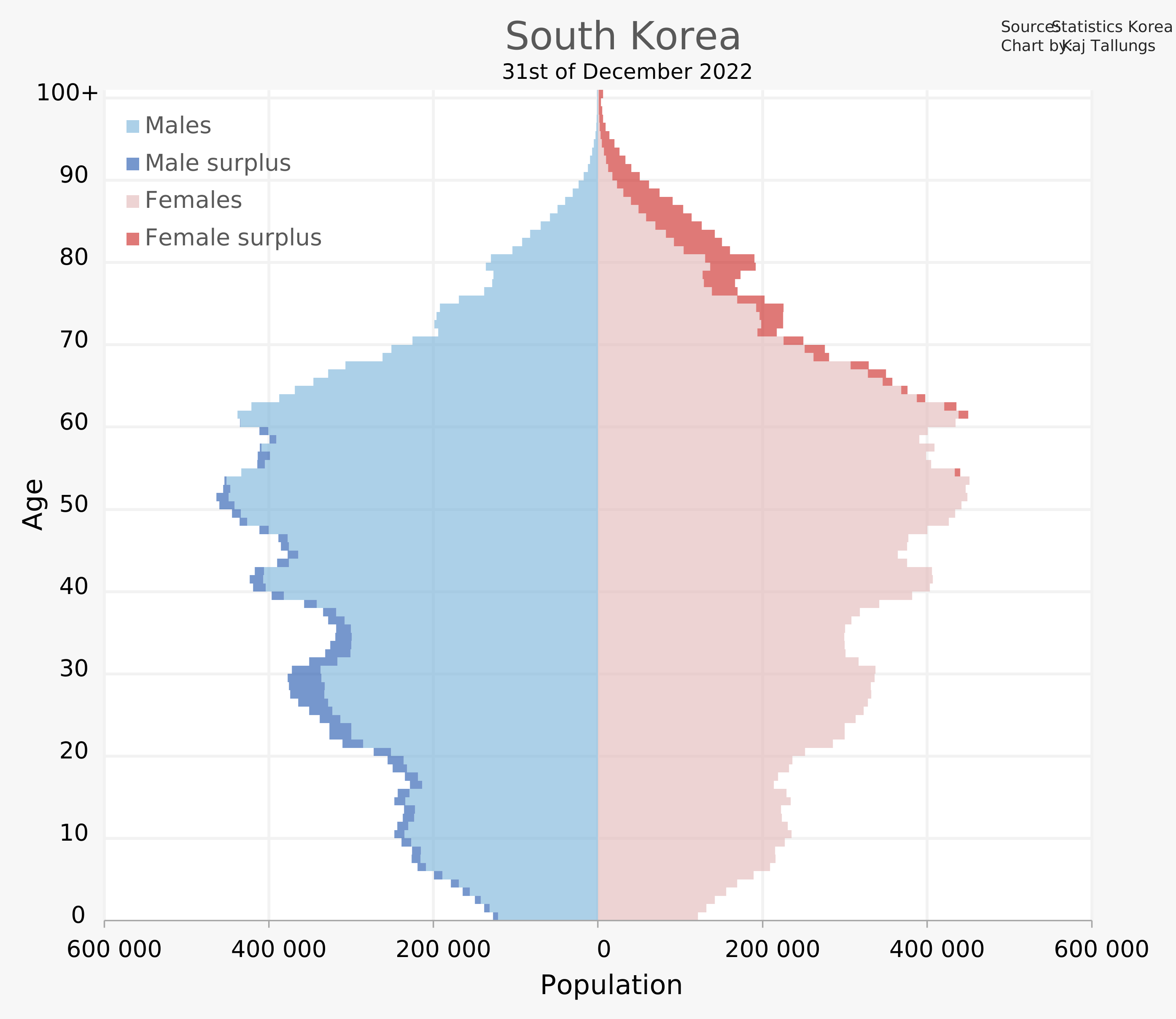
There's just a lump in the population vs. age graph and you're fixating on the back side of the lump as if it's inevitably going towards zero. After the lump passes through South Koreans will look around and see a lack of traffic congestion, abundance of housing, lack of competitors for their now abundant resources, and lack of disproportionately large population of unproductive elderly dependents. Wanna guess what h…

> How about some DATA: go to https://population.io , select Rep. of Korea, plug in some age/gender b.s. and scroll down to "Age Distribution" at the left column. Now look to the left of ~20yo (younger than 20), it's a nearly horizontal line. What does that tell you? Yeah, something is definitely wrong with the site because actual population pyramid data looks much more alarming: https://commons.wikimedia.org/wiki/Fil…

Exactly. This one looks even more alarming:

https://upload.wikimedia.org/wikipedia/commons/4/4a/South_Ko...

Also it matches up with the article, which says 261k babies were born last year. wikimedia show about that, with ~130k male and ~130k female. population.io says 454k which is way off.

Post reply on HN