Live data from Hacker News

Waterproof anything with a spray

designtaxi.com

31–40 of 53 posts

Re: Waterproof anything with a spray

#31

Earlier quoted context omitted.

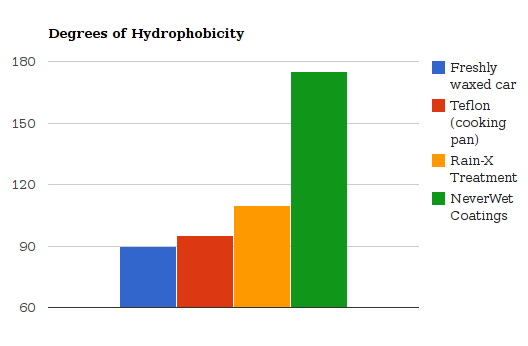
I love the graph on that page, where 160-175 "degrees of hydrophobicity" are illustrated as a huge, exponential increase over 110 degrees. To me, more than the breathability or durability or whatever other technical issues, that graph is a huge red flag that this is 90% marketing, 10% engineering.

The scaling, though not noted seems to be about 10 degrees per line. Which means the 160-175 is actually shy of where it should be (about 5 lines up from the 110). That bar actually shows it's at 150 degrees, which must mean their marketing is actually very conservative if we are to make grand judgement calls from one graph on a company's page. ;)

The parent was referring to how they didn't start from 0, so it seems 160 degrees is 5-6 times larger than 90 degrees.
Re: Waterproof anything with a spray

#32

I remember reading about similar technology before at least twice here on HN; it was 'glass in spray' then[1]. It was supposed to be here soon and revolutionize everything. I hope that this time it will actually become available to buy. [1] I think this one: http://www.smartplanet.com/blog/smart-takes/-8216liquid-glas...

This can be bought in Europe for furniture. It is a family business, so I think they are building it up slow. They have had some good studies on their product, and I still hope we will see it in the next few years. I think it is legit.

That's cool! Is there anything stopping it from being used for anything else besides furniture?

Re: Waterproof anything with a spray

#34
post #30

I would like to see what happens to a swimmer with a suit coated with this thing. Would it go faster or slower?

Faster: Friction is reduced.

Or slower, since you cannot "push" so much water with hands and feet as it "slips" through. Who wins: lower friction or lower viscosity?

Re: Waterproof anything with a spray

#35
post #30

Earlier quoted context omitted.

Faster: Friction is reduced.

Or slower, since you cannot "push" so much water with hands and feet as it "slips" through. Who wins: lower friction or lower viscosity?

Typical swimsuit doesn't cover the arms or legs, does it?

Re: Waterproof anything with a spray

#38

Earlier quoted context omitted.

Or slower, since you cannot "push" so much water with hands and feet as it "slips" through. Who wins: lower friction or lower viscosity?

Typical swimsuit doesn't cover the arms or legs, does it?

They used to, or rather there used to be the option. In the 2000's swim suit manufacturers played with all kinds of things including extremely high tech fabrics, even plastics, and suit lengths. In 2010 though the world governing body of swimming (FINA) rather controversially banned anything above the waist or below the knee for men, beyond the shoulder or below the knee for women and anything other than textile fabrics for either gender.

A relevant article: http://www.telegraph.co.uk/sport/olympics/swimming/5900497/F...

You can also find plenty of video of Ian Thorpe racing in suits wrist to ankle as early as 2000.

Re: Waterproof anything with a spray

#39

Not to "rain" on their parade (heh), but the ability to pass water vapor effectively while also remaining hydrophobic for water droplets, and doing that for a long time on surfaces that are exposed to constant wear, is sort of the holy grail of the outdoor gear industry. The company's page for their product ( http://www.neverwet.com/product-characteristics.php ) doesn't mention breathability. Considering that breatha…

I love the graph on that page, where 160-175 "degrees of hydrophobicity" are illustrated as a huge, exponential increase over 110 degrees. To me, more than the breathability or durability or whatever other technical issues, that graph is a huge red flag that this is 90% marketing, 10% engineering.

Here you go, an accurate graph: http://i111.photobucket.com/albums/n147/IDKAA/graph.png

Re: Waterproof anything with a spray

#40

Earlier quoted context omitted.

It's silicone (not silicon, as the article misstates) so it's probably safe. Silicone is used in breast implants, home window sealants, cookware (look up silpat) and yes, fabric, as silnylon (the ultralight backpacker's waterproof friend). With the last case, it is not breathable, which is why it's not used for jackets.

I thought silicone in breast implants was discontinued in favor of saline due to the dangers of toxicity with implant leaks.

I am not a breast implant expert, but if I recall, silicone fell out of favor due to fears connecting the implants to mysterious immune-related diseases. However no connection between silicone breast implants and these diseases was ever borne out.
Post reply on HN