Earlier quoted context omitted.
Hold up. Why would people who weren't willing to accept the taxes to maintain the street car willing to instead pay all the tax which subsidizes car infrastructure. This narrative doesn't quite add up because everything you said about why the street car existed and the commuter pattern that fed into the economics of developers applies equally well to why cars and suburb development exists. So once suburban homes were…
Because private cars are incredibly convenient compared to street cars. Faced with significant tax increases for street cars that only go a few places, and car infrastructure that can allow people to go directly from point to point, it was a no brainer. I just loaded up my Toyota 4Runner and dumped a bunch of junk at the town dump. I didn’t plan this in advance, I didn’t have to rent a truck (how do I get there anywa…
The Bay Area's lost streetcars
61–70 of 91 posts
Re: The Bay Area's lost streetcars
#62Earlier quoted context omitted.
This always comes up, but is not accurate. Streetcars were never greatly loved. They were boiling hot in the summer, freezing in winter, the ride was jarring, and they were crowded with all manner of people. During the war maintenance was deferred to the point that at the end of the war most such lines needed to be rebuilt in order to stay in operation. Ripping them out to build roads for cars was not a conspiracy bu…
If only there had been solutions to heating and cooling, or ride comfort. Sadly, we as a species never got around to inventing heat pumps, springs, or cushioned seating. LOL. Cars were popular post war, so were suburbs. But surely GM had no incentive to make them so. I'm not saying they personally went out and sabotaged the streetcars, but they absolutely put their thumb on every scale they could.
It also didn't really help that the US made a "standard" streetcar that was such a lemon that they were starting to get scrapped only 11 years after entering service: https://en.wikipedia.org/wiki/US_Standard_Light_Rail_Vehicle
Most of our modern improvements to modern light rail vehicles came from manufacturing designs either straight from or derivatives of successful European ones. But that wasn't an option in the less globalized mid-century.
Re: The Bay Area's lost streetcars
#63Earlier quoted context omitted.
Because private cars are incredibly convenient compared to street cars. Faced with significant tax increases for street cars that only go a few places, and car infrastructure that can allow people to go directly from point to point, it was a no brainer. I just loaded up my Toyota 4Runner and dumped a bunch of junk at the town dump. I didn’t plan this in advance, I didn’t have to rent a truck (how do I get there anywa…
As far as a truck; most moving companies in my area also offer junk haulage, and the rates are pretty decent for something I do rarely (like less than once a year)
Re: The Bay Area's lost streetcars
#64Earlier quoted context omitted.
Small electric 1/2 person transport devices (bikes, motorbikes, scooters, micro-cars, ...) are the future for high density. Everyone needs to go to a different place. Then for longer rides, regrouping those small rides in "trains", as I was saying "composition", should be the way to go.
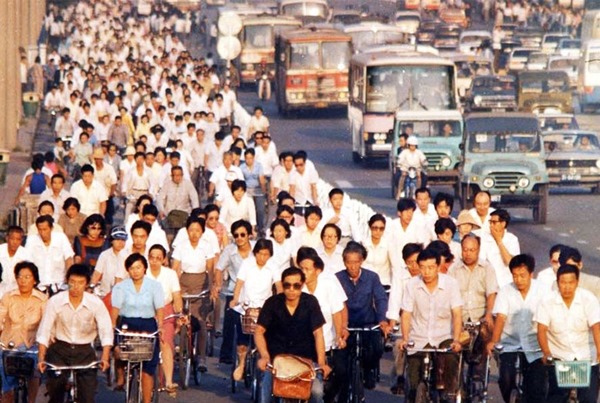
They are a major part of the future in medium-density areas. Less so in high-density areas, where individual vehicles of any kind create too much traffic to be a majority solution. Just look at pictures from Chinese cities in the 1980s to see how dystopian the combination of bikes and high density can be.
To me that doesn't look dystopian, it looks practical :shrug:
Re: The Bay Area's lost streetcars
#65Earlier quoted context omitted.
Europe, Japan and China and many other countries beg to differ and are running and/or building plenty of railways.
Railways are practical to go fast from a transportation hub to another transportation hub, without much stops in the middle. Local railways are fading away because last miles transportation needs to be more flexible that what railways can offer.
Not sure if you mean trams or branch lines by local railways, but at least Germany has also been keen on reactivating old branch lines, often to resounding success and exceeding expectations (and few failures, although there are many hurdles that reactivation projects much pass to avoid that fate). S-Bahn networks with many infill stops are also popular.
Many S-Bahn stops also rely on walking for the last mile, which works well. There are also of-course people that come by bus or bike, but both seem like a smaller portion to me. There are efforts to try to get more bike&ride traffic to expand the station reach, but it's doesn't seem to me like it has increased a huge amount. There are also always efforts to expand park&ride, but the share of passengers using it is tiny [1]. The portion of people using E-Scooters and taking them into the train has noticeably increased, but not (yet) enough to be a significant portion (I'd guess 1-2% at most). In places where E-Scooter rentals are available, the trams, subways, busses, walking and personal bikes are usually cheaper (30ct/min) and guaranteed to be available. I'd guess few people use rentals for their daily routine, but more for fun and rare trips.
A few german transport associations have tried implementing on-demand ridepooling, but I haven't heard of any large success stories yet. It's more of a complement for off-peak service due to the waiting times (if it takes 20 min for the vehicle to get to you, that's 20 minutes of waiting and you can't rely on a timetable), hassle (having to use an app and ordering it) and price.
[1]: Park&Ride is very limited anyways. You can't retrofit a lot of parking to existing stations, because they're in the middle of (sometimes small) towns and would discourage denser development. If you want enough ridership to sustain an additional stop, there'd have to be a huge amount of parking (necessitating expensive parking garages) and enough demand to take the train for part of the trip and not a car for the whole trip. There usually isn't (with some exceptions, like greenfield HSR stations that the french like).
Re: The Bay Area's lost streetcars
#66Earlier quoted context omitted.
As far as a truck; most moving companies in my area also offer junk haulage, and the rates are pretty decent for something I do rarely (like less than once a year)
What is a decent rate for you?
I junked a sectional for $50, I think?
Re: The Bay Area's lost streetcars
#67Earlier quoted context omitted.
If only there had been solutions to heating and cooling, or ride comfort. Sadly, we as a species never got around to inventing heat pumps, springs, or cushioned seating. LOL. Cars were popular post war, so were suburbs. But surely GM had no incentive to make them so. I'm not saying they personally went out and sabotaged the streetcars, but they absolutely put their thumb on every scale they could.
AC came to public transportation pretty late, mostly due to reliability issues; a broken AC in a car is a personal problem, but a broken AC in public transit is the operator's problem. It also didn't really help that the US made a "standard" streetcar that was such a lemon that they were starting to get scrapped only 11 years after entering service: https://en.wikipedia.org/wiki/US_Standard_Light_Rail_Vehicle Most of…
Oh it wasn’t less global, the Republican administration forced government entities to buy (or in this case build) American instead of European in an attempt to fight inflation.
Re: The Bay Area's lost streetcars
#68Earlier quoted context omitted.
Pepper spray and tear gas, which are legal to carry in California, are probably more useful. You can use them in situations where shooting someone would get you charged with assault with a deadly weapon, attempted murder, or murder. Against crazies and druggies, brandishing a gun without using it isn't that effective and may make things worse. Cops struggle with this - they're called to deal with crazies, it's hard t…
Its usually advised to carry both, so you have options. And to train with both. Pepper spray doesn't always work, nor is it always the appropriate tool for the job. And if you are carrying a firearm, carrying an IFAK is highly recommended. For anyone and everyone, taking a "stop the bleed" class is highly recommended.
It really isn't. In the class for a concealed and carry permit, they told us not to carry anything other than a gun. The rationale being that if you have something less lethal than a gun on you and you shoot someone, you'll get raked over the coals about why you didn't use the less lethal option. This doesn't happen if you aren't carrying anything else, it was your only option.
This might be different for those with police/military training, but even then thinking clearly with a full adrenaline dump in your system is hit or miss at best.
Re: The Bay Area's lost streetcars
#69Earlier quoted context omitted.
AC came to public transportation pretty late, mostly due to reliability issues; a broken AC in a car is a personal problem, but a broken AC in public transit is the operator's problem. It also didn't really help that the US made a "standard" streetcar that was such a lemon that they were starting to get scrapped only 11 years after entering service: https://en.wikipedia.org/wiki/US_Standard_Light_Rail_Vehicle Most of…
> that wasn't an option in the less globalized mid-century. Oh it wasn’t less global, the Republican administration forced government entities to buy (or in this case build) American instead of European in an attempt to fight inflation.
Yes, it was; trade globalization progressively advanced under the GATT regime shortly after Ww2 through the formation of (and further after and by expansion of both the membership and scope of rules of) the WTO to replace the GATT in 1997.
> the Republican administration forced government entities to buy (or in this case build) American instead of European in an attempt to fight inflation.
The Buy America Act was not a unilateral partisan or executive actions, but was a bipartisan law passed by a Democratic-majority House and Republican-majority Senate under a lame-duck Republican Administration, and it was more motivated by stimulating the domestic economy during the Depression (it was signed on the last day of the Hoover Administration) than fighting inflation, which had been negative and getting more negative for the three years preceding the passage of the bill.
Re: The Bay Area's lost streetcars
#70Earlier quoted context omitted.
My town is famous for being a city that feels like a bunch of neighborhoods. Nearly all of those iconic neighborhoods are along the historic street car routes, that were dismantled in the 30s and 40s. I won't claim the street cars were perfect, but there is a lot of merit to the idea that they were replaced by an inferior solution due to the prevailing winds of the moment. What I find more interesting is the street c…
> My town is famous for being a city that feels like a bunch of neighborhoods. Ha, I think everywhere I've lived has described itself like this. Maybe it's less common in the US because you don't have cities swallowing up villages.
My town has a reputation for being better than most, but truth is we've grown so fast the last 2 decades our transit system is overwhelmed now too.
Most US cities are dominated by suburban sprawl, and where there's pretty much nothing like a walkable neighborhood high street.