Live data from Hacker News

U.S. Army Camouflage Improvement Explained (2013)

hyperstealth.com

101–110 of 309 posts

Re: U.S. Army Camouflage Improvement Explained (2013)

#101
post #92

I was hoping to learn why the pixelated designs started appearing. Author says they work; but what led anyone to think that those designs might work? Why did they try them in the first place? And actually, why do they work? I find it bizarre that this is all done by private companies, competing in public competitions, with royalties to be paid for the chosen design. And I'm quite surprised that some designs were foun…

During the I-for-get-which war, the army hired color-blind spotters because the enemy camo turned out to be fooling fully sighted people but was less effective with red-green color blindness. I don't recall if it was texture or contrast issues but they stood out against the trees and shrubbery enough to locate. So we not only have to worry about invisible spectra, but some filters on visible light may reveal the targ…

Very real issue. My uncle used to be a big hunter (he died a couple years ago), and could never see other hunters wearing the required blaze orange, but when they were wearing camouflage he had no problem seeing them in the woods.

I have lots of other stories about the wierd things color blind people see and don't see. (My sisters are color blind, none of my family sees colors exactly the same, makes for some weird situations)
Re: U.S. Army Camouflage Improvement Explained (2013)

#102

Spotting dudes in camo seems like a prime opportunity for neural net ar

There's nothing useful to deploy it on though--the 'future soldier' concept of the 90s never went anywhere (https://en.wikipedia.org/wiki/Future_Soldier) and we don't have a computer platform on every soldier. IMHO I'd stick to using machine learning to detect stealth aircraft and missiles to improve intercepting them.

Re: U.S. Army Camouflage Improvement Explained (2013)

#103

I was hoping to learn why the pixelated designs started appearing. Author says they work; but what led anyone to think that those designs might work? Why did they try them in the first place? And actually, why do they work? I find it bizarre that this is all done by private companies, competing in public competitions, with royalties to be paid for the chosen design. And I'm quite surprised that some designs were foun…

CADPAT works terrifyingly well in the temperate forests of Canada during spring/summer. I had a chance to go try and to spot people wearing CADPAT in the early 2000's and it was a royal pain to try and see them compared to the olive drab or even the US woodland patterns. Just a fun aside: when Canada invaded Afghanistan, there was a lack of the arid variant of CADPAT. It left soldiers to land in the brown and tan des…

> Just a fun aside: when Canada invaded Afghanistan, there was a lack of the arid variant of CADPAT. It left soldiers to land in the brown and tan desert wearing vivid green camouflage designed for summer in the Canadian rain forests.

This is a (kinda funny) plotline in Generation Kill.

Re: U.S. Army Camouflage Improvement Explained (2013)

#104

Earlier quoted context omitted.

It's so interesting how luddite Reformers hold such a sway over the usually techno-optimist HN. Turns out that new technology has teething problems, what a shocker.

Wow, my first comment on the thread, consisting entirely of a quote from expert analysts, and already I'm a "luddite Reformer". (Idiosyncratic capitalization also doesn't help you seem balanced and rational.) This turkey was designed in the 1990s. The contract was awarded in 2001. The first f35 flew in 2006. When will this "technology" no longer be "new"? Presumably it will be some time, since the entire fleet was gr…

> This turkey

Spreyian detected, opinion discarded.

Re: U.S. Army Camouflage Improvement Explained (2013)

#105

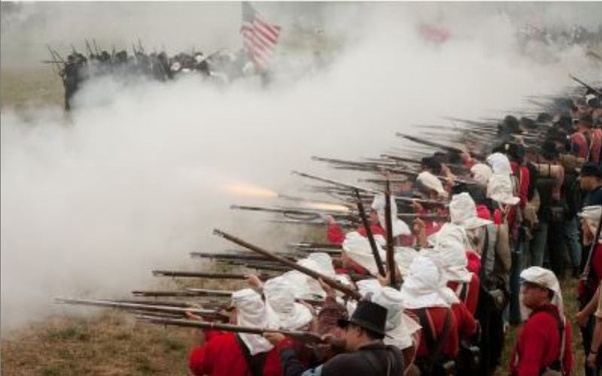
Today's camo is so much better than the red coats the British were wearing in the 18th century. chuckle

The British red coats were a kind of dazzle camouflage, making it hard to see individuals within the group. People weren't stupid back then - they just had different design goals to what we have now.

Flamboyantly colored uniforms of the time also helped prevent friendly fire. Each volley of musket fire filled the air with a white smoke cloud. [1][2]

[1] https://d1w82usnq70pt2.cloudfront.net/wp-content/uploads/202...

[2] https://www.goonhammer.com/goonhammer-historicals-firing-in-...

Re: U.S. Army Camouflage Improvement Explained (2013)

#106
post #99

Earlier quoted context omitted.

It's not really so much about the pixels being square as the fractal-ish nature of mordern pixel camos that result in a "scale invariance" effect. There's details and contrast at the level of the small pixels, and there's details and contrasts are medium levels, and then again at large levels. Previous US army camo mostly had detail at only one scale level. As jcranmer says, there's more details on the reasons it wor…

Exactly. Very very few things in nature actually are made of large blobs of a single color (unless you're very shortsighted). Honestly, it baffles me why militaries didn't realize this earlier.

Source: former military member.

In combat, camouflage is really the VERY last line of defense possible, and a fairly weak one at that. If the difference between staying alive and being dead is the pattern of your clothing, a lot of things have already gone seriously wrong and your chances of survival are not great.

In the grand scheme of things, camo relatively high-hanging fruit. Money and time have mostly been spent on building superior weapons, armor, and of course training. Camo is a very small optimization in comparison and when the Army and Air Force decided to change up their BDU patterns, it was viewed by me and my fellow service members as largely a public image stunt. ("Look everyone, we're modern!")

Edit: to be clear, I'm only referring to uniforms... snipers and such use camouflage netting for example that is tailored to their exact location and can be extremely effective at "hiding in plain sight."

Re: U.S. Army Camouflage Improvement Explained (2013)

#107

Spotting dudes in camo seems like a prime opportunity for neural net ar

There's nothing useful to deploy it on though--the 'future soldier' concept of the 90s never went anywhere ( https://en.wikipedia.org/wiki/Future_Soldier ) and we don't have a computer platform on every soldier. IMHO I'd stick to using machine learning to detect stealth aircraft and missiles to improve intercepting them.

Yes and no. Special ops forces could definitely make use of it. The hard part is ensuring the deployment equipment is reliable 99.99% of the time, since bugs on the battlefield get people killed.

Re: U.S. Army Camouflage Improvement Explained (2013)

#109
post #24

Earlier quoted context omitted.

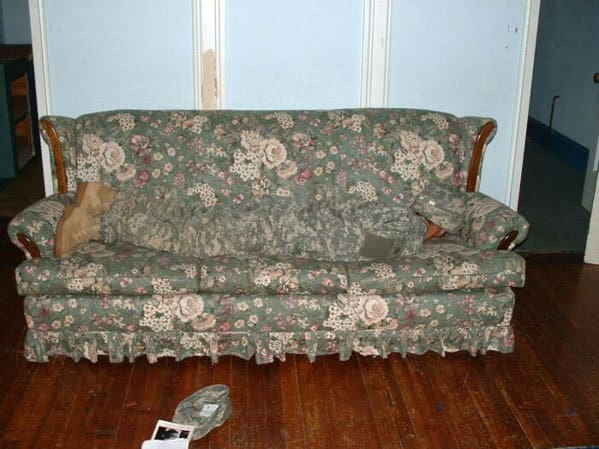
I'm in the Air force, and while not relevant to actual camouflage ability, I can personally say that OCPs look much nicer than the uniforms before. A lot of the old camo patterns looked painfully ugly. And the ability to camouflage isn't too relevant for me anyways, unless I'm trying to blend into chairs/desks.

It would be funny to have chairs and desks with the same pattern so you would actually blend in…

Relevant famous old photo:

https://soldiersystems.net/wp-content/uploads/2019/09/img_64...

Re: U.S. Army Camouflage Improvement Explained (2013)

#110
post #24

Earlier quoted context omitted.

I'm in the Air force, and while not relevant to actual camouflage ability, I can personally say that OCPs look much nicer than the uniforms before. A lot of the old camo patterns looked painfully ugly. And the ability to camouflage isn't too relevant for me anyways, unless I'm trying to blend into chairs/desks.

It would be funny to have chairs and desks with the same pattern so you would actually blend in…

C'mon, the Army and Marines already give the Air Force enough crap... I can just imagine it now... "Hey Airman Ikea, we need a good desk lamp over here, is that something you can help us with?"
Post reply on HN