Live data from Hacker News

The true costs of inflation in small-town Texas

newyorker.com

211–220 of 227 posts

Re: The true costs of inflation in small-town Texas

#211

Earlier quoted context omitted.

> It seems that this person is saying we could lose BBQ in all 254 counties in Texas? That's unmitigated hyperbole and balderdash. I interpreted this to mean that BBQ is available in all of the counties in TX, and that may no longer be true in the future, since some rural counties may lose their last BBQ joint.

Additional context: there are many big, nearly-empty counties in West Texas that, frankly, should be completely empty, and I say that as someone whose maternal grandparents were born and grew up in Swisher County (Tulia and Happy), and whose dad now lives in Kent County - where a grand jury summons meant the prospect of 160 mile daily round trips because the county seat is on the north side of the county but he lives…

Are you not allowed to return ballots via the mail?

Re: The true costs of inflation in small-town Texas

#212
The biggest problem we have facing businesses like restaurants is probably the price of labor, and that is out of whack because you can't live on the wages that restaurants can offer. A lot of that is likely due to things like health insurance, residential home prices and escalating college costs (which also lands on the price of eggs because the trucker who drives those to the supermarket needs health insurance as well). The restauranteur can't just raise prices and pay his workers more though because that "VAT" tax from stuff like health care is being taken out from every transaction in the economy. We're seeing the effects of the parasitism and rent seeking behavior where certain segments of the economy increase to squeeze and tax everyone else because their product is something nobody can do without. If it was just inflation that was happening, then everyone could raise prices and we'd eventually be back to normal (if the value if the dollar is sliced in half, but everyone doubles their prices and wages, nothing really changes). The secular problem we're seeing on the longer term (and the article addresses what has happened since he opened his business in 2001 so he's talking way beyond this latest spike) is more than just inflation.

Re: The true costs of inflation in small-town Texas

#213
post #203

Earlier quoted context omitted.

“I pay $30k for something I have to buy once every 10 years and that is ‘inflation’ vs. paying $20k for something I have to buy every 5 years” I mean, I really struggle to follow your logic. If a paper towel roll has 2x the sheets but costs 1.5x more, is that inflation too?

A lot of people buy a car every n years. For them it doesn’t matter if it lasts longer. How do you quantify how much longer cars last? Maybe people use them longer because cars are better or maybe they use them longer because they can’t afford new cars. The paper towel is a bad example because you clearly can quantify the number of sheets. It gets more tricky if you say new paper towels are more absorbent so you need…

> A lot of people buy a car every n years. For them it doesn’t matter if it lasts longer.

You can’t just keep randomly changing the relevant populations. First it was working people who can’t afford a breakdown. Now it’s wealthy people who choose to buy cars regularly. Maybe that’s why it’s difficult to grasp inflation: it’s a basket of everybody

> How do you quantify how much longer cars last?

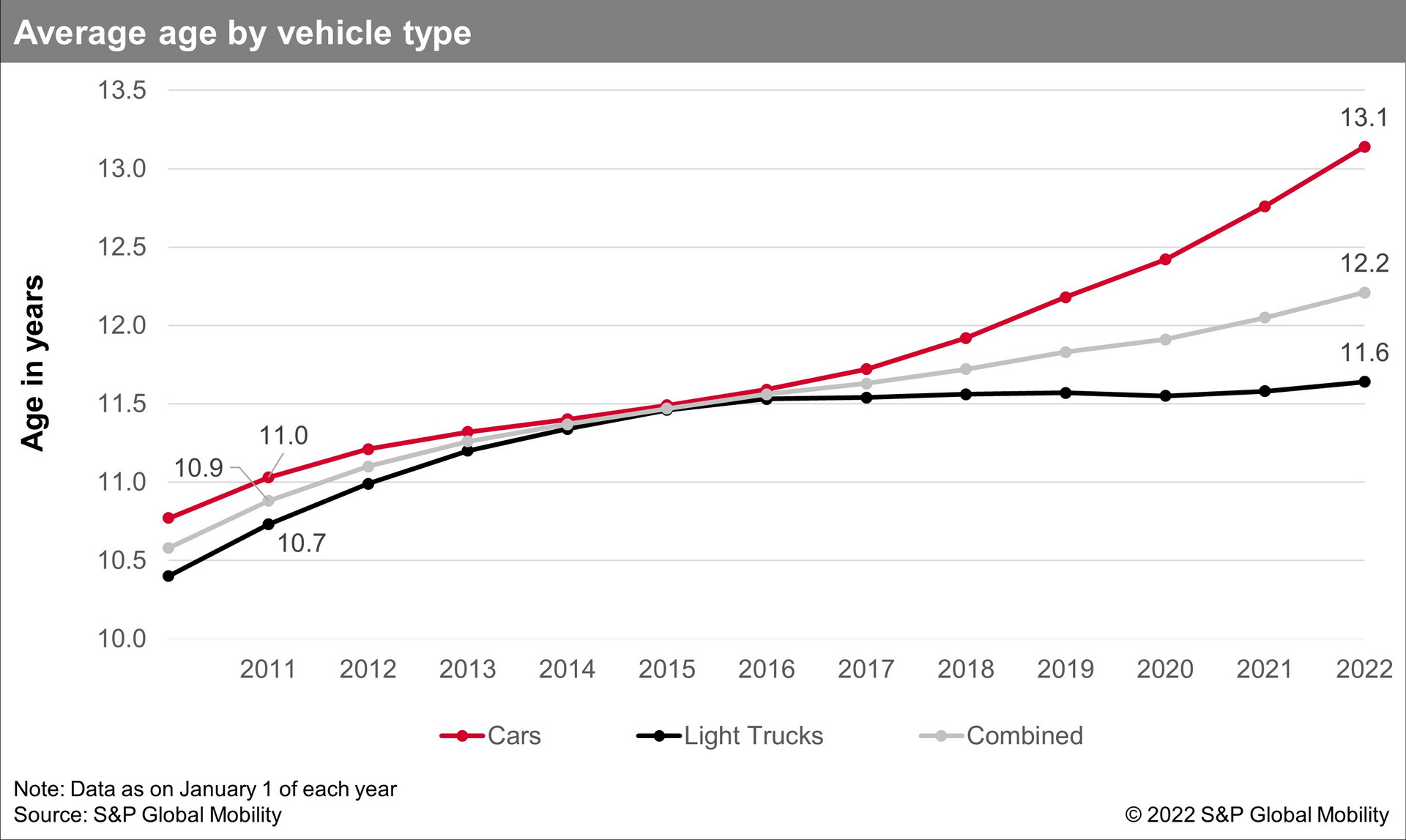
https://ihsmarkit.com/research-analysis/average-age-of-vehic...

> Maybe people use them longer because cars are better or maybe they use them longer because they can’t afford new cars.

You’re implying that people used to junk old cars because new ones were so cheap? Interesting take.

> The paper towel is a bad example because you clearly can quantify the number of sheets

I can also literally quantify how much longer cars last (see link above).

> It gets more tricky if you say new paper towels are more absorbent so you need less so there is no inflation although the sheet costs more.

Yeah, you know inflation takes a basket of spend into account, right? So yeah if in a year, the average consumer buys half as many paper towels that cost 2x as much that is exactly “no inflation”.

> These metrics are way too easy to be gamed. Next is apples costing twice as much but they are crunchier so no inflation?

I really suggest you read up more on the thinking behind inflation if you’re going to have such a strong opinion about it. Apples being crunchier is not accounted for in hedonic adjustments [0]. Like literally. Go to FK011

[0] https://www.bls.gov/cpi/quality-adjustment/home.htm

EDIT: Learn something new I guess. Cars aren’t even subject to hedonic adjustment. They have their own adjustment system that seems pretty fair if you read it[1]

[1] https://www.bls.gov/cpi/quality-adjustment/new-vehicles.pdf
Re: The true costs of inflation in small-town Texas

#214

In 2021 this IKEA gateleg table [0] cost $199 [1]. In early 2022 it was $229 according to my records, but never in stock at any IKEAs near me. Presumably because of all the crazy supply chain/lumber problems, the IKEA shelves were largely empty. By the time it managed to get back in stock, the price was $259 [2]. Today it's $279 [0], a 40% increase over its 2021 price. I don't even know how low it was before 2020/pre…

Ha, I got that table, we had to stalk Ikea's store every day to catch it in stock and drive there immediately. This is a tangential anecdote for inflation though, it's supply and demand here. They have a limited number so they are going to charge as much as they can for the limited stock they have.

> Ha, I got that table, we had to stalk Ikea's store every day to catch it in stock and drive there immediately.

When was that?

> This is a tangential anecdote for inflation though, it's supply and demand here. They have a limited number so they are going to charge as much as they can for the limited stock they have.

It was consistently in-stock at the Covina, CA IKEA around when the price jumped to $259. At least it seemed to be whenever I checked, but once it jumped to $279 I resigned to just pick up a used one eventually instead when I get back to CA.

Are you saying IKEA is still struggling to get stuff in stock today? I was under the impression that's largely behind us now.

Re: The true costs of inflation in small-town Texas

#215
post #203

Earlier quoted context omitted.

“The average new car in the US lasts like 2x longer than it did in 1998. Shouldn’t that factor in?” Absolutely not. Where do you stop with this game? Do you factor in that the seats are better so people go less to the doctor for back pain?

“I pay $30k for something I have to buy once every 10 years and that is ‘inflation’ vs. paying $20k for something I have to buy every 5 years” I mean, I really struggle to follow your logic. If a paper towel roll has 2x the sheets but costs 1.5x more, is that inflation too?

I think the original poster's claim of lasting twice as long is a big exaggeration, but it'd be interesting to see a source. Regardless, cars are likely more expensive to maintain now with all of the added complexity / sensors that can break (remember when everyone could work on their own car? I bet they didn't factor that negative into hedonic adjustments.)

Re: The true costs of inflation in small-town Texas

#216
post #110

As others said: traffic goes down, restaurants close doors. Food prices may not be the culprit, people getting their meals from delivery and cooking at home may be the cause as well. Having that said, I do work in market research and gather purchase data and create inflation models for a living and to be honest things look really scary from the US to UK+EU and Latin America (which is used to high inflation though). W…

> Who knew all that free money from the last decade would do that! As if a war where one of the largest fossil fuel exporters, also exporting enormous amounts of foodstuffs, invaded the biggest exporter in some foodstuffs (grain, sunflower oil, etc.) and a pandemic with all the death, lowered economic activity and lockdowns have nothing to do with the current economic situation. Oil and gas prices are up, and they're…

In general I agree with you, just want to point out that, as others mentioned, inflation was already in a historic record since 1982 by January/22, before the war. Also:

> Russia No one did really stop buying Russian exports, as we can see through RUB/USD YTD. Their exports actually grew.

> COVID, lockdowns It disrupted businesses and supply chains and still has a direct impact on inflation.

Having said that, I think it's about the contribution of each, and I believe all the quantitative easing and the fiscal spending plans may play a larger role on economic issues than many would like to admit.

Re: The true costs of inflation in small-town Texas

#217
post #203

Earlier quoted context omitted.

“I pay $30k for something I have to buy once every 10 years and that is ‘inflation’ vs. paying $20k for something I have to buy every 5 years” I mean, I really struggle to follow your logic. If a paper towel roll has 2x the sheets but costs 1.5x more, is that inflation too?

I think the original poster's claim of lasting twice as long is a big exaggeration, but it'd be interesting to see a source. Regardless, cars are likely more expensive to maintain now with all of the added complexity / sensors that can break (remember when everyone could work on their own car? I bet they didn't factor that negative into hedonic adjustments.)

Surprisingly only a little!

The USDOT tracks this! That’s why cars are such a bad example.

In 1998, the average age of a car on the road was 8.8 years. [0]

In 2022 it’s 13 years. [1]

Factor in install-base effects and the multiple probably rounds to 2x

[0] https://www.bts.gov/content/average-age-automobiles-and-truc...

[1] https://www.carscoops.com/wp-content/uploads/2022/05/SP-Glob...

Re: The true costs of inflation in small-town Texas

#218
post #217

Earlier quoted context omitted.

I think the original poster's claim of lasting twice as long is a big exaggeration, but it'd be interesting to see a source. Regardless, cars are likely more expensive to maintain now with all of the added complexity / sensors that can break (remember when everyone could work on their own car? I bet they didn't factor that negative into hedonic adjustments.)

Surprisingly only a little! The USDOT tracks this! That’s why cars are such a bad example. In 1998, the average age of a car on the road was 8.8 years. [0] In 2022 it’s 13 years. [1] Factor in install-base effects and the multiple probably rounds to 2x [0] https://www.bts.gov/content/average-age-automobiles-and-truc... [1] https://www.carscoops.com/wp-content/uploads/2022/05/SP-Glob...

That's actually a pretty big difference compared to the OP's claim, AND note that this statistic incorporates a delay (we are comparing 1990 vehicles to 2009 vehicles instead of 1998 to 2020). Granted, we don't know how long 2020 vehicles will last yet. The final caveat being the second point I made about people holding onto their cars longer as inflation rises / changing their preferences, not necessarily because the cars are holding up better.

Re: The true costs of inflation in small-town Texas

#219
post #217

Earlier quoted context omitted.

Surprisingly only a little! The USDOT tracks this! That’s why cars are such a bad example. In 1998, the average age of a car on the road was 8.8 years. [0] In 2022 it’s 13 years. [1] Factor in install-base effects and the multiple probably rounds to 2x [0] https://www.bts.gov/content/average-age-automobiles-and-truc... [1] https://www.carscoops.com/wp-content/uploads/2022/05/SP-Glob...

That's actually a pretty big difference compared to the OP's claim, AND note that this statistic incorporates a delay (we are comparing 1990 vehicles to 2009 vehicles instead of 1998 to 2020). Granted, we don't know how long 2020 vehicles will last yet. The final caveat being the second point I made about people holding onto their cars longer as inflation rises / changing their preferences, not necessarily because th…

> The final caveat being the second point I made about people holding onto their cars longer as inflation rises / changing their preferences, not necessarily because the cars are holding up better.

I’m sorry but the idea that “we used to junk cars sooner because new cars were cheaper” is a very big stretch to support your bias (much moreso than the concept of hedonic adjustment)

Re: The true costs of inflation in small-town Texas

#220
post #219

Earlier quoted context omitted.

That's actually a pretty big difference compared to the OP's claim, AND note that this statistic incorporates a delay (we are comparing 1990 vehicles to 2009 vehicles instead of 1998 to 2020). Granted, we don't know how long 2020 vehicles will last yet. The final caveat being the second point I made about people holding onto their cars longer as inflation rises / changing their preferences, not necessarily because th…

> The final caveat being the second point I made about people holding onto their cars longer as inflation rises / changing their preferences, not necessarily because the cars are holding up better. I’m sorry but the idea that “we used to junk cars sooner because new cars were cheaper” is a very big stretch to support your bias (much moreso than the concept of hedonic adjustment)

> we used to junk cars sooner because new cars were cheaper

This is not obvious to you? Look at how many things (especially plastics and electronics) are wasted today while they still function because they are so cheap. How many times have you replaced your smartphone while it still worked fine?

The point, again, is that we can do reasonable mental gymnastics to more or less counter-act any hedonic adjustments (which were also mental gymnastics to make inflation seem lower in the first place). A better metric would involve fewer loopholes like this that allow arbitrary mental gymnastics in the first place and instead say "how much does an entry level vehicle cost, amortized with upkeep costs and fuel for the average American." There should be no adjustment for better airbags or bluetooth, nor a reverse adjustment for taking into account improved automation in factories.

Post reply on HN