Live data from Hacker News

Is JPEG 2000 a preservation risk? (2013)

blogs.loc.gov

51–60 of 87 posts

Re: Is JPEG 2000 a preservation risk? (2013)

#51
post #47

Earlier quoted context omitted.

Yeah, Pixar literally had to spin up VMs of their old software stack when they had to remaster the Toy Story films because it was less work than getting it running again on their current stack

Actually, it seems to me VMs are an ideal way to preserve things like that. Perhaps it should be standard procedure for the archivists of such big films to build and preserve a fully functioning, self-sufficient rendering environment in the form of a virtual machine.

Until we switch to another architecture. It's pretty likely the x86 architecture will be gone in a few decades. Rebuilding VM software to run on new hardware is probably harder than fixing bugs in a JPEG decoder.
Re: Is JPEG 2000 a preservation risk? (2013)

#52
post #44

Earlier quoted context omitted.

How common is 4K at 24fps though? I'd expect 4K to usually use higher framerates than that.

24fps is still standard for movies, in part because people have associated higher framerate video with amateur home video recordings so it looks cheap. :)

To elaborate on this, higher frame rate video registers the same way to people who aren’t aware that’s what they’re noticing. I was discussing this with my dad just a little over a week ago, where he noted some portion of a movie looked lower production than the rest of the movie. I had noticed it too, because it was visibly higher frame rate. Lower frame rates more closely match the visuals of film, and higher frame rates more closely match the production of daytime TV like judge shows and “soap operas”, and that’s what they visually evoke.

Re: Is JPEG 2000 a preservation risk? (2013)

#53

Earlier quoted context omitted.

Fun fact, whenever you go to the movies, films (that are projected digitally) are encoding in JPEG2000 (wrapped in a MXF in XYZ Colourspace). We also use it for our 3D renders for archviz, and is supported in our editing applications aswell... lower filesize compared to PNG, and better quality compared to JPG, and also supports alphas.

In what way is it interesting to note that the format is used by someone, somewhere, for something? That much is a given, and addresses none of the article's points.

It was interesting to me.

Re: Is JPEG 2000 a preservation risk? (2013)

#54
post #28

We're building an iPad reader app that uses Apple's PDFKit, but we encountered JPEG2000s in the PDFs of the client's library, and PDFKit doesn't render them correctly. The frustrating thing is we're stuck with the issue since it's such a niche case that I don't think Apple will ever fix it. There is a 3rd-party commercial library PSPDF for iOS that renders it right, but I don't think they want to pay for it.

This may be fixed in the newest macOS betas. The manual for my car wasn't rendering before and now is.

Re: Is JPEG 2000 a preservation risk? (2013)

#55

Like many others, I don't think I will bother talking about JPEG2000 as a preservation risk. I guess it is, given the bugs and difficult implementation. But for me, the problem is just how unwieldy the files are. Nothing seems to work with them well, except ImageMagick, to convert the files to some more-usable format. I do a lot of Blender renders, and for a while I thought I'd use 12-bit JPEG2000 so that I could cap…

The arithmetic coder in JPEG2000 is often the culprit for slow encoding / decoding.

GIMP doesn't work well high-precision files, although it's gotten better. Photoshop can deal with these, even very old versions of Photoshop.

Use OpenEXR or HDR output formats and do the tone mapping as a separate step.

Also note that plain JPEG supports 12-bit in the first place.

Re: Is JPEG 2000 a preservation risk? (2013)

#56
post #51

Earlier quoted context omitted.

Actually, it seems to me VMs are an ideal way to preserve things like that. Perhaps it should be standard procedure for the archivists of such big films to build and preserve a fully functioning, self-sufficient rendering environment in the form of a virtual machine.

Until we switch to another architecture. It's pretty likely the x86 architecture will be gone in a few decades. Rebuilding VM software to run on new hardware is probably harder than fixing bugs in a JPEG decoder.

But you only have to rebuild the VM software once to get access to all kinds of software that ran on that architecture.

Re: Is JPEG 2000 a preservation risk? (2013)

#57

I decided to use JPEG 2000 to save disk space on my photo archive a decade ago... huge mistake. [edit] I thought I had the originals backed up on CD, it turns out I didn't. DigiKam and many other programs don't support them natively. At some point I'm going to have to write a script and convert them all to normal jpegs.

Convert them to JPEG XL instead. It seems to be the future widely supported format, and it can loselessly convert back and forth with regular JPEG.

Re: Is JPEG 2000 a preservation risk? (2013)

#58
post #51

Earlier quoted context omitted.

Actually, it seems to me VMs are an ideal way to preserve things like that. Perhaps it should be standard procedure for the archivists of such big films to build and preserve a fully functioning, self-sufficient rendering environment in the form of a virtual machine.

Until we switch to another architecture. It's pretty likely the x86 architecture will be gone in a few decades. Rebuilding VM software to run on new hardware is probably harder than fixing bugs in a JPEG decoder.

A few decades? The IBM System/360 architecture is still being shipped, and that first shipped in 1965!

Re: Is JPEG 2000 a preservation risk? (2013)

#59
post #57

I decided to use JPEG 2000 to save disk space on my photo archive a decade ago... huge mistake. [edit] I thought I had the originals backed up on CD, it turns out I didn't. DigiKam and many other programs don't support them natively. At some point I'm going to have to write a script and convert them all to normal jpegs.

Convert them to JPEG XL instead. It seems to be the future widely supported format, and it can loselessly convert back and forth with regular JPEG.

I don't think you can ever convert to a regular JPEG and the outcome will be lossless. Like Webp ,JPEG XL has a lossless setting but it has to remain there.

Re: Is JPEG 2000 a preservation risk? (2013)

#60
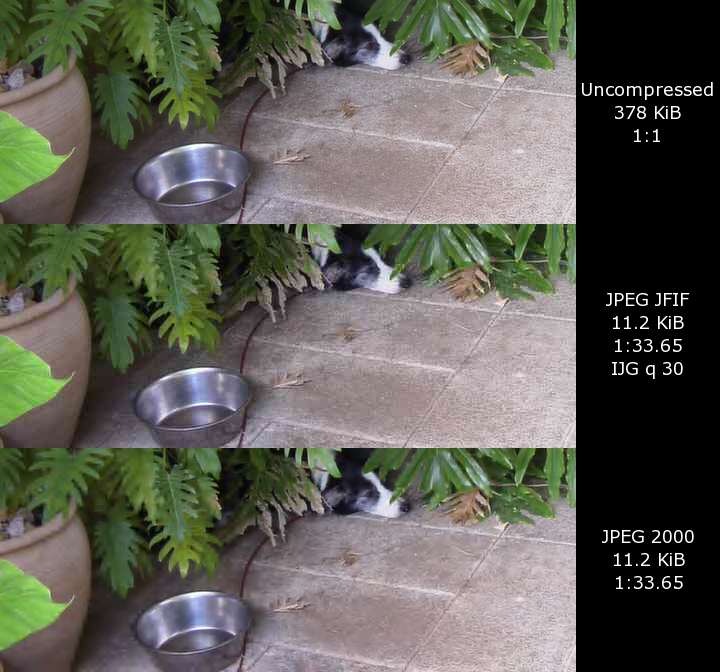
The Wikipedia page for JPEG 2000, for the past 16 years, has used the same sample image[0] which arguably makes JPEG 2000 look worse than JPEG at the same file size. I wonder how many people that one image alone has put off.

[0]https://upload.wikimedia.org/wikipedia/commons/5/51/JPEG_JFI...

Post reply on HN