Earlier quoted context omitted.
In case anyone was wondering, most SWAT teams do 8-16 callouts a year. Major metropolitan teams might see 50ish on a busy year. The vast majority of these are hostage situations, but bomb situations and active shooters land in there too. https://www.ksl.com/article/46295693/when-swat-teams-are-use...
https://theweek.com/articles/531458/troubling-rise-swat-team... This 2015 article claims 80k deployments per year And I guess it makes little difference whether it’s the SWAT team that shoots you or just regular cops.
U.S. transition to 988 suicide and crisis lifeline begins Saturday
211–220 of 354 posts
Re: U.S. transition to 988 suicide and crisis lifeline begins Saturday
#212Re: U.S. transition to 988 suicide and crisis lifeline begins Saturday
#213Earlier quoted context omitted.
$500 for a specialized vehicle on demand 24/7 with somewhat trained workers who have to deal with undesirable work seems pretty good. Assuming that was under the deductible, so the ambulance provider did not get paid anything else, and $500 was the negotiated pricing for members of your insurance plan.
$500 could be a reasonable fee if it were generally predictable, but you're completely ignoring the fraudulent $12,000 bill and the fact that OP had to sign up for "good" "insurance" to access the real price.
Source: https://www.census.gov/library/publications/2021/demo/p60-27...
Re: U.S. transition to 988 suicide and crisis lifeline begins Saturday
#214Earlier quoted context omitted.
I also wonder what the impacts of having "Placed calls to the suicide hotline" in your permanent record will be on people's lives if they do choose not to take it. With the state collecting that data, your phone company collecting that data, your cell phone OS collecting that data, random apps collecting that data, and who knows who is on the other end of that call and what they're doing with your data. Will you be t…
Absolutely those things can happen, and they should. For example, imagine if an airplane pilot or anyone in a position of being responsible for a mass number of lives has previously called into suicide hotlines. Would you feel secure knowing the pilot of your plane once exhibited suicidal tendencies? I doubt it. Any bits of data we can collect to make accurate assessments should be collected.
For example, resident physicians are known for being pushed to work 80+ hour weeks. Would any of them ever officially admit to having mental health issues? Hell no, and that's a problem from an ethics perspective and a declining level of healthcare, not to mention tragically ironic to boot.
Re: U.S. transition to 988 suicide and crisis lifeline begins Saturday
#215I’ve heard people advise not to call such hotlines because their intervention is not limited to just talking to you. It’s said they often cal the police who stop you by force and often make your life even worse than it was.
"...We are trained to risk assess each and every texter, irrespective of our intuition about their mental state. That means I treat someone testing the system like I would someone who has been flagged as an imminent suicide risk.
Supervisors monitor this evolution of the conversation closely.
The assessment is important because ultimately the decision to call emergency services comes after that rigorous assessment of the person's suicidal ideation, followed by their plan and access to means, as well as their timeline. If all those criteria are met, I contact my supervisor, and then we work on separation from means. If those criteria are not met, we continue the conversation accordingly.
I have personally walked numerous people back from the edge simply by talking to them and hearing them out; often times, texters deemed imminent risks are capable of staying safe that night after we have come up with a safety plan for them together. Calling EMS is truly a last resort and not an attempt to cast off responsibility.
In the cases when we do call emergency services, it is after we have exhausted all other options. It should be noted that access to geolocation is strictly limited to these supervisors, and in all likelihood is limited to a texter's phone number alone. It's not like they have a backdoor into AT&T, and the supervisor must make a call to emergency services directly. From what I can tell, very little information is given back to CTL. On occasion, I can see a timeline that EMS was dispatched but rarely do I ever learn about the outcome.
The success of the platform is that we can work with people to find them their own solutions. CTL was not a viable intermediary for calling 911."
I've volunteered nearly 300 hours, most of those were dead of night EST. I've spoken to several hundred people, and maybe a couple dozen have been flagged as imminent risk. Of those flags, I can count on one hand those who have required a call to EMS. Mostly, I'm able to come up with a safety plan with them and get them through the night.
Re: U.S. transition to 988 suicide and crisis lifeline begins Saturday
#216Earlier quoted context omitted.
I also wonder what the impacts of having "Placed calls to the suicide hotline" in your permanent record will be on people's lives if they do choose not to take it. With the state collecting that data, your phone company collecting that data, your cell phone OS collecting that data, random apps collecting that data, and who knows who is on the other end of that call and what they're doing with your data. Will you be t…
Absolutely those things can happen, and they should. For example, imagine if an airplane pilot or anyone in a position of being responsible for a mass number of lives has previously called into suicide hotlines. Would you feel secure knowing the pilot of your plane once exhibited suicidal tendencies? I doubt it. Any bits of data we can collect to make accurate assessments should be collected.
I really don't care, to be honest. As long as the problem has been fixed through major changes to lifestyle and/or medication, plus enough time has passed to ensure that the person is stable, the fact that they once called a hotline is irrelevant.
I might not be as vehemently against the collection of this data if there were a strict retention limit written into law, perhaps 3-5 years, alongside a solid plan to properly enforce that limit and to keep records confidential.
As written, your comment implies that people can never change and situations can never improve. People regularly change their lives drastically, especially young adults whose brains are not even fully done developing.
> Any bits of data we can collect to make accurate assessments should be collected.
I doubt that the fact that someone called into a hotline twenty years ago would allow anyone to make an accurate assessment as to their fitness to fly today. It would likely be used as a tool of oppression, and it would make people think twice before choosing to risk their future career prospects by calling into the hotline in the first place.
Permanently barring hotline callers from becoming pilots makes about the same amount of sense as permanently barring people who have ever had a broken arm from becoming pilots.
Re: U.S. transition to 988 suicide and crisis lifeline begins Saturday
#217Earlier quoted context omitted.
My last ambulance trip in the US was billed at $12000. With my (good!) insurance I still had to pay $500.
I find this hard to believe. I work in healthcare, and occasionally see billing numbers as part of my job. Even when we send an air ambulance helicopter to a remote part of the desert, it doesn't cost $12,000. Related to the rest of this thread, a family member was hurt at work about six months ago and needed a 12-mile ambulance ride. The ambulance company billed the company's insurance $1,400. The company's insuranc…
Re: U.S. transition to 988 suicide and crisis lifeline begins Saturday
#218Policing is in such a horrible state in America that an emergency number that excludes police involvement seems increasingly necessary. I wonder if you can get paramedics through this route or if it just rings and you eventually get a counsellor.
Don’t overindex on anecdotes. Policing has problems but in general where police in America have retreated, crime has gone up.
Re: U.S. transition to 988 suicide and crisis lifeline begins Saturday
#219Policing is in such a horrible state in America that an emergency number that excludes police involvement seems increasingly necessary. I wonder if you can get paramedics through this route or if it just rings and you eventually get a counsellor.
I have experience in this field: I ran technology for one of the only hotlines in the US that didn't engage in non-consensual active rescue [0] [1]. I've written about this a little on this site in the past, when Crisis Text Line was caught sharing data. Many, if not most, of these places give the operator full access to your phone number and whatever geolocation data they can get based on that. They also have polici…
edit: why am I being downvoted?
Re: U.S. transition to 988 suicide and crisis lifeline begins Saturday
#220Earlier quoted context omitted.
Policing in the US is shit in part because other social services are under developed that the police have to double for everything. Frankly it’s crisis too because doing social services and policing is a shit job that isn’t going to attract the best and brightest. Add to that it’s a job for Iraq and Afghanistan vets probably suffering from their share of PTSD, and you get a pretty volatile combo
The reason social services are underdeveloped is because police spending has swollen to consume massive portions of municipal, state, and federal budgets. This is thanks to decades of conservative politicians beating the drums of "wasteful" welfare spending and "fighting crime by spending more on police." Forty percent of Uvalde's budget was going to the police - $4.3M for 15,000 residents, or $2900/person. That does…
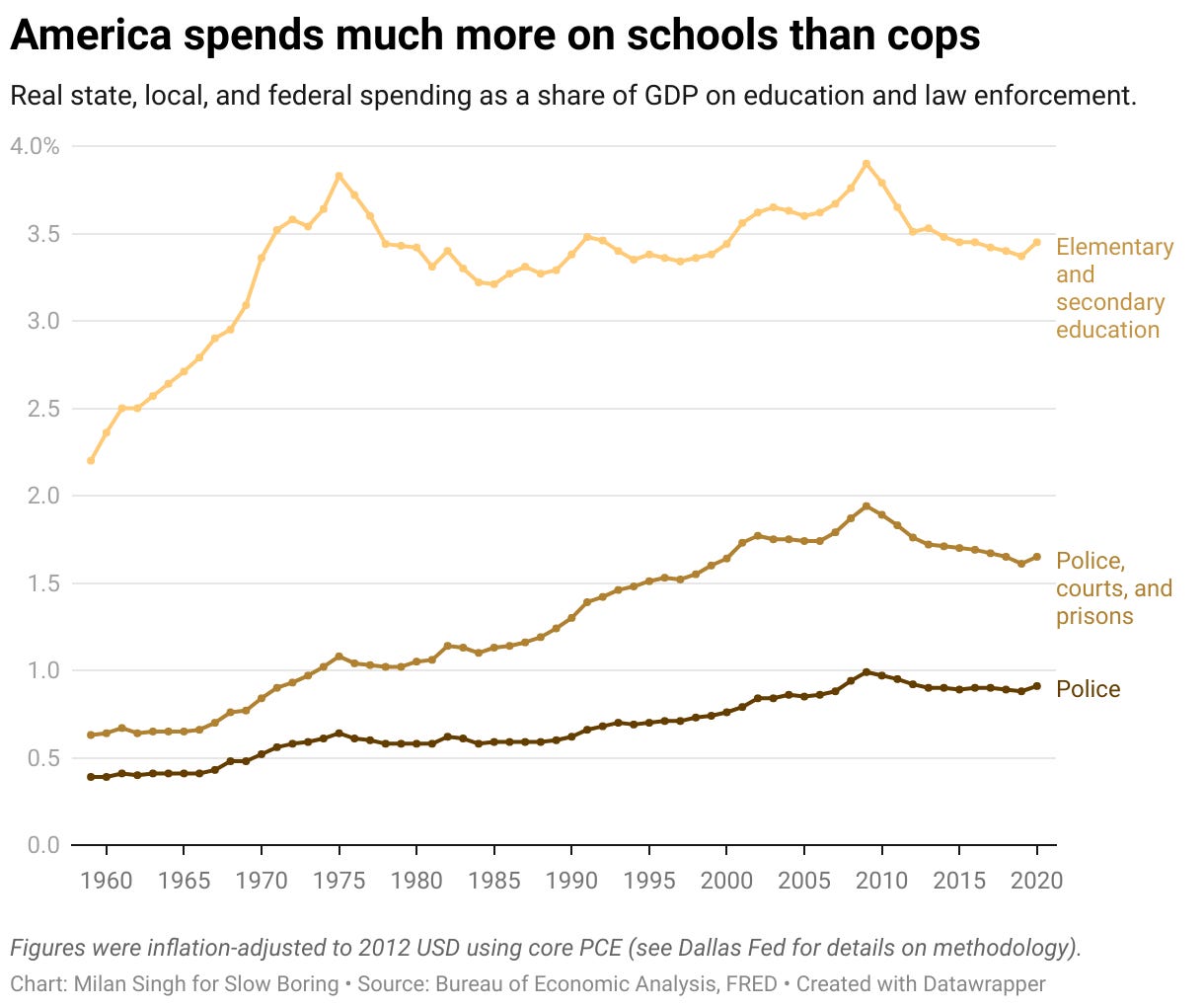
https://substackcdn.com/image/fetch/f_auto,q_auto:good,fl_pr...
Second, spending on police has actually been trending down for quite some time:
https://fred.stlouisfed.org/graph/?g=Q7WX
And the number of officers per capita has remained remarkably stable over time (contra suggestions that the number of police has risen dramatically). See Table 1 in this PDF:
https://bjs.ojp.gov/content/pub/pdf/nsleed.pdf
Third, we spend much more on schools than on police:
https://substackcdn.com/image/fetch/f_auto,q_auto:good,fl_pr...
Despite the prevalence of memes to the contrary:
https://twitter.com/RCAFDM/status/1532739121562656770?s=20&t...
https://twitter.com/CharlesFLehman/status/153270044228675993...
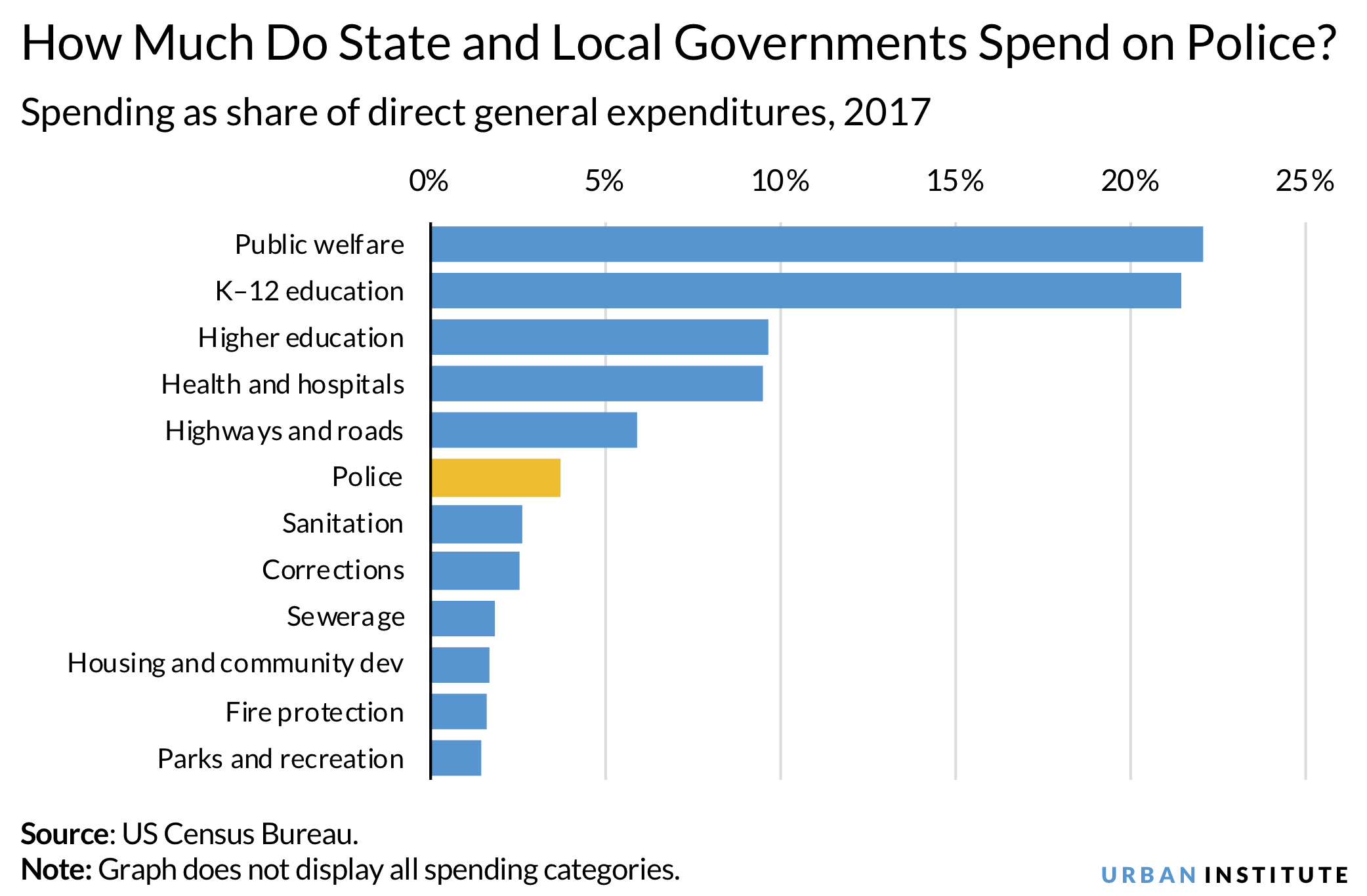
Fourth, because spending in the U.S. is split amongst federal, state, and local governments, looking purely at local budgets is often more obfuscatory than explanatory. If we look at combined state and local spending, the picture looks quite a bit more reasonable:
https://www.urban.org/sites/default/files/2020-06/state_loca...
That graph in words:
> Overall, police spending was 4 percent of state and local direct general expenditures in 2017. (This data included federal transfers; if we look at just own-source funds, police spending was 5 percent of state and local expenditures.)
> This is far less than what state and local governments spent on public welfare (mostly Medicaid in the Census accounting) and K–12 education, but more than many other services, including housing and community development (and others not listed on the chart).
Source: https://www.urban.org/urban-wire/what-police-spending-data-c...
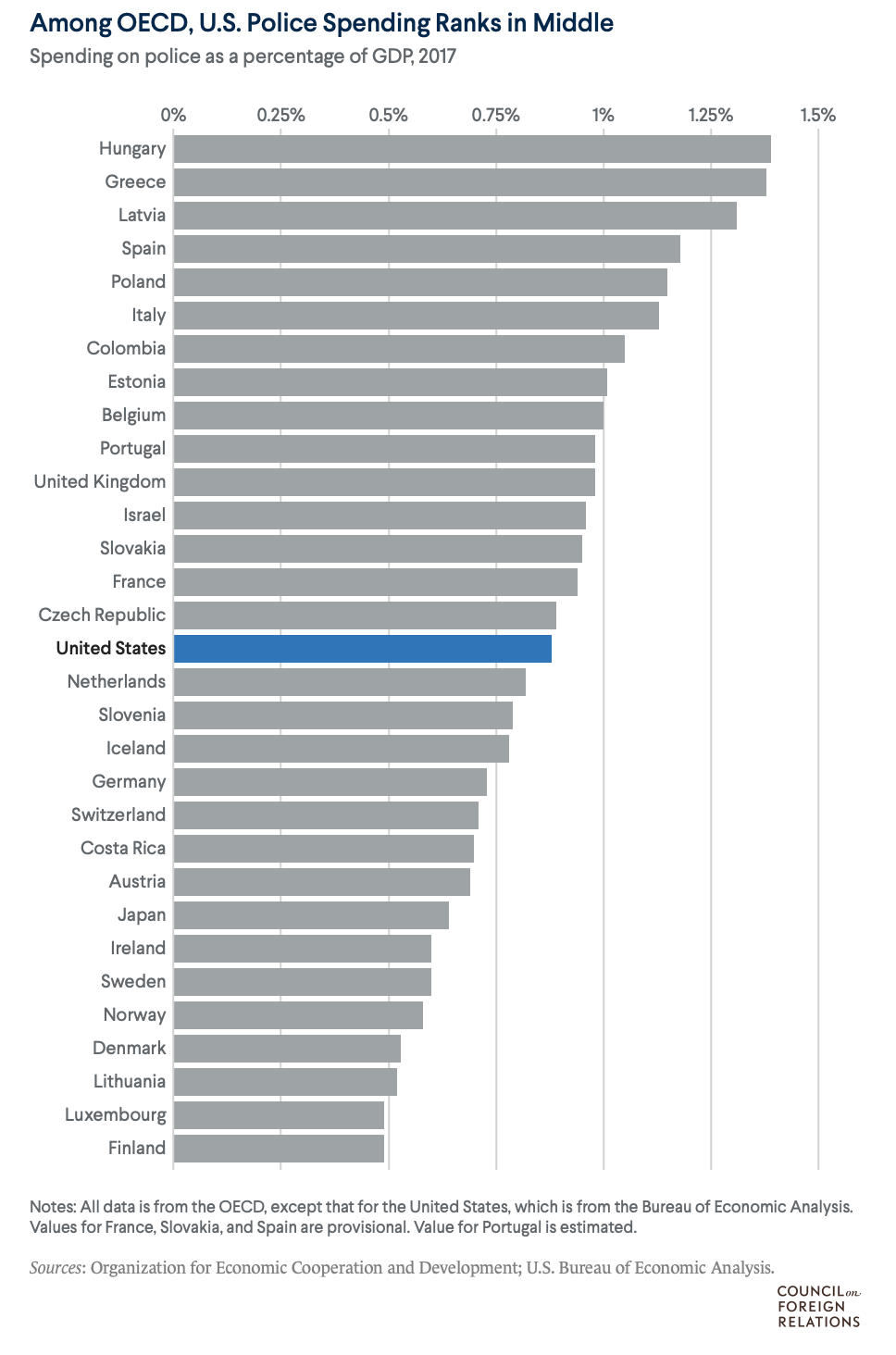
Obviously people can disagree about how much we should spend and on what, but, generally, the U.S. spends a pretty typical amount on police, that amount is significantly less than on various other social services, and the amount has largely not been growing.