Earlier quoted context omitted.
That just sounds like banking with extra steps.
Spoken like someone who doesn't know the steps involved in opening a bank account (hint: many people can't), accepting online payments using a bank account (hint: hope you have deep pockets), using a bank for sending interbank/international payments (hint: might need to collect a page worth of information from your recipient. second hint: their bank might refuse to receive the payment), etc. Bonus steps: do all the a…
The Lightning Network: Turning Bitcoin into Money
291–300 of 448 posts
Re: The Lightning Network: Turning Bitcoin into Money
#292Earlier quoted context omitted.
How is this better than Visa and MC?
Visa and MC could be L5 networks for Bitcoin, why not? Lightning is lower level and more decentralized, but it doesn't solve issues like dispute arbitration which credit cards do.
Yes, being able to settle across currencies pretty efficiently is nice, but the real value is just what you mention: Dispute arbitration and managing liability in case of fraud.
Re: The Lightning Network: Turning Bitcoin into Money
#293When will the blockchain ecosystem provide something with that "WOW I need this in my life right now" factor to the average user? Google went from a research project to incorporated and usable on the internet in roughly two years with a total investment of about $2mm in 2022 money. Let's just say the pace of innovation had some serious roadblocks at the time (they literally had to build their own servers and host the…
Re: The Lightning Network: Turning Bitcoin into Money
#294Earlier quoted context omitted.
Are you familiar with OSI and TCP/IP architecture? Because it definitely works in layers.
Scaling is not a goal of the OSI model, and TCP/IP predates (and does not adhere to) the OSI model anyway. For insight into how and why this came about, I recommend Padlipsky's "The Elements of Networking Style."
"A really vicious critique of the misguided ISO networking standards attempt, written when the 'OSI model' was trendy & lots of people were babbling about the sacred seven layers."
https://news.ycombinator.com/item?id=19866389
Pfff, TCP/IP will never succeed. It doesn't have enough layers! /s
https://archive.org/details/elementsofnetwor00padl
"The Book": The Elements of Networking Style: And Other Essays & Animadversions of the Art of Intercomputer Networking, by M. A. Padlipsky (1985)
The World's Only Know Constructively Snotty Computer Science Book: historically, its polemics for TCP/IP and against the international standardsmongers' "OSI" helped the Internet happen; currently, its principles of technoaesthetic criticism are still eminently applicable to the States of most (probably all) technical Arts-all this and Cover Cartoons, too but it's not for those who can't deal with real sentences.
Standards: Threat or Menace, p. 193
A final preliminary: Because ISORM is more widely touted than TCP/IP, and hence the clearer present danger, it seems only fair that it should be the target of the nastier of the questions. This is in the spirit of our title, for in my humble but dogmatic opinion even a good proposed Standard is a prima facie threat to further advance in the state of the art, but a sufficiently flawed standard is a menace even to maintaining the art in its present state, so if the ISORM school is wrong and isn't exposed the consequences could be extremely unfortunate. At least, the threat / menace paradigm applies, I submit in all seriousness, to protocol standards; that is, I wouldn't think of being gratuitously snotty to the developers of physical standards -- I like to be able to use the same cap to reclose sodapop bottles and beer bottles (though I suspect somebody as it were screwed up when it came to those damn "twist off" caps) -- but I find it difficult to be civil to advocates of "final," "ultimate" standards when they're dealing with logical constructs rather than physical ones. After all, as I understand it, a fundamental property of the stored program computer is its ability to be reprogrammed. Yes, I understand that to do so costs money and yes, I've heard of ROM, and no I'm not saying that I insist on some idealistic notion of optimality, but definitely I don't think it makes much sense to keep trudging to an outhouse if I can get indoor plumbing . . . even if the moon in the door is exactly like the one in my neighbor's.
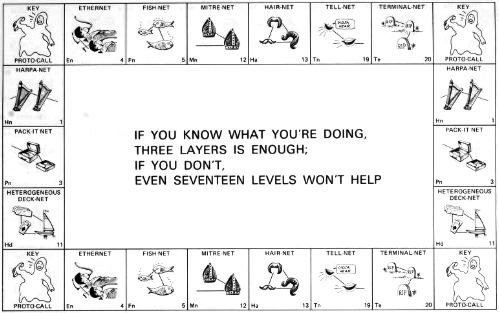
Appendix 3, The Self-Framed Slogans Suitable for Mounting
https://donhopkins.com/home/Layers.png
IF YOU KNOW WHAT YOU'RE DOING,
THREE LAYERS IS ENOUGH;
IF YOU DON'T,
EVEN SEVENTEEN LEVELS WON'T HELP
https://en.wikipedia.org/wiki/Michael_A._PadlipskyOn the occasion of The Book's reissuance, Peter Salus wrote a review in Cisco's Internet Protocol Journal which included the following observations:
Padlipsky brought together several strands that managed to result in the perfect chord for me over 15 years ago. I reread this slim volume (made up of a Foreword, 11 chapters (each a separate arrow from Padlipsky's quiver) and three appendixes (made up of half a dozen darts of various lengths and a sheaf of cartoons and slogans) several months ago, and have concluded that it is as acerbic and as important now as it was 15 years ago. [Emphasis added] The instruments Padlipsky employs are a sharp wit (and a deep admiration for François Marie Arouet), a sincere detestation for the ISO Reference Model, a deep knowledge of the Advanced Research Projects Agency Network (ARPANET)/Internet, and wide reading in classic science fiction.
In a lighter vein, The Book has been called "... beyond doubt the funniest technical book ever written."
Re: The Lightning Network: Turning Bitcoin into Money
#295Earlier quoted context omitted.
BTC and a lot of other chains are Level 1 (L1). Final settlement layers for transactions. To compare that to normal banking, your credit card is like an L5. Tons of things go on in-between your CC transactions before its actually settled even if it appears to be instant and final to the end user. Truth is crypto enthusiasts have been overly ambition in this space, insisting a single L1 chain will come along and be th…
> To compare that to normal banking, your credit card is like an L5. Could you tell us what L1, L2, L3, L4 are in a credit card example?
L1: Central bank (implements monetary policy)
L2: Member banks (have accounts at the central bank)
L3: Non-member banks
L4: Clearing house, SWIFT, etc. for interbank payments
L5: Credit card networks
Re: The Lightning Network: Turning Bitcoin into Money
#296Earlier quoted context omitted.
tired and copypasta-like impulsive response written in hysterics is why you're getting downvoted
It's only tired and copypasta-like because it can't be refuted. He's right. Cryptocurrency had it's shot, here's what we got out of it: 1. People trying to make a currency or interoperable token that they can directly or indirectly profit from 2. People trying to replace traditional object-relational databases or P2P networking with the Blockchain Neither of those are particularly meaningful to the average person. Th…
Re: The Lightning Network: Turning Bitcoin into Money
#297Due to blockchain's architectural shortcomings, you need to do the transactions off chain. Fine... But crypto-"currencies" are actually highly speculative assets (as South Africa declared today [1]). No bro will spend them - the ideology is to HODL for 100k remember [2]? Earnest patron saints like Laszlo Hanyecz bought two papa john’s pizzas in 2010 for what would be worth today roughly $200,000,000 [3]. They wanted…
Re: The Lightning Network: Turning Bitcoin into Money
#298When will the blockchain ecosystem provide something with that "WOW I need this in my life right now" factor to the average user? Google went from a research project to incorporated and usable on the internet in roughly two years with a total investment of about $2mm in 2022 money. Let's just say the pace of innovation had some serious roadblocks at the time (they literally had to build their own servers and host the…
Yeah sending value through the internet without an intermediary that can't be stopped, confiscated or censored is whatever Maybe the problem is that you lack an understanding of what money should be and what problems banking and fiat have?
Tax evasion, money laundering, trafficking, drugs, sanctions evasion etc.
Since the introduction of KYC it's very hard to do any of these in the traditional finance system. And each of them has very serious implications for people's lives.
Re: The Lightning Network: Turning Bitcoin into Money
#299Earlier quoted context omitted.
> The root problem with conventional currency is all the trust that's required to make it work. The central bank must be trusted not to debase the currency, but the history of fiat currencies is full of breaches of that trust. Banks must be trusted to hold our money and transfer it electronically, but they lend it out in waves of credit bubbles with barely a fraction in reserve. We have to trust them with our privacy…
> Banks must be trusted to hold our money and transfer it electronically, but they lend it out in waves of credit bubbles with barely a fraction in reserve. Right, which is why we have regulations on reserve requirements for banks, as well as things like FDIC insurance that guarantees your money in a bank account.
Re: The Lightning Network: Turning Bitcoin into Money
#300When will the blockchain ecosystem provide something with that "WOW I need this in my life right now" factor to the average user? Google went from a research project to incorporated and usable on the internet in roughly two years with a total investment of about $2mm in 2022 money. Let's just say the pace of innovation had some serious roadblocks at the time (they literally had to build their own servers and host the…
Yeah sending value through the internet without an intermediary that can't be stopped, confiscated or censored is whatever Maybe the problem is that you lack an understanding of what money should be and what problems banking and fiat have?
I have friends that have fled war torn countries, dictatorships, etc and I'm glad blockchain now exists for that scenario but again - can that use case (fortunately very rare) justify tens if not hundreds of billions of dollars of investment and over 10 years of work?
This is what I don't understand.
I understand banking has problems (fiat is a much longer debate). What needs to be understood is how many of the 5 billion internet users think the benefit of blockchain justifies throwing out the entire financial (and often legal) system and operating in a parallel one? Not to mention the willingness of average people to essentially be their own bank. For this reason alone I think blockchain is a non-starter for the overwhelming majority of internet users.
How many people care? Answer is: a tiny portion. A very optimistic estimate of total blockchain "users" worldwide is in the range of 100m. 13 years and untold billions of dollars of investment to reach 2% adoption of the internet population isn't exactly a success story that speaks well to the utility of the solutions provided and the real world problems they solve.