Live data from Hacker News

James Webb first images – complete set of high resolution shots now live

webbtelescope.org

391–400 of 410 posts

Re: James Webb first images – complete set of high resolution shots now live

#391

Earlier quoted context omitted.

My understanding is that the IR here is used to see "through" the "smoke", so you can see more details that would normally be obstructed. A good way to see this is comparing it to Hubble [1], a lot of the extra detail you see is thanks to IR letting you see the stars behind. [1] https://johnedchristensen.github.io/WebbCompare/

> to see "through" the "smoke" What causes this "smoke"?

Different wavelengths of light scatter more or less as they pass through gas or dust. This is why the Earth's sky is blue on a clear day, and sunsets are red --- the red light scatters less, blue scatters more.

In smokey or smoggy air, the red light is also scattered.

The "smoke" in a nebula is mostly gas and dust. It's either left-over primordeal matter (hydrogen gas, some helium), or ejecta from novas and supernovas --- star-smoke if you will, though it's created by nuclear fusion rather than chemical combustion.

JWST's IR sensors can cut through that dust more readily than Hubble's optical-range sensors could, and pull out more detail on the dust to boot (based on my own viewing of comparative images).

I'm not sure if the dust is reflecting light or glowing from heat, though my hunch is it's mostly reflecting. Stellar gas that gets hot enough will also glow in infrared (or higher) wavelengths, and that might also be picked up by JWST. I suspect there will be targets demonstrating this in future.
Re: James Webb first images – complete set of high resolution shots now live

#392
post #29

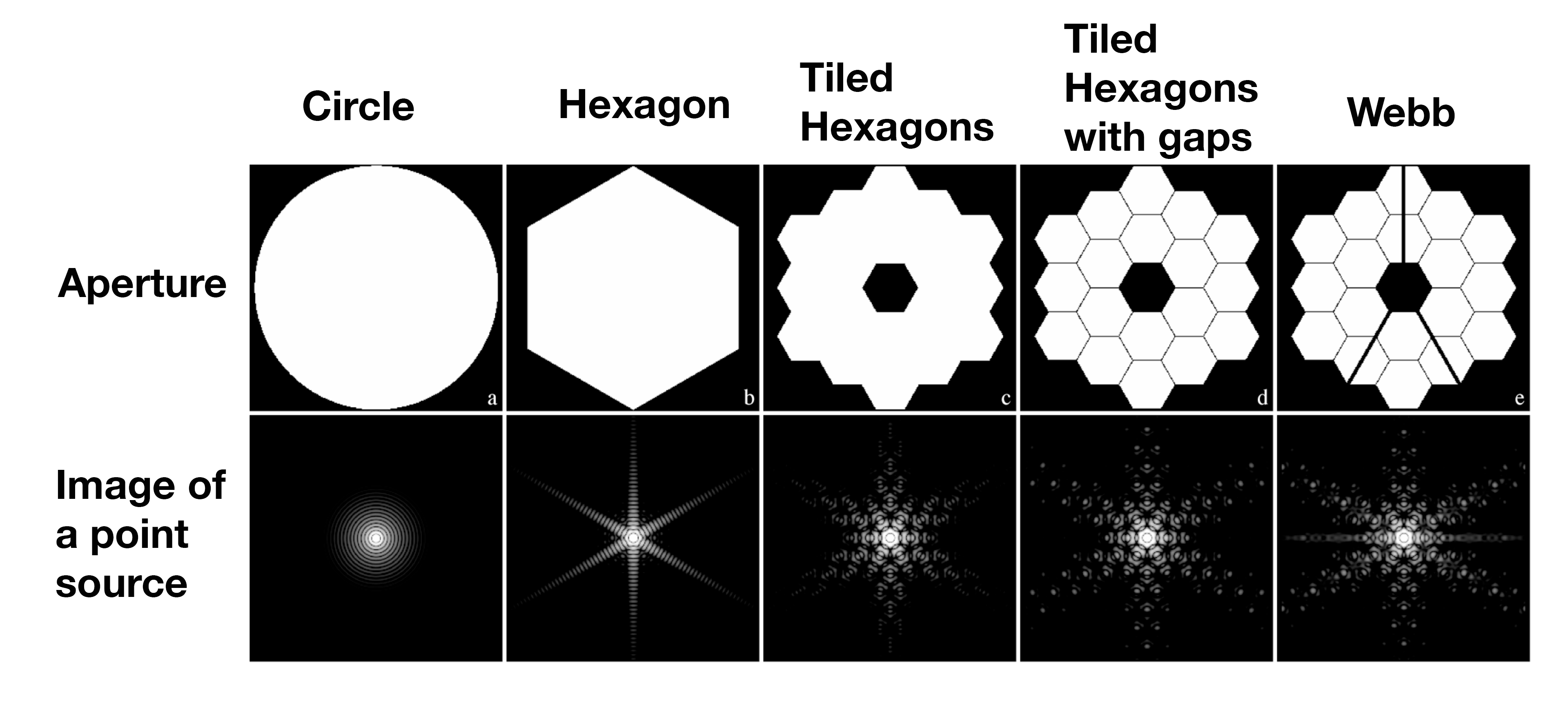
A lot of the pictures have some bright stars with 6 long lens flare like points coming out of them in a consistent pattern. Is that because of the hexagonal shape of JWT's lenses/mirrors?

Yes, it's a combination of both the primary mirror and struts. The JWST website has a very helpful infographic explaining: https://webbtelescope.org/contents/media/images/01G529MX46J7...

Here is an image showing how each part of the distortion comes about - https://bigthink.com/wp-content/uploads/2022/03/FOFC8ZPX0AIB...

Re: James Webb first images – complete set of high resolution shots now live

#393
post #29

Earlier quoted context omitted.

Yes, it's a combination of both the primary mirror and struts. The JWST website has a very helpful infographic explaining: https://webbtelescope.org/contents/media/images/01G529MX46J7...

That's quite exhaustive, but it makes me wonder why isn't anything done to correct for that. Like for example instead of taking one 15h exposure, why not take three 5h exposures and roll the telescope 5 degrees in between, then median filter out the artefacts?

Mainly because it doesn't matter. They're not looking at the stars in the foreground, they're looking at the background which is much further away. The diffraction pattern is actually super dim -- those foreground stars are just very bright due to the exposure.

Re: James Webb first images – complete set of high resolution shots now live

#394
post #247

Earlier quoted context omitted.

It’s real light, just color shifted as the JWST is designed to look at severely very distant and thus red shifted objects. The nebula is however much closer than that. Anyway, that looks like science fiction because science fiction borrowed that look from astronomy. https://en.wikipedia.org/wiki/Nebula

I have been wondering, how does the scale of color shifting relate to the red-shift present in deep-field subject? Idly wondering: are the furtherest objects being captured, so red-shifted, that the translation for human viewing done in these images more or less balances that out, so what we see in the translated images for some thickness of distance-bubble, is what we would see from a much closer perspective with th…

I'm suspecting that there's no hard rule for what colours are assigned to what frequencies, though "more red" in processed images probably corresponds to "longer wavelengths" in captured imaging data. There's no specific red-shift interpretation, though for viewing of distant objects (and galaxies particularly which have reasonably uniform emission spectra) "redder" -> "more distant, receding faster".

What you'd want to see specifically are the emission spectra showing absorption lines for well-known spectral bands. This shows specifically how red-shifted the light is, and is how red-shift was initially detected.

I doubt that there's an intentional mapping of red-shifted appearance + spectral sensitivity to near-and-unadjusted appearance. Though that might be possible.

In practice, I suspect the bands JWST is receiving don't map well to the RGB sensitivity of the human eye, but insteat JWST's sensitivity is tuned to scientific interests and value.

Re: James Webb first images – complete set of high resolution shots now live

#395
post #168
post #64

Direct links -- Stephan's Quintet (NIRCam and MIRI Composite Image): https://stsci-opo.org/STScI-01G7DB1FHPMJCCY59CQGZC1YJQ.png Southern Ring Nebula (NIRCam and MIRI Images Side by Side): https://stsci-opo.org/STScI-01G79R28V7S4AXDN8NG5QCPGE3.png “Cosmic Cliffs” in the Carina Nebula (NIRCam Image): https://stsci-opo.org/STScI-01G7ETPF7DVBJAC42JR5N6EQRH.png Webb's First Deep Field (NIRCam Image): https://stsci-opo.org…

My god, look at the background of the first image at full scale.

In the Ring Nebula image, the two galaxies just kind of casually hanging out on the left side (just above midline), one square on, the other edge on, is pretty impressive.

There are a few others to be found (I suspect image duration is much shorter than for the Deep Field).

Even as far-from-primary-interest-objects, amazing detail.

Re: James Webb first images – complete set of high resolution shots now live

#396
post #79

Not to spoil anything, but anybody else here finding these results quite underwelming?

I guess what I would like to get is some quick analysis showing how much further away Webb has been able to peek in the abyss close to the big bang. I assume from that POV the interesting part will be the red-shift measurement of the reddest galaxies in the deep field. So the pictures are "beautiful" per se, it's the accompanying data that is still missing

Re: James Webb first images – complete set of high resolution shots now live

#397
post #386
post #385

Earlier quoted context omitted.

It doesn’t. It just refutes the claim that nothing matters.

It doesn't refute anything. The point is rather; what matters to you is part of your personal journey. Ultimately it still doesn't matter in the grander scheme, but that isn't the point of enjoying your adventure while you're around. Does the cosmos care if I give my Mother a birthday present or not? Unlikely it does. Do I? Yes, I send one every year. Does it matter then? Not really, but I like doing it because I lik…

I think we nearly agree, but I’d say you’re throwing the baby out with the bathwater.

The bathwater is the notion of a subjective cosmos, some overarching supreme being to whom specific events ought to matter somehow. I’m very happy to throw out that bathwater, along with other theocratic sophistries that still influence our thinking too much. The baby is meaning itself, all of which takes place within the cosmos, and every instance of which is subjectively experienced by some specific subject, by definition. And crucially, these subject–object connections can themselves be observed by third parties as real, objective phenomena through abundant evidence. They are as real as potatoes or sound waves.

This part of your comment feels like a non sequitur:

> Does it matter then? Not really

You just said it matters to you. Then you said it doesn’t ‘really’ matter because it doesn’t matter to…the cosmos as a whole? So what? It doesn’t matter to your toaster either, nor to my cat, but it still matters to you. For something to ‘matter’ there must be some particular object that matters to some particular subject, and in this case the subject is you. Your reason for doing it doesn’t mean it doesn’t matter to you, it’s just an explanation of why it matters to you.

Re: James Webb first images – complete set of high resolution shots now live

#398

Earlier quoted context omitted.

No, there's none of that. These pictures aren't being used for any kind of science. They're 100% PR pieces, made to look pretty - which is fine!

These are Webb's first science images, so published papers will come out of them. Of course, those papers will have additional data and analysis to go alongside it, but they absolutely are looking at details resolved in these specific images, processed in this specific way. So I'm not sure where the sentiment that these are just images for the public is coming from. That's certainly part of why these observations wer…

"but they absolutely are looking at details resolved in these specific images, processed in this specific way."

I don't think you're correct. PR images from telescopes aren't new, so if you are correct then surely you'll be able to find papers based on older photoshopped images from Hubble.

Are you able to find any?

Re: James Webb first images – complete set of high resolution shots now live

#399
post #383

Earlier quoted context omitted.

Nothing matters. You live for a while and then you die, but it sure can be a cool trip getting there!

“Nothing matters” is an easily disprovable claim. I assure you many things matter to me. Mattering is subjective. “Everything as a whole does not matter” or “there is no single ultimate purpose to everything as a whole” are more valid claims, but tautological. Something can only matter to some subject by definition, and ‘everything’ is a magic word that includes every thing, so it can’t matter to anything else, by de…

You sure spent a lot of words to agree with me.

Re: James Webb first images – complete set of high resolution shots now live

#400

Earlier quoted context omitted.

Webb's primary camera is infrared, so there is by necessity a choice to be made with how to present the data for humans who can't see in infrared.

I had always assumed they were doing it completely mathematically though. Like collating spectrometry readings to know what elements were present where and figuring out the temperature for blackbody emission or something, or even just linearly transforming the raw data from the spectrum the telescope can receive to the visible spectrum. Kinda disappointing if it's really just a paint by numbers Photoshop to look nice

Terrestrial cameras don't behave that way. They apply tone curves from the beginning. They have to pick a white balance. They have to cram an HDR signal into an 8-bit image. They have to decide exactly how to process the color- every film stock and digital camera renders color a bit differently, even when ones that are all trying to produce true-color images and there are humans around who can compare it with their own subjective perceptions. The simplest, linearest way to do it is probably wrong, due to mismatches between human color perception and the camera's sensor / film stock. Eg, human rods and cones almost certainly don't have the same frequency response as the color filters inside your camera, and that's just the beginning.

Anyway, this post shows an example comparing a "flat" color composite and one that's been tonemapped etc. This is using Hubble data but it's the same subject as one of the JWST images.

https://www.rocketstem.org/2015/04/20/how-astronomers-proces...

This video goes into some detail about the filters that were used for one of these JWST images:

https://www.youtube.com/watch?v=zAbI8bux-jM

Post reply on HN