The fragmented nature of modern-day railways
hackaday.com
The fragmented nature of modern-day railways
1–10 of 90 posts
Re: The fragmented nature of modern-day railways
#2The real *ways (not just rails, also roads) issue is one: evolution.
We start a project a day, with a certain set of needs and desires. The project takes time to be complete, let's say 10-15-20 years, at the end some parts of the network are still useful and valuable many others are not. Change them is hard, demand again more time, once done (IF done) we end up in the similar departure scenario.
Society does not change that fast in general, but still do. In the past we have followed nature and people have started to follow transport networks, now with climate change, transport tech changes etc we experience issues.
The sole solution is IMO:
- do their best to create free networks, like privileging air and water transports who demand infra but only at their endpoints letting paths evolve much faster and simpler;
- do their best to avoid LARGE infra, preferring capillar ones were surely there would be useless parts but being a small local size and much connected network any segment cost far less so both profitable ones and unprofitable ones can be operated.
In the past we have seen something like this, for rails for instance: http://carfree.fr/img/2015/06/sncf.jpg overall the old network worked LESS well and cost A BIT more, but the old one allow many paths from A to B so allow flexibility, the new one is far more efficient AS LONG AS transportation needs do not change.
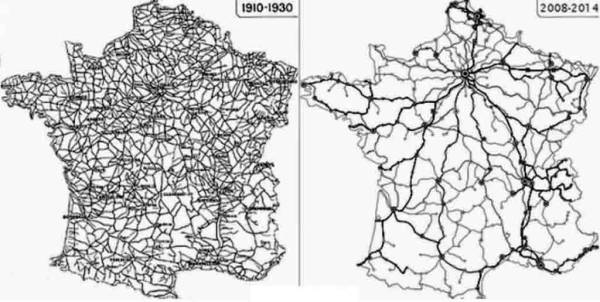
We have seen the very same issue in modern just-in-time manufacturing and we see that solutions found so far are the same: less efficiency traded for more flexibility.
Re: The fragmented nature of modern-day railways
#3An automated system could be made for this.
Imagine two tracks side by side. Now have a mechanism above that lifts goods off one train and into another. The mechanism could work on moving trains such that a 30 mph train could unload all its cargo and have it all loaded into a neighbouring train also moving at 30 mph.
Such a mechanism would be expensive, but only needs to exist at cargo borders, and the cost would be dwarfed by the value of the trade it enables.
Re: The fragmented nature of modern-day railways
#4[dead]
Re: The fragmented nature of modern-day railways
#5An automated system could be made for this. Imagine two tracks side by side. Now have a mechanism above that lifts goods off one train and into another. The mechanism could work on moving trains such that a 30 mph train could unload all its cargo and have it all loaded into a neighbouring train also moving at 30 mph. Such a mechanism would be expensive, but only needs to exist at cargo borders, and the cost would be…
What's the benefit of moving during the operation? It seems like it would add a lot of cost and complexity for no clear benefit.
Re: The fragmented nature of modern-day railways
#6An automated system could be made for this. Imagine two tracks side by side. Now have a mechanism above that lifts goods off one train and into another. The mechanism could work on moving trains such that a 30 mph train could unload all its cargo and have it all loaded into a neighbouring train also moving at 30 mph. Such a mechanism would be expensive, but only needs to exist at cargo borders, and the cost would be…
What's the benefit of moving during the operation? It seems like it would add a lot of cost and complexity for no clear benefit.
There isn't any benefit, it only eats up capacity of two tracks that could be used by other, faster trains.
If you need to move cargo from one train to another, just do it somewhere away from the main tracks.
Re: The fragmented nature of modern-day railways
#7Hm, after reading the title I monetarily thought the article would talk about the implosion of Union Pacific and complications of switching to a different provider. FYI:
https://www.manufacturing.net/labor/news/13118134/union-paci...
https://www.wsj.com/articles/union-pacific-to-cut-nearly-3-0...
https://www.thepacker.com/news/transportation/union-pacific-...
https://www.reddit.com/r/collapse/comments/sd9kqw/union_paci...
https://www.reddit.com/r/CatastrophicFailure/comments/s6c04a...
https://www.theguardian.com/us-news/2022/jan/14/los-angeles-...
https://www.cfindustries.com/newsroom/2022/union-pacific-shi...
https://www.youtube.com/watch?v=YDxp8lUXDz0
Meanwhile at the top:
https://www.youtube.com/watch?v=qF_5jng3RYM
TLDR version. UP switched to some fancy "efficient" system several years ago, laid off thousands of employees. At the time many people predicted collapse of the company in a couple of years. Three years later it is plagued by rampant theft and trash on the tracks. This year it refused to ship fertilizer during planting season. It also refused to ship additives to diesel fuel earlier this year (amidst general truck shipping issues and skyrocketing fuel costs). Meanwhile the CEO is smiling like a Cheshire Cat and giving out Bloomberg interviews about efficient management.
Re: The fragmented nature of modern-day railways
#8So my grandpa was an engineer and I love railways...
"different signaling systems, different voltages for electrical trains" isn't that much of a problem nowadays. There are almost always enough multi-system engines available that can cross borders and cope with those changes. We have a jumble of voltages in Czechia and yet another voltage on our German/Austrian borders, and trains go through without a hitch, not even slowing down, full speed.
A break of gauge is a different beast: a real tough problem. Even the railcars are wider on wide-gauge railways, which means that they cannot pass through some European tunnels etc.
Frankly, the only solution is to re-gauge the entire Ukraine to 1435 mm and introduce a new fleet of railway vehicles there. As an added bonus, that would complicate further Russian invasions in the future, as the Russian army still heavily relies on rail for its logistics.
This will be expensive, but the EU could pay for that, plus a lot of that work could be done by European contractors.
Re: The fragmented nature of modern-day railways
#9An automated system could be made for this. Imagine two tracks side by side. Now have a mechanism above that lifts goods off one train and into another. The mechanism could work on moving trains such that a 30 mph train could unload all its cargo and have it all loaded into a neighbouring train also moving at 30 mph. Such a mechanism would be expensive, but only needs to exist at cargo borders, and the cost would be…
Something like a container crane? I'd argue even that is too complicated.
Bulk cargo like grain is often unloaded like this [1]: doors on the bottom of the wagon that allow dumping the cargo next to the rail, or in some configurations below it. Loading happens by dumping stuff in from the top.
Now it doesn't take much to make a structure to have one train drive below and lightly to the side of another, enabling one train to dump their cargo into the other.
The problem with all those solutions is that they have to be built, and before the war Ukraine had little reason to invest. Shipping bulk goods by ship was cheaper, thus train infrastructure for them was neglected. It's the same story as Europe underinvesting in port infrastructure for unloading oil and lpg because in peace time pipelines were cheaper.
1: https://thumbs.dreamstime.com/b/unloading-crushed-stone-rail...

Re: The fragmented nature of modern-day railways
#10My suggestion is that we build a dedicated freight network of Soviet gauge and SA3 couplers and leave the existing network for passengers.
We're only going to need more capacity for climate-friendly transportation of both passengers and freight, and stronger tracks and couplers for heavier trains is going to help with efficiency of the latter.