Earlier quoted context omitted.
> It’s pretty convenient as the time periods uses the format YYYY-MM-DD/YYYY-MM-DD and I think is easier to mentally parse than MM/DD/YYYY-MM/DD/YYYY Especially for those outside the USA!
As someone who grew up in the US, it's still bizarre as a programmer to have a mixed-significance ordering (MM-DD-YYYY) instead of any consistently-endian ordering (DD-MM-YYYY or YYYY-MM-DD). Out of curiosity, in what order do Europeans verbally say full dates with month names? Or does it vary by language?
Show HN: Markwhen: Markdown for Timelines
31–40 of 93 posts
Re: Show HN: Markwhen: Markdown for Timelines
#32Re: Show HN: Markwhen: Markdown for Timelines
#33Once nice thing about Mermaid is it's built into [GitHub's markdown](https://github.blog/2022-02-14-include-diagrams-markdown-fil...) and has support in Notion
Re: Show HN: Markwhen: Markdown for Timelines
#34This looks neat. I wish it used iso8601 [0] dates. It’s pretty convenient as the time periods uses the format YYYY-MM-DD/YYYY-MM-DD and I think is easier to mentally parse than MM/DD/YYYY-MM/DD/YYYY. Of course I didn’t even know what a solidus (“/“) was until using iso8601. Also, I usually find standards pretty much as overhead, but 8601 seems pretty good as a universal standard. [0] https://en.wikipedia.org/wiki/ISO…
Yeah, so long form 8601 are supported `2022-08-02T23:00:00.000Z - 2022-08-03T00:00:00.000Z: Event` but in general I do need to figure out a way to allow more customizable date parsing.[0] [0] https://github.com/kochrt/markwhen/issues/27
Re: Show HN: Markwhen: Markdown for Timelines
#35Can the renderer be used separately to embed in other editors?
Re: Show HN: Markwhen: Markdown for Timelines
#36Very interesting. Why is there work inside of the education sections of the life timeline? In the project planning example, I could see it being useful to have something like $ref references from Swagger to e.g. reference a duration from a project group into the overall section.
Re: Show HN: Markwhen: Markdown for Timelines
#37Earlier quoted context omitted.
As someone who grew up in the US, it's still bizarre as a programmer to have a mixed-significance ordering (MM-DD-YYYY) instead of any consistently-endian ordering (DD-MM-YYYY or YYYY-MM-DD). Out of curiosity, in what order do Europeans verbally say full dates with month names? Or does it vary by language?
It does vary by language, but Roman languages (French, Spanish, Italian, etc.) say the 4th of July. Same in German. In Polish, it’s the same, except for official matters since 2002, which now follows ISO8601. Even in the UK they commonly say the 5th of May, and not May, the 5th (but it does happen). I can’t talk about other languages.
The only time I see this is in the UK is on movie posters/trailer, e.g. "In cinemas May 5th", which I assume is due to re-using the US material.
PS: 5th of May is a degenerate example, since it's 05/05 regardless of ordering
PPS: 5th of May is also my birthday ;)
Re: Show HN: Markwhen: Markdown for Timelines
#38Someone at Microsoft please please buy/license/implement this for GitHub projects.
Re: Show HN: Markwhen: Markdown for Timelines
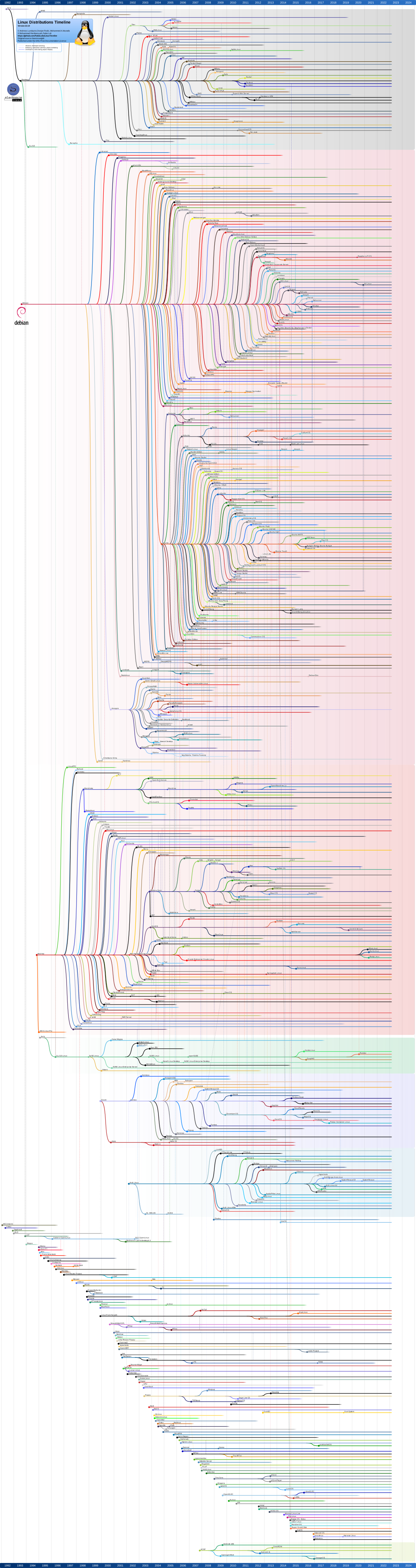
#39[1]https://upload.wikimedia.org/wikipedia/commons/1/1b/Linux_Di...
Re: Show HN: Markwhen: Markdown for Timelines
#40Earlier quoted context omitted.
As someone who grew up in the US, it's still bizarre as a programmer to have a mixed-significance ordering (MM-DD-YYYY) instead of any consistently-endian ordering (DD-MM-YYYY or YYYY-MM-DD). Out of curiosity, in what order do Europeans verbally say full dates with month names? Or does it vary by language?
These replies are fascinating. When saying a date I always say month day year. I hadn’t considered that this might be cultural.