Lynn Conway, co-author along with Carver Mead of "the textbook" on VLSI design, "Introduction to VLSI Systems", created and taught this historic VLSI Design Course in 1978, which was the first time students designed and fabricated their own integrated circuits:
>"Importantly, these weren’t just any designs, for many pushed the envelope of system architecture. Jim Clark, for instance, prototyped the Geometry Engine and went on to launch Silicon Graphics Incorporated based on that work (see Fig. 16). Guy Steele, Gerry Sussman, Jack Holloway and Alan Bell created the follow-on ‘Scheme’ (a dialect of LISP) microprocessor, another stunning design."
THE M.I.T. 1978 VLSI SYSTEM DESIGN COURSE:
https://ai.eecs.umich.edu/people/conway/VLSI/MIT78/MIT78.htm...
A Guidebook for the Instructor of VLSI System Design:
https://ai.eecs.umich.edu/people/conway/VLSI/InstGuide/InstG...
That book and course catalyzed the "Mead–Conway VLSI chip design revolution":
https://en.wikipedia.org/wiki/Mead%E2%80%93Conway_VLSI_chip_...
https://ai.eecs.umich.edu/people/conway/conway.html
https://en.wikipedia.org/wiki/Lynn_Conway
https://en.wikipedia.org/wiki/Carver_Mead
Lynn Conway's "Reminiscences of the VLSI Revolution: How a series of failures triggered a paradigm shift in digital design":
https://ai.eecs.umich.edu/people/conway/Memoirs/VLSI/Lynn_Co...
Also:
https://news.ycombinator.com/item?id=25964865
Here's some historic Vintage VLSI Porn that I posted 6 years ago, from Lynn Conway's famous VLSI Design course at MIT:
https://en.wikipedia.org/wiki/Lynn_Conway
https://ai.eecs.umich.edu/people/conway/conway.html
https://news.ycombinator.com/item?id=8860722
DonHopkins on Jan 9, 2015 | on: Design of Lisp-Based Processors Or, LAMBDA: The Ul...
I believe this is about the Lisp Microprocessor that Guy Steele created in Lynn Conway's groundbreaking 1978 MIT VLSI System Design Course:
http://ai.eecs.umich.edu/people/conway/VLSI/MIT78/MIT78.html
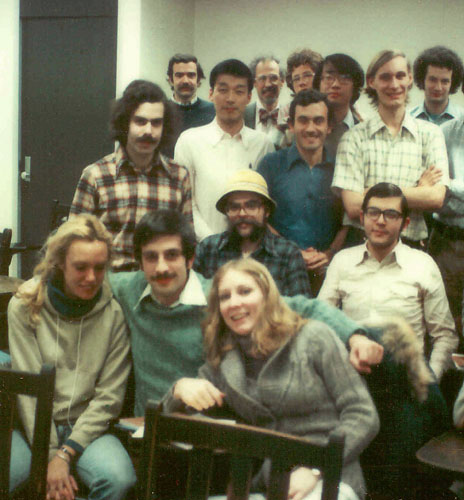
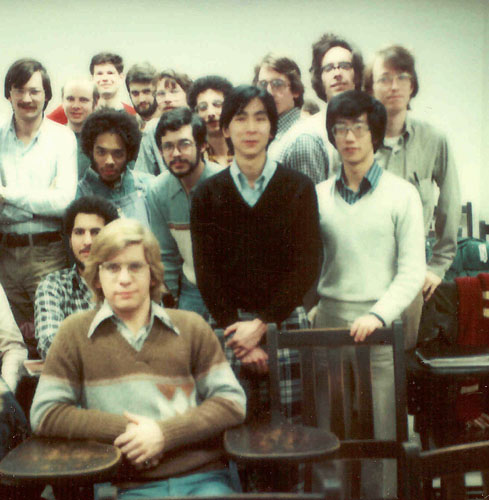
My friend David Levitt is crouching down in this class photo so his big 1978 hair doesn't block Guy Steele's face:
The class photo is in two parts, left and right:
http://ai.eecs.umich.edu/people/conway/VLSI/MIT78/Class2s.jp...
http://ai.eecs.umich.edu/people/conway/VLSI/MIT78/Class3s.jp...
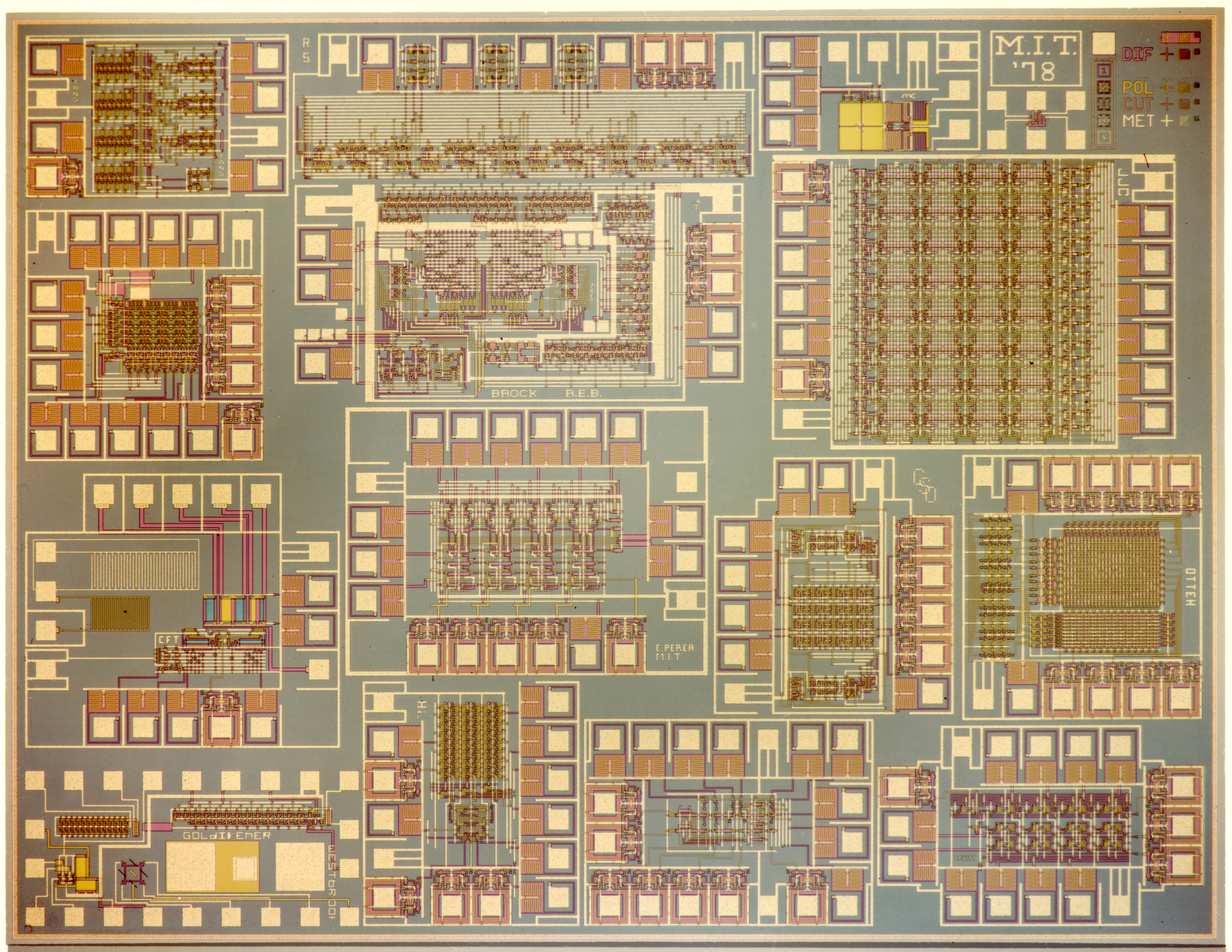
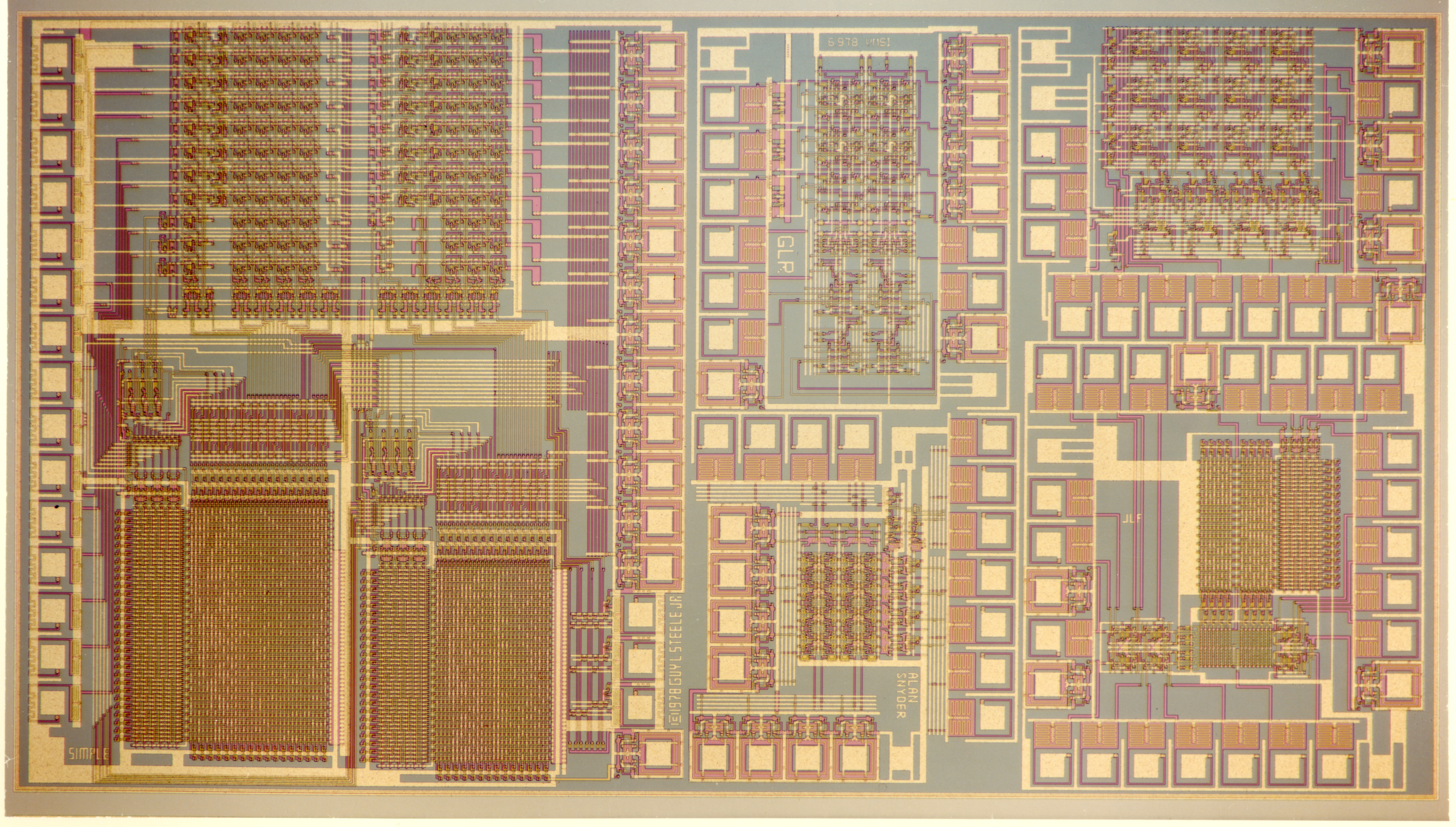
Here are hires images of the two halves of the chip the class made:
http://ai.eecs.umich.edu/people/conway/VLSI/InstGuide/MIT78c...
http://ai.eecs.umich.edu/people/conway/VLSI/InstGuide/MIT78c...
The Great Quux's Lisp Microprocessor is the big one on the left of the second image, and you can see his name "(C) 1978 GUY L STEELE JR" if you zoom in. David's project is in the lower right corner of the first image, and you can see his name "LEVITT" if you zoom way in.
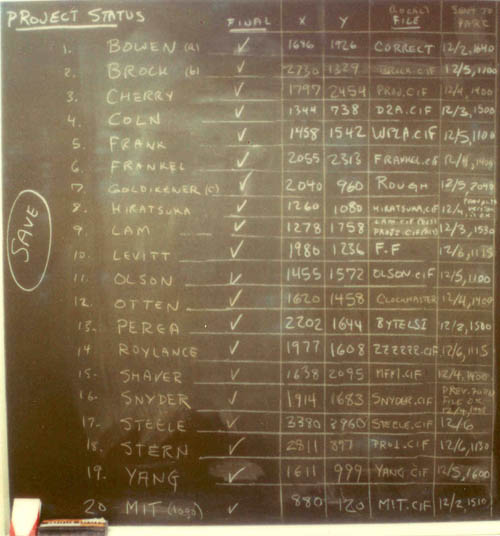
Here is a photo of a chalkboard with status of the various projects:
http://ai.eecs.umich.edu/people/conway/VLSI/MIT78/Status%20E...
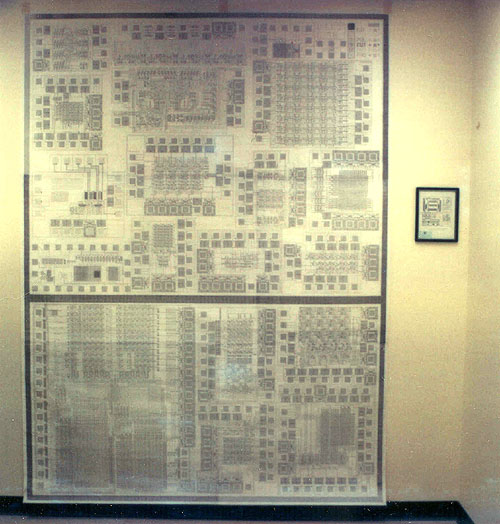
The final sanity check before maskmaking: A wall-sized overall check plot made at Xerox PARC from Arpanet-transmitted design files, showing the student design projects merged into multiproject chip set.
http://ai.eecs.umich.edu/people/conway/VLSI/MIT78/Checkplot%...
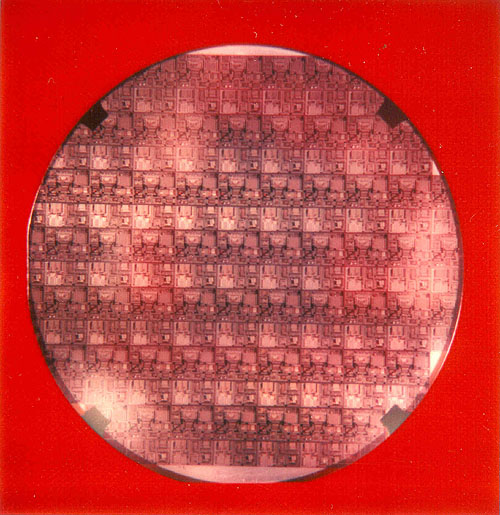
One of the wafers just off the HP fab line containing the MIT'78 VLSI design projects: Wafers were then diced into chips, and the chips packaged and wire bonded to specific projects, which were then tested back at M.I.T.
http://ai.eecs.umich.edu/people/conway/VLSI/MIT78/Wafer%20s....
Design of a LISP-based microprocessor
http://dl.acm.org/citation.cfm?id=359031
ftp://publications.ai.mit.edu/ai-publications/pdf/AIM-514.pdf
Page 22 has a map of the processor layout:
http://i.imgur.com/zwaJMQC.jpg
We present a design for a class of computers whose “instruction sets” are based on LISP. LISP, like traditional stored-program machine languages and unlike most high-level languages, conceptually stores programs and data in the same way and explicitly allows programs to be manipulated as data, and so is a suitable basis for a stored-program computer architecture. LISP differs from traditional machine languages in that the program/data storage is conceptually an unordered set of linked record structures of various sizes, rather than an ordered, indexable vector of integers or bit fields of fixed size. An instruction set can be designed for programs expressed as trees of record structures. A processor can interpret these program trees in a recursive fashion and provide automatic storage management for the record structures. We discuss a small-scale prototype VLSI microprocessor which has been designed and fabricated, containing a sufficiently complete instruction interpreter to execute small programs and a rudimentary storage allocator.
Here's a map of the projects on that chip, and a list of the people who made them and what they did:
http://ai.eecs.umich.edu/people/conway/VLSI/MPCAdv/SU-BK1.jp...
1. Sandra Azoury, N. Lynn Bowen Jorge Rubenstein: Charge flow transistors (moisture sensors) integrated into digital subsystem for testing.
2. Andy Boughton, J. Dean Brock, Randy Bryant, Clement Leung: Serial data manipulator subsystem for searching and sorting data base operations.
3. Jim Cherry: Graphics memory subsystem for mirroring/rotating image data.
4. Mike Coln: Switched capacitor, serial quantizing D/A converter.
5. Steve Frank: Writeable PLA project, based on the 3-transistor ram cell.
6. Jim Frankel: Data path portion of a bit-slice microprocessor.
7. Nelson Goldikener, Scott Westbrook: Electrical test patterns for chip set.
8. Tak Hiratsuka: Subsystem for data base operations.
9. Siu Ho Lam: Autocorrelator subsystem.
10. Dave Levitt: Synchronously timed FIFO.
11. Craig Olson: Bus interface for 7-segment display data.
12. Dave Otten: Bus interfaceable real time clock/calendar.
13. Ernesto Perea: 4-Bit slice microprogram sequencer.
14. Gerald Roylance: LRU virtual memory paging subsystem.
15. Dave Shaver Multi-function smart memory.
16. Alan Snyder Associative memory.
17. Guy Steele: LISP microprocessor (LISP expression evaluator and associated memory manager; operates directly on LISP expressions stored in memory).
18. Richard Stern: Finite impulse response digital filter.
19. Runchan Yang: Armstrong type bubble sorting memory.
The following projects were completed but not quite in time for inclusion in the project set:
20. Sandra Azoury, N. Lynn Bowen, Jorge Rubenstein: In addition to project 1 above, this team completed a CRT controller project.
21. Martin Fraeman: Programmable interval clock.
22. Bob Baldwin: LCS net nametable project.
23. Moshe Bain: Programmable word generator.
24. Rae McLellan: Chaos net address matcher.
25. Robert Reynolds: Digital Subsystem to be used with project 4.
Also, Jim Clark (SGI, Netscape) was one of Lynn Conway's students, and she taught him how to make his first prototype "Geometry Engine"!
http://ai.eecs.umich.edu/people/conway/VLSI/MPCAdv/MPCAdv.ht...
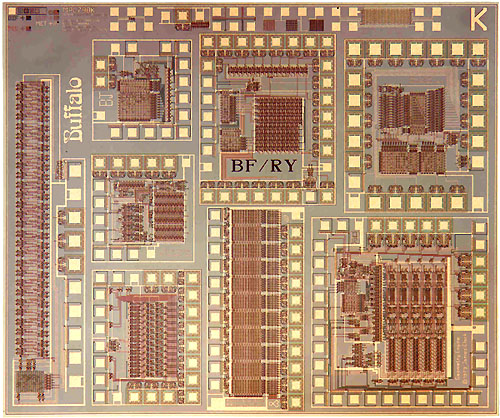
Just 29 days after the design deadline time at the end of the courses, packaged custom wire-bonded chips were shipped back to all the MPC79 designers. Many of these worked as planned, and the overall activity was a great success. I'll now project photos of several interesting MPC79 projects. First is one of the multiproject chips produced by students and faculty researchers at Stanford University (Fig. 5). Among these is the first prototype of the "Geometry Engine", a high performance computer graphics image-generation system, designed by Jim Clark. That project has since evolved into a very interesting architectural exploration and development project.[9]
Figure 5. Photo of MPC79 Die-Type BK (containing projects from Stanford University):
http://ai.eecs.umich.edu/people/conway/VLSI/MPCAdv/SU-BK1.jp...
[...]
The text itself passed through drafts, became a manuscript, went on to become a published text. Design environments evolved from primitive CIF editors and CIF plotting software on to include all sorts of advanced symbolic layout generators and analysis aids. Some new architectural paradigms have begun to similarly evolve. An example is the series of designs produced by the OM project here at Caltech. At MIT there has been the work on evolving the LISP microprocessors [3,10]. At Stanford, Jim Clark's prototype geometry engine, done as a project for MPC79, has gone on to become the basis of a very powerful graphics processing system architecture [9], involving a later iteration of his prototype plus new work by Marc Hannah on an image memory processor [20].
[...]
For example, the early circuit extractor work done by Clark Baker [16] at MIT became very widely known because Clark made access to the program available to a number of people in the network community. From Clark's viewpoint, this further tested the program and validated the concepts involved. But Clark's use of the network made many, many people aware of what the concept was about. The extractor proved so useful that knowledge about it propagated very rapidly through the community. (Another factor may have been the clever and often bizarre error-messages that Clark's program generated when it found an error in a user's design!)
9. J. Clark, "A VLSI Geometry Processor for Graphics", Computer, Vol. 13, No. 7, July, 1980.
[...]
The above is all from Lynn Conway's fascinating web site, which includes her great book "VLSI Reminiscence" available for free:
http://ai.eecs.umich.edu/people/conway/
These photos look very beautiful to me, and it's interesting to scroll around the hires image of the Quux's Lisp Microprocessor while looking at the map from page 22 that I linked to above. There really isn't that much too it, so even though it's the biggest one, it really isn't all that complicated, so I'd say that "SIMPLE" graffiti is not totally inappropriate. (It's microcoded, and you can actually see the rough but semi-regular "texture" of the code!)
This paper has lots more beautiful Vintage VLSI Porn, if you're into that kind of stuff like I am:
http://ai.eecs.umich.edu/people/conway/VLSI/MPC79/Photos/PDF...
A full color hires image of the chip including James Clark's Geometry Engine is on page 23, model "MPC79BK", upside down in the upper right corner, "Geometry Engine (C) 1979 James Clark", with a close-up "centerfold spread" on page 27.
Is the "document chip" on page 20, model "MPC79AH", a hardware implementation of Literate Programming?
If somebody catches you looking at page 27, you can quickly flip to page 20, and tell them that you only look at Vintage VLSI Porn Magazines for the articles!
There is quite literally a Playboy Bunny logo on page 21, model "MPC79B1", so who knows what else you might find in there by zooming in and scrolling around stuff like the "infamous buffalo chip"?
http://ai.eecs.umich.edu/people/conway/VLSI/VLSIarchive.html
http://ai.eecs.umich.edu/people/conway/VLSI/VLSI.archive.spr...