Live data from Hacker News

The case for expanding rather than eliminating gifted education programs (2021)

teachforamerica.org

391–400 of 922 posts

Re: The case for expanding rather than eliminating gifted education programs (2021)

#391
post #282

Earlier quoted context omitted.

> how the US funds public education (K-12) is rather unique. It's done through property taxes essentially. Depending on your state and city your property taxes can vary a lot with the same value property. But what this means is the wealthier localities have more tax revenue and thus better schools. This is an oft repeated myth. In addition to property taxes, school funding is supplemented by state and federal budgets…

From the abstract of the paper you cited: > Yet race remains related to funding disparities and schooling experiences in ways that raise concerns about the role of school finance in perpetuating racial opportunity gaps. What you are pulling out seems to be narrowly-focused and highly-contextualized. Consider [1]: > Property taxation and school funding are closely linked in the United States. In 2018–2019, public educ…
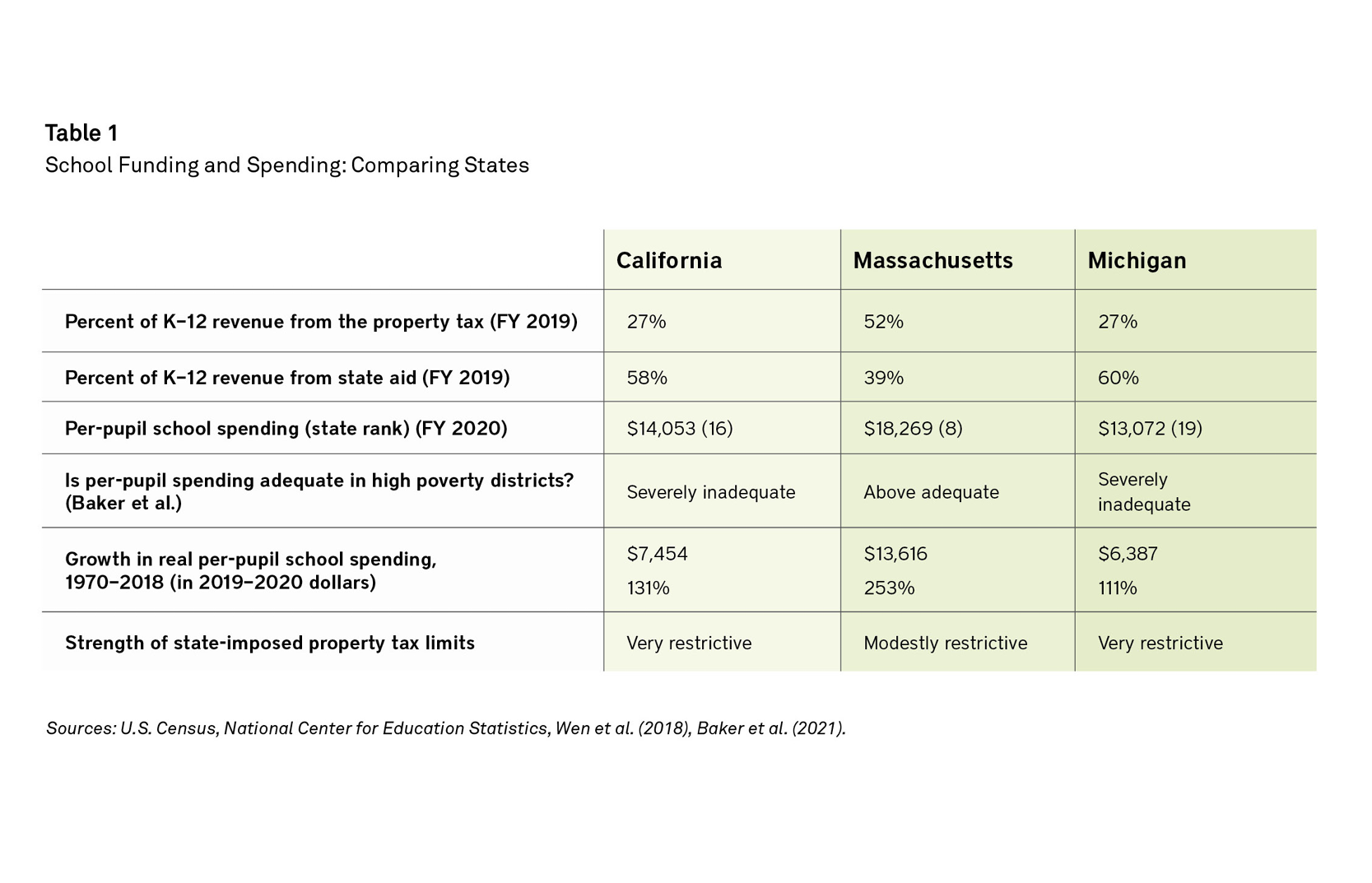
From the article you linked: https://www.lincolninst.edu/sites/default/files/content/04.2...

Compare California and Massachusetts. It seems to demonstrate the point of the poster you replied to. Despite MA relying nearly twice as much on property tax, as state revenue versus California, it seems to have better outcomes. Mostly because as the article discusses, MA appears to use targeted transfers from state revenue to poor districts.

Re: The case for expanding rather than eliminating gifted education programs (2021)

#392
post #194

Earlier quoted context omitted.

It is much more expensive to teach and support the children at lower performing schools than it is at higher performing schools. Lower performing schools are also providing significant front line social support services for the communities they serve, including food, trauma counseling, sometimes medical intervention, extreme behavior management. None of that is cheap. Students/families at higher performing schools ha…

Also you tend to find daycare programs for teenage mothers at poorer schools. Rich parents get their children abortions, while poor children give birth to their babies.

This is an oft-repeated myth, and in fact the opposite is true.

"there are substantial disparities in abortion rates in the United States, with low-income women and women of color having higher rates than affluent and White women"

https://www.ncbi.nlm.nih.gov/pmc/articles/PMC3780732/

Re: The case for expanding rather than eliminating gifted education programs (2021)

#393

Earlier quoted context omitted.

Ever had a 3rd grader threaten to stab you, and look like they really mean it? A second grader call you the c-word? That kind of thing happening basically every day, often multiple times a day? Credible threats of gang violence on a regular basis. School-wide lockdowns with some regularity due to threats of violence, or violence that has actually occurred. Admin with extremely limited options to deal with any of this…

You didn't even get to the covid restrictions, and parents calling teachers anti-American and traitors and Nazis for supporting mask and vaccine mandates. Teachers were getting death threats after being told they were "essential workers" for a year. Meanwhile they have to use their own funds to buy their own body armor, because they have to buy that along with pencils and paper now.

Heh, I omitted that because most of that stuff happens often-enough in our good districts.

And yeah, it's a red state. Even the blue areas are red enough to get plenty of obnoxious assholes harassing teachers.

[EDIT] Downvoters: go talk to some teachers about this topic. I'll wait. It may be a while, because they'll have a lot to say.

Re: The case for expanding rather than eliminating gifted education programs (2021)

#394

Earlier quoted context omitted.

> The supporters of this form of affirmative action recognize that in a system where black/latino/indigenous students have structural disadvantages (poverty, prejudice, health, etc) that any pure meritocracy leads to a system where their racial group possesses disproportionately less power vs their population. You’re describing why you believe it’s okay to discriminate against that Asian student because there’s “too…

> You’re describing why you believe it’s okay to discriminate against that Asian student because there’s “too many yellows, not enough blacks”. Not really. If intelligence is equal between races and a system is an actual meritocracy, then the balance between groups should be the same. One group outperforming indicates a difference in circumstances. If you believe those circumstances aren't because of disadvantages th…

> or that one group has a more effective culture

> Generally, there is a lot of animosity within the black community toward ̶A̶s̶i̶a̶n̶ people who tend to believe any of the above

In my experience, there is much, much discourse within the black community regarding culture, and how it affects success.

Re: The case for expanding rather than eliminating gifted education programs (2021)

#395
post #295

Earlier quoted context omitted.

No. It is not unacceptable when white children have opportunities. It is unacceptable when black children do not.

Nobody is saying "actively remove white children from gifted programs" they're saying, "when more people qualify for gifted programs than can fit in the program, consider including those who have fewer overall opportunities." Those white kids will get other opportunities to be successful, and the non-white kids will get fewer of those opportunities, because society is racist as hell. Therefore, when you have a chance…

That would work better if things were more continuous. Having gifted classes imposes several practical barriers:

- Resource constraints (e.g. can only afford to teach sixty students)

- "catching up"; entering an existing gifted class stream after missing the first few years

- You'd want to select early in the school year. Joining a gifted class in the last few weeks of the year is pointless

- Kids in gifted streams want or are pressured to remain there

Modifications of the current distribution outside of the source and those factors above can result in zero sum outcomes. It's rhetorically useful to wave this off but still a practical concern.

Re: The case for expanding rather than eliminating gifted education programs (2021)

#396
post #137

Earlier quoted context omitted.

> In Washington State, the teachers finally got their "fully funding" proposal enacted, which was supposed to solve all the funding problems, including big raises for teachers. Are you referring to when the state finally complied with court orders that they were illegally and unconstitutionally underfunding public schools? (A lawsuit started over a decade before and decided over a half a decade before action was take…

To make a compelling case that funding matters to outcome you really need to detail how a lack of funding hurts the learning process. Are the teachers bad teachers, and more pay will recruit better teachers? I'm not sure how many teachers enter the profession for the money to be honest. I'm sure they would like pay, but I'm not really of the mind that the curre nt crop of teachers are on average bad. Do kids not have…

> I'm not sure how many teachers enter the profession for the money to be honest

Few enter for money, but many leave because of it.

Re: The case for expanding rather than eliminating gifted education programs (2021)

#397

Alright, I don't imagine this will be a common take here but here goes. I am a product of the New York City public school system. I have spent the majority of my life as a student in it. The New York city public school system is both the largest public school system in the country and the most segregated. The argument about removing gifted programs are built on the faulty assumptions that the students in those progra…

This is where I think things are kind to vary wildly between different regions and districts so we have to be specific make sure we are comparing apples to apples. A gift program like you describe “by name only” isn’t a gifted program at all, that doesn’t mean “real” ones don’t exist. It’s like saying the funding for baseballs is not producing any baseball players meanwhile they only use the baseballs for playing tennis.

Re: The case for expanding rather than eliminating gifted education programs (2021)

#398

Earlier quoted context omitted.

The property tax leading to funding differences is part of the puzzle, but not all of the puzzle. In my random neck of the world we have roughly 4 school districts. 1) Public school 1. Covers most of the black and brown students of the area. 2) Public school 2. Covers most of the lower to middle class white students of the area. 3) Public school 3. Covers most of the higher class white students, especially families o…

Even when you have poorer families who value the better education their children could receive at option 3, the transportation hurdle can be huge. Often they may lack reliable transportation of their own or work at a job or jobs that don't offer the kind of flexibility in the workday that white-collar workers tend to have.

It isn't just the flexibility that accounts for the differences in education. Time spent by parents, with children, on education helps account for test scores and grades. Lower income parents often have to work more hours to meet the basic needs and have a lower educational background to help their children with schoolwork.

A study showed that even having a home library would be beneficial to children in a myriad of ways, which isn't as feasible to a low income family who isn't rent stable.

https://www.jcfs.org/blog/importance-having-books-your-home#....

Re: The case for expanding rather than eliminating gifted education programs (2021)

#399
post #194

Earlier quoted context omitted.

It is much more expensive to teach and support the children at lower performing schools than it is at higher performing schools. Lower performing schools are also providing significant front line social support services for the communities they serve, including food, trauma counseling, sometimes medical intervention, extreme behavior management. None of that is cheap. Students/families at higher performing schools ha…

The lower performing schools also tend to be older and require more maintenance and repairs than newer schools in wealthier areas. Not all of that additional per-pupil funding makes it to the classroom.

The study I linked (https://journals.sagepub.com/doi/full/10.1177/23328584198724...) addresses this in table 1, page 8. Surprisingly, Black pupils get on average $10 less "infrastructure" expenditures, and $150 more "instructional" expenditures compared to White. The table breaks the spending down into 5 different categories, but in all of them, the differences are negligible. The $150 instructional expenditure difference is the largest.

Re: The case for expanding rather than eliminating gifted education programs (2021)

#400

Earlier quoted context omitted.

What makes it so bad, and what would be a better way?

I don't have a great alternative in mind, but here is why it's not a good measure: suppose I take any school, then give the teachers a pay raise or a pay cut of X%. Nothing has fundamentally changed about the school, but per student expenditure has gone up or down, respectively, depending on which direction the salary adjustment was.

If you increase or decrease the pay of the teachers, I would expect to see an outcome on student educations over the long term.

For example, if District X pays better than neighboring district Z, District X will most likely have greater chance of hiring teachers in both districts, letting them choose the most qualified. Resulting in the school with higher salaries naturally getting more teacher candidates to choose from.

While some expenditures might not have a direct impact on student educations, they still have some effect. Another one would be - a school investing in a new Air conditioning and filtration system, students are probably going to have an easier time learning when they don't have to worry about being too hot or too cold in their classrooms.

Post reply on HN