Live data from Hacker News

What a gas stove ban means for restaurants

latimes.com

481–490 of 614 posts

Re: What a gas stove ban means for restaurants

#481

Earlier quoted context omitted.

My preference for electric (although not a dealbreaker, my condo has a gas stove) is solely because they're so much easier to clean. Having an entirely flat stovetop is very relaxing.

> Having an entirely flat stovetop is very relaxing. That sounds like an induction stovetop (which is electric). Those are nice and becoming more common, but they cost more. The majority of electric stove top ranges are like this: https://www.istockphoto.com/photo/corroded-kitchen-electric-... Not exactly flat.

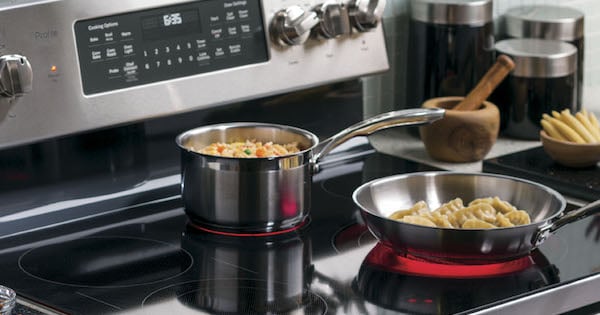
I have a flat glass electric stovetop, not induction. They seem to be becoming more common from what I've seen.

Re: What a gas stove ban means for restaurants

#482

Earlier quoted context omitted.

My preference for electric (although not a dealbreaker, my condo has a gas stove) is solely because they're so much easier to clean. Having an entirely flat stovetop is very relaxing.

> Having an entirely flat stovetop is very relaxing. That sounds like an induction stovetop (which is electric). Those are nice and becoming more common, but they cost more. The majority of electric stove top ranges are like this: https://www.istockphoto.com/photo/corroded-kitchen-electric-... Not exactly flat.

These are common and cheap:

https://blog.bellinghamelectric.com/hs-fs/hubfs/Above%20the%...

Not induction, so not the same plusses, but the flat stovetop thing is nice, even for an old gas head like me.

Re: What a gas stove ban means for restaurants

#483

It seems like an alternative might be to use induction to warm a small heat exchange device, then blow air through it so that extremely hot air similar to a gas flame comes out. Probably some engineering would be needed, but not that much. There are already serious problems with water vapor condensation from burning natural gas so this could potentially be a superior alternative with more opportunities for controllin…

No point to induction then. Just use a resistive element. Seems like it would be hard to heat the air fast enough to compete, but who knows.

This is basically my holy grail electric stovetop. I want a ring coils just like in my broiler sitting just below a normal stove grate because heating the air is basically the only way to get even heat distribution.

Induction can also do that i know but I’m not really a fan of my stovetop being basically not user serviceable and a sealed box of electronics and glass.

Re: What a gas stove ban means for restaurants

#484

Earlier quoted context omitted.

Same way planting a seed today will give you a tree in 20 years. Existing infrastructure is emitting CO₂. The stuff we replace it with won't. The gas pipes that are shut off will no longer leak methane. The next century will be dominated by how we deal with the last century's monumental carbon emissions. We went from 300 to 400 ppm by burning immense amounts of fossil fuels. To go from 400 back to 300 will take a bit…

I can guarantee you that the fabrication / transportation / installation of a new electric unit far outweighs using the existing gas unit until end of life in terms of CO2 emissions. No different than diving a old truck vs buying a new tesla. Net negative.

> in terms of CO2 emissions

CH4 is the larger concern with natural gas

This paper explains it:

https://pubs.acs.org/doi/10.1021/acs.est.0c00437

Re: What a gas stove ban means for restaurants

#485
post #355

Earlier quoted context omitted.

Give me the data where it says how much gas stoves contribute to climate change. It's probably so insignificant that it's purely a point for virtue signaling. I've had a gas stove for years and I still haven't needed to refill the tank, and it's not even that big of a tank. Shipping your new induction stove will probably use more gas than you will in a decade of cooking. Induction stoves can't be used for things like…

The problem with this point of view is that each contributor to climate change, by itself, is not especially significant. So if we dismiss each individually as being insignificant, we end up doing nothing about any of them. That’s my perception anyway, if you know of the big, highest priority climate change contributor that should be focused on before the smaller things, please let me know!

Yes, the United States military is the biggest institutional carbon emitter in the world.

If we're not doing anything to eliminate the military industrial complex, we're not serious about climate change, either.

Re: What a gas stove ban means for restaurants

#486
post #6

I've got a Control Freak, probably the highest end induction cooktop available for a home chef, and is even used in 3 michelin star restaurants like Alinea. It's amazing for consistency, holding temperature, and a dozen other things. It's quite responsive in general! But I still reach for my Iwatani butane stove and copper saucepot sometimes. These are still significantly more responsive even than a top of the line i…

right now, there are thermal properties around materials like copper which will not work with induction that mean there are things that simply can't be done with them, and resistive electric is horribly non-responsive. As it happens, the latest installment of Technology Connections [1] does direct comparisons of the time required to boil a volume of water on various cooktop technologies. The winner was a cheap electr…

Gas stove pans should really be more like jet boil pots with fins

Re: What a gas stove ban means for restaurants

#487

Earlier quoted context omitted.

They are faster to heat than gas since they can deliver all energy directly to the pan, whereas gas wastes ~75% of the energy heating the surrounding air. They boil water much faster than even an electric kettle for this reason. Pot handles don't get hot from the hot air going up the side. They are much easier to clean. Spills don't get burnt onto the cooktop. There's no risk of fire or burning oneself. No risk of a…

And when there is a power failure, what then? I live in hurricane country and being without power is a real concern. I happen to have a backup generator which runs on natural gas. But electrical outages are a real thing.

Ironically in today’s world betting on natural gas seems like a losing proposition. I’d feel more comfortable betting on access to electricity than I would betting on access to natural gases.

Re: What a gas stove ban means for restaurants

#488
post #404

Earlier quoted context omitted.

>Look at the classic beer industry... you have/had a crate full of standardized glass bottles, with metal caps and paper labels, you pay some deposit to take the crate and the bottles, you drink the beer, return the crate and the empty bottles to be washed and refilled, get back your deposit (or take a new full crate), and that's it. I'm not sure what time period "classic" implies, but what you described hasn't been…

> I'm not sure what time period "classic" implies, but what you described hasn't been the case for years. It's still the case in many countries for "normal" (non craft, etc.) beers. > I find it strange that you admit this is a thing, but ultimately gloss over it. What really is the TCO of plastic bottles vs glass bottles? It's tempting to conclude that reusing must be better than throwing stuff out, but given the cos…

>Considering that CO2 is not the only thing, and we have problems with microplastics, we should consider that impact too.

Realistically speaking the amount of microplastics being generated from drink bottles is negligible in first world countries. Over there, the overwhelming amount of plastic waste is properly managed (recycled or landfilled), which means they're not sitting in rivers degrading and generating microplastic.

> But we did just that, before china banned import. We ship that stuff over to china "for recycling" and they burn it. Same with e-waste in africa ( https://www.smithsonianmag.com/science-nature/burning-truth-... )

Again, it's more complicated than that. The importers are actually trying to recycle the plastic/e-waste. It's just that through a combination of incompetence/malice, that some of the unrecycleable waste gets improperly disposed.

https://www.npr.org/sections/goatsandsoda/2019/03/13/7025017...

>China had plenty of capacity to handle plastics and lots of cheap laborers to sort the recyclable materials from the nonrecyclable. By 2016, the U.S. was exporting almost 700,000 tons a year to China alone. Overall, China imported 7 million tons from around the world.

>About five years ago, the Chinese government started to worry about all this trash coming in. A lot of the plastic was contaminated with stuff that made it difficult and expensive to recycle – paper, food waste, plastic wrap (which is not recyclable). And some of the plastic was hard to recycle and thus not profitable to import.

I suppose your statement is technically true in the sense that yes, we do ship plastic to china, and yes, they burn some of it, but that statement is still misleading. With the same logic you could also say that we send people to hospitals to die.
Re: What a gas stove ban means for restaurants

#489
post #366

Earlier quoted context omitted.

You could be running gas through fuel cells if you want, still not as efficient as amortizing existing infrastructure. This reminds of the EV debacle, you should be buying a used Prius or walking places if you care about the environment, everything else is just posturing.

The person you're buying that used Prius from, what are they buying? Or: When you purchase that EV, what are you doing with your previous car? 2 different perspectives, both require new stock to enter the market. That new stock should be EV.

Possibly a new Prius, which should be less environmentally destructive to produce given its lower price (this is kinda disingenuous since price is only a rough predictor of env impact, there’s economies of scale, taxes and subsidies, etc) than an EV. Here’s another question though, in a state like CA which wants to shut down its last nuclear plant, has a bad outlook for hydro in the near future, where would you charge this EV? During the day at work?

Re: What a gas stove ban means for restaurants

#490

Earlier quoted context omitted.

> God forbid I spill something in the middle of cooking on induction. Suddenly I have to try to cleanup a hot glass and manage the whole mess. I think you’re overestimating how hot induction stoves get, the element itself doesn’t heat up at all. When you have a significant spill on a gas stove, it can put the flame out partially or entirely, which is much more of a challenge than wiping off an induction element.

Yeah what is 3. This smells like never used induction before.

Or maybe you haven't. You can burn the sh_t out of your fingers on the glass surface of an induction cooktop. The heat does not magically stay in the cooking vessel. It radiates, as heat is wont to do. Voice of experience. I love induction and think it is safer than gas.
Post reply on HN