Live data from Hacker News

Why isn’t new technology making us more productive?

nytimes.com

521–530 of 603 posts

Re: Why isn’t new technology making us more productive?

#521

Earlier quoted context omitted.

Depends on what you mean by async programming. If you literally mean async and await as available in Haskell, Rust, C#, JS, Python etc. Then no that's definitely not the same thing as windows 3.1's cooperative multitasking.

The async and await is just syntactic sugar that makes you more addicted to it.

And structured programming is just sugar over GOTOs.

Polymorphism is just sugar over type inspection and branching.

Recursion-free function calls are just sugar over variable renaming and text movement.

Re: Why isn’t new technology making us more productive?

#522

Because new technology is as Thiel often quips limited to the world of bits rather than the world of atoms. Paul Krugman once asked, if you go into an average house right now and you take out all the screens, could you tell that you're not in the 80s? Gordon in the Rise and Fall of American Growth gives a similar example, what if you went into a time capsule between say 1890 and 1950 compared to 1960 and 2010? In one…

> Paul Krugman once asked, if you go into an average house right now and you take out all the screens, could you tell that you're not in the 80s?

My robot vacs say yes, you can.

By the way, Neato’s robot vac regressed from its peak, completely autonomous models like Signature Pro from 10 years ago, to the cloud only lineups of today.

Sometime during the last 10 years was when data harvesting became more important than real consumer tech.

Peter Thiel and industry counterparts are directly to blame for consumer regression and the “world not changing much”.

Sorry. They don’t get a free pass.

Re: Why isn’t new technology making us more productive?

#523
post #388

Earlier quoted context omitted.

There's also quite a bit more people who travel by airplane today than in the 1930s. This adds complexity in trafficking, which works to slow things down, rather than speed things up. The fact that overall trip times are marginally faster, despite added traffic volume & complexity, largely explains things here. But despite this, I mostly agree with the broader premise.

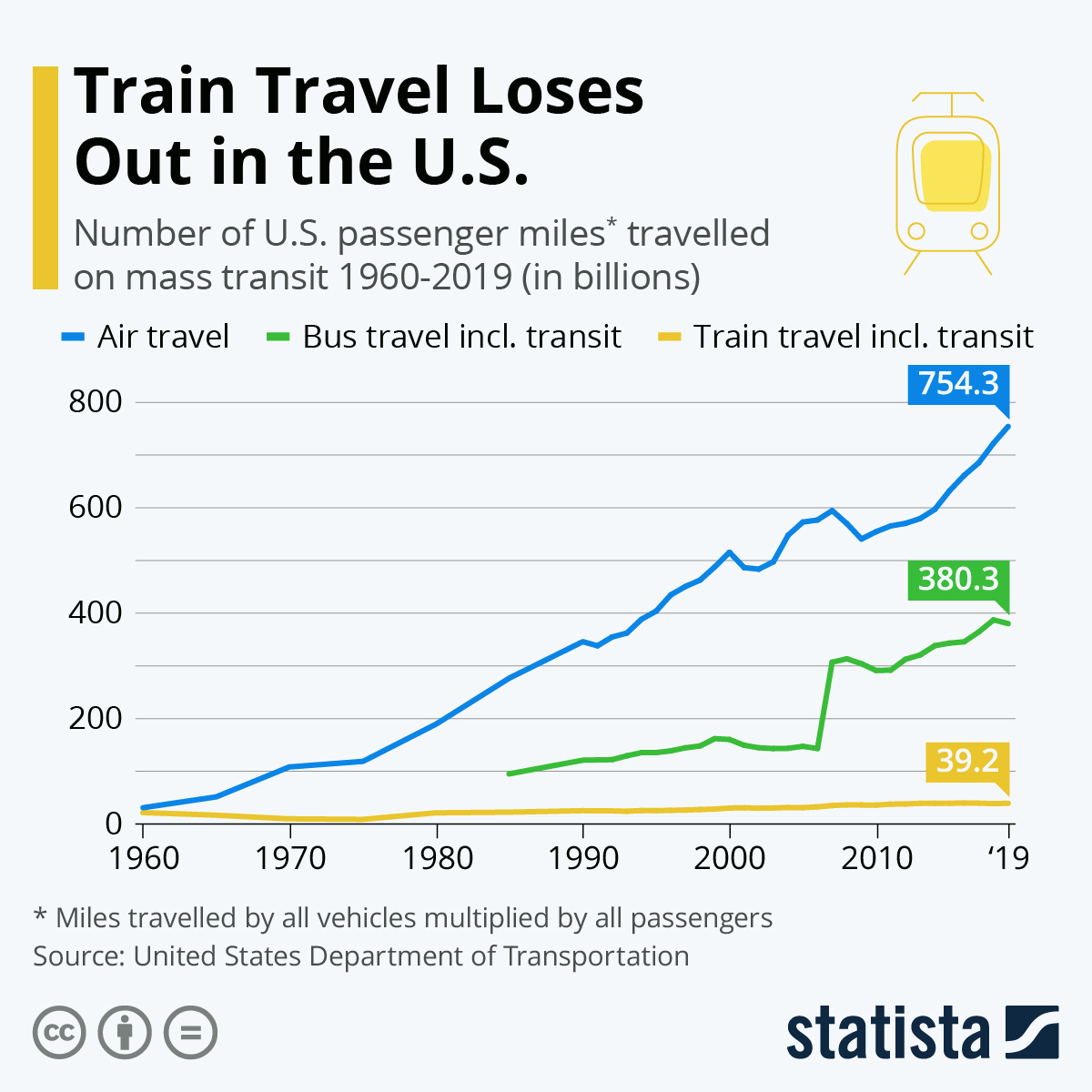
Gordon notes that air passenger miles are effectively an inverse relation to costs. Lower costs -> more passengers. Total passenger miles have been largely flat since 2000. Total departures actually fell during the aughts, along with jet fuel consumption. Some of that's due to more efficient flight booking (appropriately sized aircraft, higher seat utilisation), though a large share is decreased seat pitch, which is…

In case anyone is curious what "largely flat since 2000" looks like:

https://www.economist.com/img/b/1280/670/90/sites/default/fi... https://cdn.statcdn.com/Infographic/images/normal/16947.jpeg

Re: Why isn’t new technology making us more productive?

#524

Earlier quoted context omitted.

What is the point you're trying to make here? That somehow people were better off for having to spend hours thumbing through books instead of searching things on the Web?

The fastest way of learning something is to have a professional teach you. Not even the Internet can beat that. Because of cut backs to education, we have fewer good mentors. Because of loss in manufacturing in N. America there are fewer skilled professionals to pass on their knowledge.

You are making several big logical jumps here that I don't think are connected. This sounds more like a dinner table conversation among some conservatives validating each other's worldviews than a constructive discussion point.

There are arguably more opportunities now for learning things from a professional than in the past.

Public schooling has very rarely been about mentorship anyway. Arguably higher education always was to some extent, but it very often still is; you end up in debt nowadays, but it's still widely accessible.

And I don't see what loss of manufacturing has to do with anything. Some of those manufacturing jobs were in skilled trades, sure, but there are still plenty of opportunities still to learn skilled trades. And even then, I don't think that has much of anything to do with learning things from a book at the library vs. a course on the Web.

Re: Why isn’t new technology making us more productive?

#525
post #318

Earlier quoted context omitted.

Consumption is directly related to production. If I was willing to live on the minimum I could have retired after only a couple years. People retire at 65 now like before, but with a lot more stuff their additional productivity gave them. People seem to like it, so the argument that they shouldn't have so much junk is a bit flat.

Is all that extra stuff making them happier? Or are they just acquiring it to keep up with their neighbours? Maybe someone who retired early on the minimum would genuinely be less happy, but only because of seeing how much "better off" everyone else was.

Yes it makes them happy. Not just the consumption itself, but the act of earning it, and the competition is what some people live for.

Maybe your values are different, but those people don't understand your values any more than you understand theirs

Re: Why isn’t new technology making us more productive?

#526
post #507

Earlier quoted context omitted.

PEX doesn't corrode like copper will. Depending on your local water this may not be an issue you notice, but one house I had it was an issue.

But will PEX harden over the years and eventually crack like most plastics?

Probably not - the plastics harden are a different type with different properties. The industry was burned with early plastics that did have problems and is paying attention to this. PE has been used in plumbing for more than 50 years with no problems, PEX should last even longer.

Assuming you follow directions of course: PEX has zero UV resistance and if exposed to the sun for a couple months will break down and be useless.

Re: Why isn’t new technology making us more productive?

#527

Earlier quoted context omitted.

Memetics is much more potent than genetics. We're about to achieve much more than people could 2000 years ago, not because humans have genetically evolved to be that much smarter, but because we have memetically evolved much more sophisticated social structures. Genetics is still important, and augmenting individual intelligence should still be pursued, but memetics is in the driver seat now.

Could you expand on what you mean by this? What kind of new social structures are enabling progress in this way?

New forms of government, larger and more complicated corporations, public schooling, labor unions, global shipping routes, universities, remote work, wikipedia, internet forums, open-source software development, stock markets, etc etc.

None of these required a genetic change in the individuals involved, just a "memetic" change in the way the individuals acted, communicated, and thought.

Re: Why isn’t new technology making us more productive?

#528

Because new technology is as Thiel often quips limited to the world of bits rather than the world of atoms. Paul Krugman once asked, if you go into an average house right now and you take out all the screens, could you tell that you're not in the 80s? Gordon in the Rise and Fall of American Growth gives a similar example, what if you went into a time capsule between say 1890 and 1950 compared to 1960 and 2010? In one…

I would trade my dishwasher for Google.

Re: Why isn’t new technology making us more productive?

#529
post #424

Earlier quoted context omitted.

Never going to the gas station? The fact that the per-mile cost is much lower? Isn't that pretty much the definition of productivity?

Potential downsides entirely ruin the concept. Think of having to find charging spot every week, potential waiting for days if not weeks for one to open up. The continuous degradation of range. The charge time on longer trips, with the potential of having to wait the mentioned days or weeks on each charging session.

I own an electric car, and I know many, many others that own them as well. Everything you've written is ludicrous - I can assure you nobody is waiting days or weeks to charge. If anything the situation is much better than gas cars as 99% of the time I just charge at home.

Re: Why isn’t new technology making us more productive?

#530

Earlier quoted context omitted.

Much of that is consumption, though. I don't want to knock consumption, but it's not productivity.

What things do you do at home that you would count as productivity? I'd say dishwasher and microwave would be much more common today than in the 80s. Clothes washing machine probably not more common but today's would be brighter, beepier, more economical on power and water and with better chemical detergents. Power Showers compared to waiting for an immersion heater to heat a hot water tank, maybe, high power transis…

All fair considerations, but I think the main point is a matter of degree between the two time periods. Surely there were also less visible efficiencies that took place during the first period too, i.e. the electric fridge vs. an ice box, but that's not the point of the comparison, I think.
Post reply on HN