Live data from Hacker News

Nature has enormous emotional and cognitive benefits on people

npr.org

201–210 of 303 posts

Re: Nature has enormous emotional and cognitive benefits on people

#201
post #114

Funny thing is, making cities more green isn't even _that_ difficult. I see above conversations on living closer to nature, or mountains vs parks - but the vast majority of time spent is walking and driving in the cities. So it seems a no-brainer that before everything else, before thinking about taking a 2 hour drive to hike, or making the time for a weekly visit to the park, we should first make sure the places peo…

I've been involved in the design of a green neighborhood in my city [1][2]. We spent quite some time taking in account as much considerations for sustainability and integration with the environment. It wasn't easy, at all. The hardest part, still fully unsolved, is operating with current legislation and outdated city planning rules. Those normatives revolve around high density and cheap development. Nature takes spac…

> The hardest part, still fully unsolved, is operating with current legislation and outdated city planning rules. Those normatives revolve around high density and cheap development. Nature takes space and efficient buildings are expensive so housing constructors will have a hard time buying into the green zone.

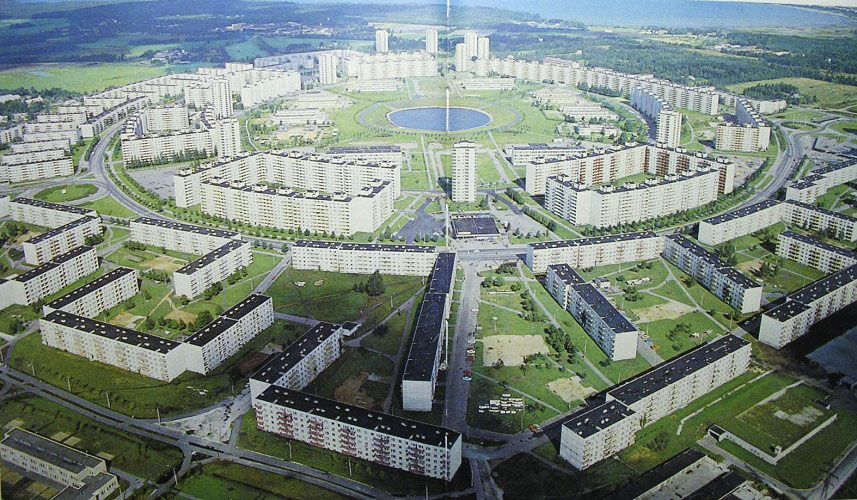
where i live there is constant discussion of "we need high density housing" and this is exactly what comes to mind. eventually this would end up with something like soviet style block housing, which doesn't seem so well received around the world. not to mention this style of housing is very constrictive in terms of lifestyle - maximum 2 child family with minimal space for hobbies/interests, limited sunlight, high noise pollution, etc.

this city in Estonia [0] for example, is somewhat pleasing to look at from a birds eye view and seems to check the boxes for having green space but i wonder about the range of residents' experiences.

[0] - https://www.traveller.ee/blog/wp-content/uploads/2016/06/852...
Re: Nature has enormous emotional and cognitive benefits on people

#203

Earlier quoted context omitted.

> My criticism of cities is that a lot of them are hours away from anything that anyone would call nature This is only because the suburbs are often sprawled in between the city and any nature that might have been nearby. It’d be a heck of a lot easier to get to from the city if you didn’t have miles and miles of low-density suburbs in each direction. Anyway, “local urban parks” is a pretty broad category. It’s not j…

> This is only because the suburbs are often sprawled in between the city and any nature that might have been nearby. Agreed, but I don’t think there’s a realistic world where you have dense urban cores immediately juxtaposed with forest, especially considering how m any people are advocating for accelerated urbanization (moving people from suburbs and rural areas). Sure, that park looks pretty legit. I think that’s…

> Agreed, but I don’t think there’s a realistic world where you have dense urban cores immediately juxtaposed with forest, especially considering how m any people are advocating for accelerated urbanization (moving people from suburbs and rural areas).

At this point, maybe, because we’ve leveled any forests immediately around cities for suburban sprawl. But in the general case, if you’re starting fresh, urbanization makes it easier to leave the forest intact than if you sprawl out with low-density housing.

> Sure, that park looks pretty legit. I think that’s with pretty exceptional or those photos aren’t telling the full story—my city has similar parks but behind the photographer would be rows of houses and the city would still be loud around us.

I’ve hiked there a bunch and the photos are representative. If you’re near the edge of the park you’ll be able to hear cars as there are unfortunately large roadways nearby, but for the most part the trees tend to block out the noise.

Re: Nature has enormous emotional and cognitive benefits on people

#204

Funny thing is, making cities more green isn't even _that_ difficult. I see above conversations on living closer to nature, or mountains vs parks - but the vast majority of time spent is walking and driving in the cities. So it seems a no-brainer that before everything else, before thinking about taking a 2 hour drive to hike, or making the time for a weekly visit to the park, we should first make sure the places peo…

It’s tedious to take a 2 hour drive to go hiking, but it’s basically impossible for most of us to make our cities considerably greener. Obviously if it were a realistic possibility, I would be all for it, but for most of us it depends on factors well outside of our control and anyway it would be a decades-long initiative.

Re: Nature has enormous emotional and cognitive benefits on people

#205
post #116

Earlier quoted context omitted.

Where I live, the city encourages citizens to make tiny gardens against the facades off their building. If you request them, the municipality will pop out some tiles from the sidewalk and supply the soil. The idea is that citizens themselves are then responsible for the gardening, and as you say "keeping nature at bay". The city has become prettier because of it.

>the municipality will pop out some tiles from the sidewalk Where do you walk, then?

It's time for pedestrians to take back the streets.

Re: Nature has enormous emotional and cognitive benefits on people

#206
post #132
post #104

Earlier quoted context omitted.

Two points on this: (1) If you want to know how people feel, I’m afraid self-reports are the gold standard (2) Some other studies have large sample sizes (e.g. this one, which is based on my PhD: https://eprints.lse.ac.uk/49376/1/Mourato_Happiness_greater_... )

Thanks for posting your paper which I will print out and read properly! Section 3.2 and Table 1: does the 'continuous urban' category cover e.g. a fairly large park in the middle of a city? I can't see a category for 'parkland'. As a concrete example have a look at Cannon Hill Park in Birmingham [1]. It struck me that it is possible to be surrounded by green semi-natural parkland within the inner ring of a city of 1…

The dataset used is the UK Land Cover Map 2000 [1]. It's at 25m resolution, and urban parkland should show up as the appropriate land cover types: grassland, deciduous forest, etc.

[1] https://www.ceh.ac.uk/sites/default/files/2021-11/LCM2000%20...

Re: Nature has enormous emotional and cognitive benefits on people

#207

This is the sort of thing I think about when the pro-urban/pro-density/anti-car people talk about their vision for the world. I live in a city now, and the lack of substantial nature is suffocating to the extent that I plan to move. The idea that we should all live this way to conserve space—a resource which is only scarce in these urban places—seems excessive to put it mildly. EDIT: A lot of urban folks are rebuttin…

I’m not really anti-car. I think cars bring a kind of personal freedom that is hard to replicate in other ways but are a big liability in cities and for pedestrians, so ideally cars in cities would all be shunted underground so the surface can be for people and parks.

My ideal vision of the future is we mostly live in luxury in dense, beautiful cities that are walkable with good, seamless transit (think like escalator-like seamlessness). People spend weekends camping in vast, re-wilded nature reserves.

Year 2100 scenario: Get rid of most suburbs and staple-crop farms eventually (vat-grown staples—think Calysta FeedKind or Solar Foods—replace the need for highly processed staples like corn or wheat or soy or factory farms). Replace with rewilded nature reserves which people get to via tunnels or electric VTOL (with special consideration to low-noise design).

Pedestrians in very dense cities walk in park-like surface paths. Solarpunk-style. :) Solarpunk cities and vast nature reserves (accessible via low-impact transport, and commonly used for camping) instead of endless row crops and suburbs. :)

Re: Nature has enormous emotional and cognitive benefits on people

#208

Earlier quoted context omitted.

I like the London practice of having a small square of park in the center among the homes. Although it seems a practice of wealthier urban areas, the parks are gated, the home owners have a key and they pay for the upkeep. I don't know how common this is. NYC Central Park is beautiful and vast, but sometimes I wonder if cities need more smaller little parks. There's a lovely lawn behind Rodin's house in Paris where p…

Those gardens in London are privately owned and maintained. And far from ubiquitous - they’re mostly in wealthy areas. It’s nice that they exist. But it’s not so nice that they’re a perk for the rich and not accessible by an average resident. And AFAIK, there is no planning rule that requires they be added with new (re-)development. Only maintaining what’s there.

As long as you can look into it from the street you'll have some benefit at least. Walking along other people's gardens can be quite relaxing too as long as high walls are not allowed.

Re: Nature has enormous emotional and cognitive benefits on people

#209

Wouldn’t be an NPR blog post without bringing up colonialism, and sure enough, there it is.

That was jarring I have to admit. 3 of the 4 sections are injecting unrelated political or religious incantations? By the end I almost forgot what the article was supposed to be about.

Re: Nature has enormous emotional and cognitive benefits on people

#210
post #19

Wouldn’t be an NPR blog post without bringing up colonialism, and sure enough, there it is.

Comments like these make it appear as if colonialism was just “forced” into an article where it shouldn’t belong. However, reading the actual segment, it seems that it’s not really that out of place at all. It’s talking about how locations for parks came to be and is also offering some references to native tribes and nature.

[deleted]
Post reply on HN