Live data from Hacker News

Historic fertilizer crunch threatens food security

bloombergquint.com

51–60 of 575 posts

Re: Historic fertilizer crunch threatens food security

#51

Earlier quoted context omitted.

I second this - cow based protein and cricket based protein both supply adequate value in an average human diet - why is there such a stigma against one versus the other?

I ordered a cricket steak and was a little disappointed. But seriously its not stigma, its cuisine preference.

Crickets don't taste like much. But we also each chicken. It's all about how you prepare it.

Re: Historic fertilizer crunch threatens food security

#52
post #5

Earlier quoted context omitted.

Please stop repeating the falsehood that animal pastures can somehow be transmuted into high yield crops for the human food supply: about 1/3rd of farmland in the US can never be transformed into suitable farmland for that task, and this accounts for most of the land used for pasture. If we're having problems maintain soil fertility levels now, imagine if we needed 2-3x the fertilizer to transform unsuitable land int…

I don't believe the argument is that the acreage for animal pastures would be converted, but rather the acreage for the crops they eat would be converted. Or is that in error as well?

Pasture is not just where animals are held. It is land that grows plants eaten directly from the ground by animals, i.e., grazing. So if pasture land isnt suitable to be crop land, then animals fed by grazing pasture is efficient. And according to my reading of this industry website, nearly half of livestock calories come from this:

https://www.sacredcow.info/blog/qz6pi6cvjowjhxsh4dqg1dogizno...

I think you are talking about fodder i.e., crops grown for animal consumption on land that could be used for crops eaten by people. But the above link says only 8% of livestock calories come from fodder. Another 14% come from grains and other food that could have been eaten by people. But altogether this less than a quarter of the calories livestock consume.

The remaining ~30% of calories feeding livestock come from eating stuff generated by the agricultural industry as human-inedible byproducts, chiefly the crop residue left behind when crops are harvested.

Would great appreciate corrections or clarifications if I’ve misinterpreted the above.
Re: Historic fertilizer crunch threatens food security

#53

Earlier quoted context omitted.

Vegetarian diet somehow equals synthetic sludge and nothing to hope for?! Sorry if that mischaracterizes your point, but it does seem that's the slippery slope you were going for.

I regularly hear people saying the earth could support x billion people if we all just adopted diet y. Is it really our ambition to turn the whole world into residential skyscrapers just because we figured out how to feed 40 billion people on this one planet?

[deleted]

Re: Historic fertilizer crunch threatens food security

#56

Global food shortage always feels like "well, I'm not concerned many other countries will be hit first". Many countries will literally have issues, but the food will _also_ be a lot more expensive for all of us. The coming years will be "fun" (and I mean bad, to be clear).

Middle East is starting to have issues. This will impact oil prices.

Re: Historic fertilizer crunch threatens food security

#57

Earlier quoted context omitted.

I was reading the journals of Gareth Jones about his time spent in Soviet Russia and Ukraine, and find remarkable similarities to this sort of thing. The government took over, for example, the manufacture and maintenance of tractors, and also selected people nearly at random to maintain them. The one guy he interviewed said something to the extent that the tractors barely last a year before breaking. The people who d…

Thanos’ ideas about everything were extremely silly. A halving of population would do nothing on any time scale. A small blip easily recovered by reproduction. People deserve better writing, even in comic book movies.

The original rationale for Thanos made a lot more sense: he simped for Death, like the concept of death was a woman in the Marvel universe. He thought half the universe's souls would make a perfect offering for her and would impress her enough to make her want to be with him.

It's outrageously comic-book-y, but may as well lean into the illogic.

Re: Historic fertilizer crunch threatens food security

#58

Earlier quoted context omitted.

I don't believe the argument is that the acreage for animal pastures would be converted, but rather the acreage for the crops they eat would be converted. Or is that in error as well?

Not at all. Those fields are now fertilized with cow manure, though. Without the cattle, you'd need more artificial fertilizer for the crops you intend to feed humans with. Would it be good for the environment? Quite possibly. Would it result in more fertilizer available on the market? Not really.

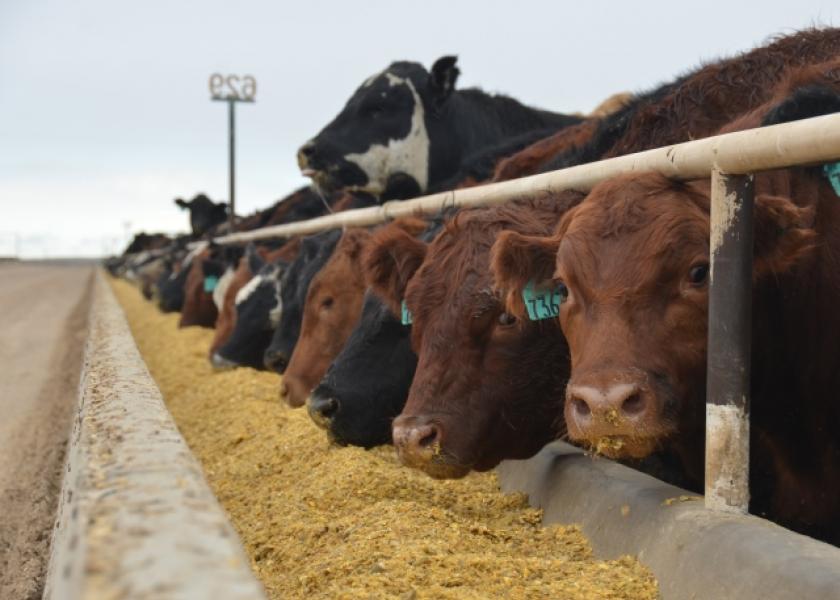
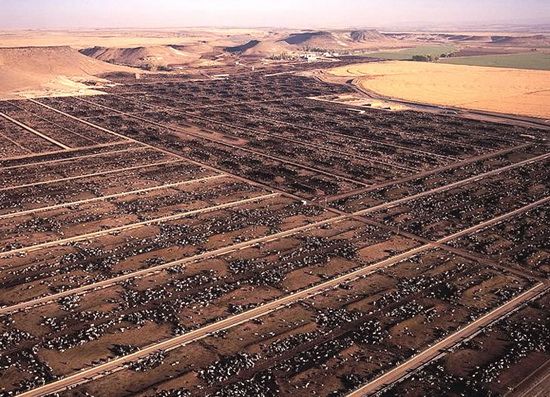
Most commercial cattle aren't pasture fed, they aren't free ranging it in a field eating whatever they forage. Hobby and small farms, sure, but the operations that raise the most heads the cattle generally spend the bulk of their life standing in a dirt pen (a feedlot) eating from a trough. They're then fed a mix of corn, soy, ruffage (grasses).

Here is an example of a feedlot https://www.bilaterals.org/IMG/jpg/33a3ab67aa6bbe3184c0441d2...

The cattle come to a side and eat from troughs like this https://cdn.farmjournal.com/s3fs-public/styles/840x600/publi...

It takes 2.5~ pounds of grain and 1,850~ gallons of water to produce 1 pound of beef.

Re: Historic fertilizer crunch threatens food security

#59
post #26

If all the land and resource that goes into feeding cows is used for crops, a lot more people can be supported. It has never been a lack of global food shortage, it is always regional anyways.

When you feed a cow you are essentially trading up.

Animal meat is much more bioavailable and nutrient dense. Especially when they are eating grass on land unsuitable for crops.

Re: Historic fertilizer crunch threatens food security

#60
post #50

Mostly good comments in here. My take is we have at least 1-2 years of global supply of most grains. This is a completely political problem; its not like we're getting 2012 US Midwest levels of drought in back-to-back years (now THAT would be a crunch). Food waste is a problem, yes. Animal protein is not a problem. There is plenty of land in the US only suitable for grazing. Much better than that synthetic soup of Im…

> its not like we're getting 2012 US Midwest levels of drought in back-to-back years (now THAT would be a crunch).

I got a shiver down my spine just reading that sentence. Please do not tempt fate. We just had the hottest year on record. I expect we'll break that record in the next few years again. Drought is depressingly likely.

Post reply on HN