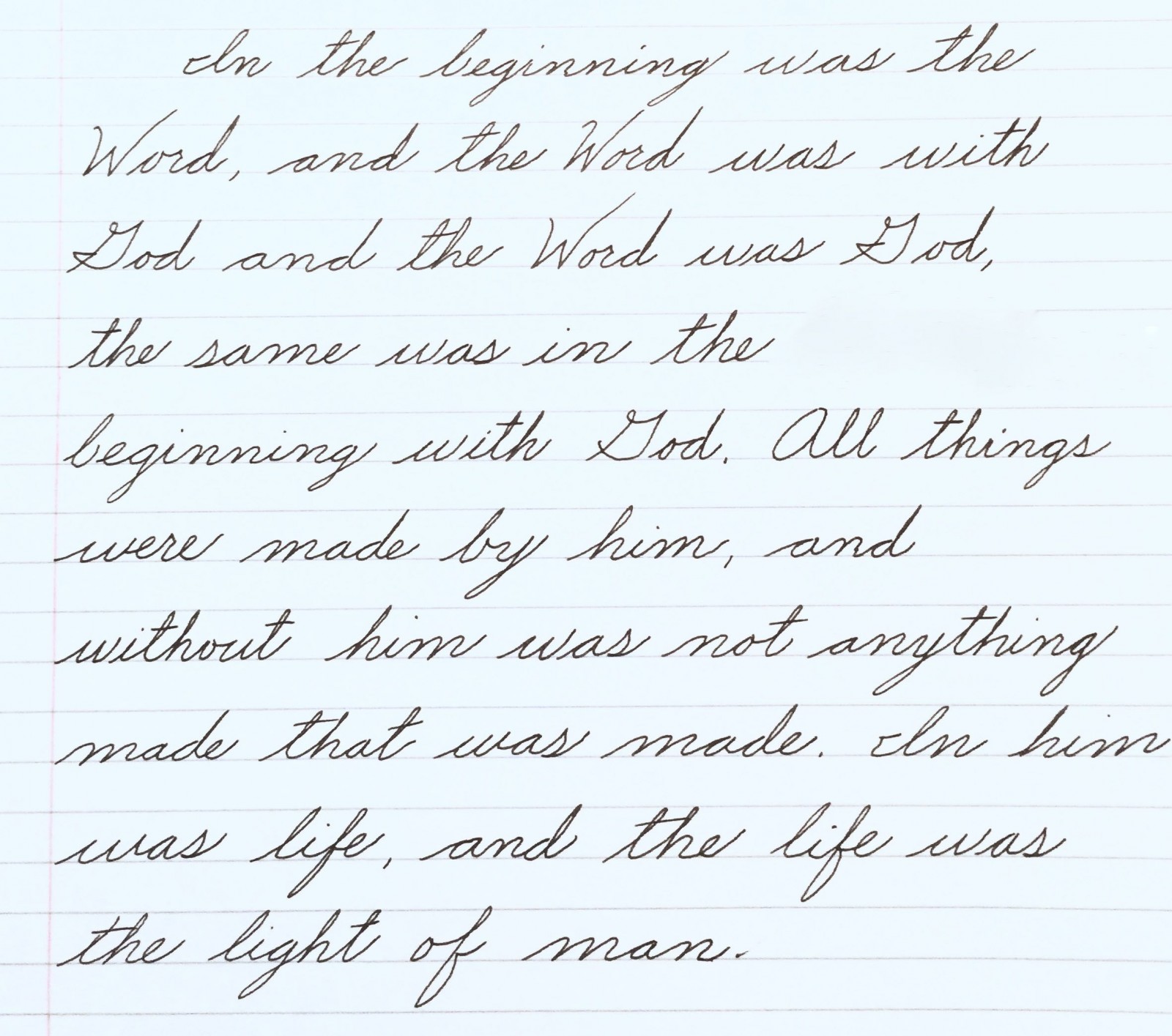
I hated learning cursive as a child, and as soon as I could get away with it, switched to writing printed non-cursive letters. BUT, I'm glad I did learn it, as just an alternate way of writing, and if I ever have a child/ren will probably try to teach them if it's not being taught in their school (which it doesn't sound like is common these days).
Penmanship
61–70 of 120 posts
Re: Penmanship
#62> Most non-architectural hand-writers write the letter “P” with a single stroke: draw a small loop and extend the side downward to form the stem. An architectural hand-writer writes the letter “P” using two independent strokes: draw a small circle, lift the pen, and then draw a vertical line tangent to the left-side of that circle, extending downward. Am I the only one who draws the downstroke first, then back up and…
Re: Penmanship
#63Fun (or maybe not-so-fun) fact: my 15-year-old nephew recently had to sign a document for some volunteer work, and he didn't know how. Apparently, schools no longer teach cursive, not even enough for kids to learn how to sign their own names for legal documents. The secretary was just like, "Yeah, we get that a lot; he can just print his name instead, that's fine." I've always had shitty handwriting, and when I was i…
"The traditional function of a signature is to permanently affix to a document a person's uniquely personal, undeniable self-identification as physical evidence of that person's personal witness and certification of the content of all, or a specified part, of the document."[0]
Re: Penmanship
#64Fun (or maybe not-so-fun) fact: my 15-year-old nephew recently had to sign a document for some volunteer work, and he didn't know how. Apparently, schools no longer teach cursive, not even enough for kids to learn how to sign their own names for legal documents. The secretary was just like, "Yeah, we get that a lot; he can just print his name instead, that's fine." I've always had shitty handwriting, and when I was i…
Part of the reason I'm so cynical about the teaching profession is that I had a string of two or three elementary teachers who insisted that cursive was the only acceptable method of handwriting in educational settings. Immediately after—and for every single other teacher or professor—no one cared whether the letters were connected or block-printed so long as they were legible. The other reason was the far-longer str…
I have ditched cursive for block printing, but it is an annoyance because I'm much slower that way. Even though I sit at a keyboard ten hours a day, better handwriting ability would be a noticeable asset for me. Still, I can't blame the teachers who taught me in elementary school, because none of them could make the individual choice to teach me a different cursive system, just like I can't make the individual choice to start writing code in a different language at my company.
Re: Penmanship
#65Earlier quoted context omitted.
This is a good comment. I do have a contrary opinion however as I generally recommend a spencerian derivative over an italic one to new learners these days. One could say simple Spencerian derivatives are like Rust with a steep learning curve to inculcate the core shapes into muscle memory but have lesser overhead during runtime owing to their dependence on muscle memory. Italic derivatives otoh more like Go, easier…
What Spencerian derivative(s) can you recommend? Asking because I think I've got about as much benefit as I'm going to from having used a fountain pen exclusively for the last five or so years, so I'm looking at this point to learn a proper script. It sounds like you're considerably more familiar and may know some good places to start, and I'm hoping to get the benefit of your experience.
[0]https://archive.org/details/cu31924029485467/page/n47/mode/2...
Re: Penmanship
#66> In penmanship class, we learned a standard cursive font. I think it’s the standard cursive font, in fact. He's wrong that there's a standard cursive. Different countries and different centuries have used a variety of different cursives. Most Americans who were taught cursive in school learned either Zaner-Bloser or D'Nealian, which both derive from Palmer. Both of them are terrible . They have indistinct letter sha…
This is a good comment. I do have a contrary opinion however as I generally recommend a spencerian derivative over an italic one to new learners these days. One could say simple Spencerian derivatives are like Rust with a steep learning curve to inculcate the core shapes into muscle memory but have lesser overhead during runtime owing to their dependence on muscle memory. Italic derivatives otoh more like Go, easier…
http://www.richimages.net/wp-content/uploads/2015/07/spencer...
Re: Penmanship
#67Oddly enough I used to write my '0' like an 'O', until I started writing down a lot of chemical structures with numbered atoms. I had to distinguish between the 0 label and the 'O' of an oxygen. I've now adopted the 0 as the way to do it :) edit: Ok, so HN font as displayed does not show the bar across the 0, even though the editor does ...
(And I still swear that my differential equations professor wrote problems that used mu, 'u', 'v', and nu at the same time as a prank on people with bad handwriting.)
Re: Penmanship
#68Oddly enough I used to write my '0' like an 'O', until I started writing down a lot of chemical structures with numbered atoms. I had to distinguish between the 0 label and the 'O' of an oxygen. I've now adopted the 0 as the way to do it :) edit: Ok, so HN font as displayed does not show the bar across the 0, even though the editor does ...
I picked up the wild ass french numeral 1 from living there in my youth. I still think it's more ambiguous than the english variants but I had so much trouble with people misinterpreting mine I switched and have never been able to shake it. If you look up examples online they seem fairly reasonable. But in actual daily handwriting they are very extreme. It looks more like a stylized capital A than a number honestly.
Re: Penmanship
#69Earlier quoted context omitted.
This is a good comment. I do have a contrary opinion however as I generally recommend a spencerian derivative over an italic one to new learners these days. One could say simple Spencerian derivatives are like Rust with a steep learning curve to inculcate the core shapes into muscle memory but have lesser overhead during runtime owing to their dependence on muscle memory. Italic derivatives otoh more like Go, easier…
Great point about muscle memory, I found it fascinating to learn Spencerian as it kind of distills the essence of writing to a surprisingly low number of forms (7 or 8 I think?), a kind of local optimum for Latin-based cursive. The hardest thing for me to learn about it, with which I still struggle, is keeping the arm posture correct and using the upper, rather than lower, part of the arm for control. I also found it…
It’s great that you recognize this handicap as dealing with it sooner rather than later is a good; bad posture is indeed harder to correct later as we know. The first measure you can take is course correcting yourself over shorter intervals i.e.Move The Paper towards yourself with no shame, even during the length of a line, as often as need be. Even Louis Madarasz did it, so don’t hesitate. But I think your fix becomes a habit, it becomes a non-issue later.
> ... the proscribed 52 degree writing angle for Spencerian is almost exactly what you get matching the diagonal on an 8.5" by 11" piece of paper
If this is true, you just blew my mind, thanks for sharing the discovery.
Re: Penmanship
#70"I never write cursive these days. Nobody writes it anymore. Nobody can read it, anyway. And I honestly couldn’t write it neatly anymore even if I tried. Cursive is obsolete." This is a rediculous inference - I don't do it, therefore nobody does it and it's obsolete. I for one, write in cursive every day, taking notes in a notebook/journal, and carry a fountain pen to do so. It's just such a nicer experience than wri…