Live data from Hacker News

The State of Fortran

arxiv.org

21–30 of 113 posts

Re: The State of Fortran

#21
post #4

What kind of editor support does Fortran have? I think a language is more than just a language as such, and the surrounding environment is at least as important if not more. I've used things like Mathematica, RStudio and Matlab, as well as Java IDEs, and these make all the difference.

Last I checked, you had to write out your program on paper, using the special Fortran coding forms. Then you just gave the written out forms to someone who would type out your codes at a keypunch and give you a deck of freshly punched cards, or you could take care of it yourself.

Re: The State of Fortran

#22

Earlier quoted context omitted.

For what it is worth - I write Fortran professionally (in some of the use cases you describe) and I doubt its usefulness. The way I see it, Fortran exists today because of inertia, not because it still has technical superiority. These mountains of Fortran code represent decades of investment and undocumented "features" that you could never code around during a rewrite. And so today, new code is bolted on, with a pray…

When we cannot re-make the things we made before is a sign of a slow decline.

It's really not. It is simply very expensive to build up experimental validation of simulation code rewritten in a new language, and much more expensive than the aesthetic value given by programmers who want new things. There's nothing magic about the old things, there's just an existing ecosystem which works which would involve a whole lot of effort to recreate and most people think they have better things to do.

Re: The State of Fortran

#23
post #4

What kind of editor support does Fortran have? I think a language is more than just a language as such, and the surrounding environment is at least as important if not more. I've used things like Mathematica, RStudio and Matlab, as well as Java IDEs, and these make all the difference.

Last I checked, you had to write out your program on paper, using the special Fortran coding forms. Then you just gave the written out forms to someone who would type out your codes at a keypunch and give you a deck of freshly punched cards, or you could take care of it yourself.

It is entirely possible this person is telling the truth that this was the state of things the last time they checked. :)

Fortran was absolutely run on punch cards, which also informs some of the strangeness of its formatting, especially pre-fortran-90.

Re: The State of Fortran

#24
post #4

What kind of editor support does Fortran have? I think a language is more than just a language as such, and the surrounding environment is at least as important if not more. I've used things like Mathematica, RStudio and Matlab, as well as Java IDEs, and these make all the difference.

There have been Visual Studio plugins for commercial compilers since ages.

Re: The State of Fortran

#25

The fact that “The State of Fortran” is a paper on arXiv instead of a blog post actually says a lot about the state of Fortran.

Indeed, it isn't something that is only cool for a month or to be embraced by magpie developers.

Re: The State of Fortran

#26

Earlier quoted context omitted.

Last I checked, you had to write out your program on paper, using the special Fortran coding forms. Then you just gave the written out forms to someone who would type out your codes at a keypunch and give you a deck of freshly punched cards, or you could take care of it yourself.

It is entirely possible this person is telling the truth that this was the state of things the last time they checked. :) Fortran was absolutely run on punch cards, which also informs some of the strangeness of its formatting, especially pre-fortran-90.

I programmed FORTRAN on punch cards and on paper tape using a teletype, over an acoustically coupled modem, timesharing to a Univac 1103. Those were the days.

Re: The State of Fortran

#27
Very interesting paper! It's cool to see that Fortran is still evolving. I've been considering learning it (when I have the time) because of its use for numerical computations and parallel processing. I feel like there's been a big push towards general-purpose languages like C++. However, I'd love to get a better feel for what it's like to program in a language specifically designed for your use case. The closest I've experienced is MatLab, but I feel like MatLab is designed more for scientists and engineers who need to perform some calculations but don't want to actually learn how to program, not for professional programmers working on scientific computation.

Re: The State of Fortran

#28
I've always liked Fortran - one big project I wrote in Fortran 77 was an Intel 8080 simulator that was used for teaching at the Polytechnic I worked for. The original code was on a Dec10, but I ported it to a VAX and an IBM 4381 in a couple of days.

It's an easy language to get to grips with, but the users somewhat less so. At one point doing consultancy, I came across people declaring variables like I1,I2,I3,I4 to IN where N was a large number.

I asked "why?" and they said "we might need them" - Fortran programmers will see at least two reasons why this is daft.

Re: The State of Fortran

#29
post #4

What kind of editor support does Fortran have? I think a language is more than just a language as such, and the surrounding environment is at least as important if not more. I've used things like Mathematica, RStudio and Matlab, as well as Java IDEs, and these make all the difference.

Last I checked, you had to write out your program on paper, using the special Fortran coding forms. Then you just gave the written out forms to someone who would type out your codes at a keypunch and give you a deck of freshly punched cards, or you could take care of it yourself.

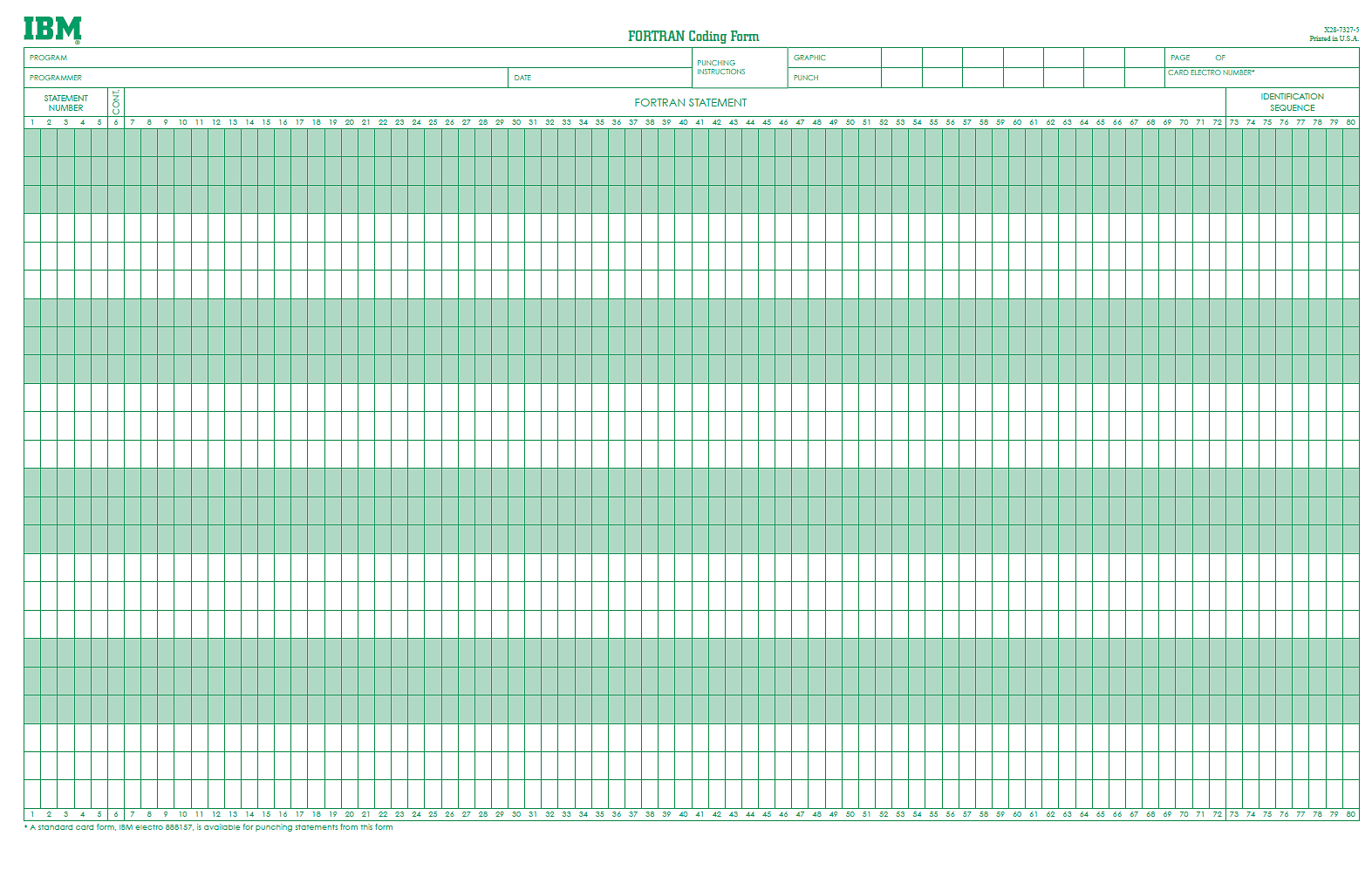
For anyone who wants to experience the first part of this process, here is a FORTRAN Coding Form (in caps because that's how it was spelled back then):

https://upload.wikimedia.org/wikipedia/commons/1/18/FortranC...

Print that in color on 8½x14" (legal size) paper and get to work!

Of course there were a few other steps in the programming process back then.

1. A Systems Analyst took business requirements and turned them into an overview diagram of the system structure.

2. A Programmer took those diagrams and drew detailed flowcharts. These included every "if" statement, every loop, every detail. They were in effect code, but in a diagram form. Don't forget your IBM Flowcharting Template! https://ids.si.edu/ids/deliveryService?id=NMAH-AHB2012q05389

3. A Coder read the programmer's flowcharts and wrote out the equivalent FORTRAN code on multiple pages of Coding Forms.

4. A Keypunch Operator read the Coder's forms and punched them onto cards, one card for each line of a Coding Form.

5. Finally we get to the High Priest of this operation. A Computer Operator - the only person allowed to touch the Computer! - ran your deck of cards through the machine and blessed you with a printout. Which was usually a core dump.
Re: The State of Fortran

#30

Very interesting paper! It's cool to see that Fortran is still evolving. I've been considering learning it (when I have the time) because of its use for numerical computations and parallel processing. I feel like there's been a big push towards general-purpose languages like C++. However, I'd love to get a better feel for what it's like to program in a language specifically designed for your use case. The closest I'v…

I don't think there's much in Fortran that's still unique or "specifically designed" for numerics compute. General purpose languages reached parity with Fortran a long time ago. And "general purpose" typically wins anyway because it has the larger and more diverse ecosystem.
Post reply on HN