Live data from Hacker News

Excel 2.0 – Is there a better visual data model than a grid of cells?

subset.so

111–120 of 223 posts

Re: Excel 2.0 – Is there a better visual data model than a grid of cells?

#111
post #90

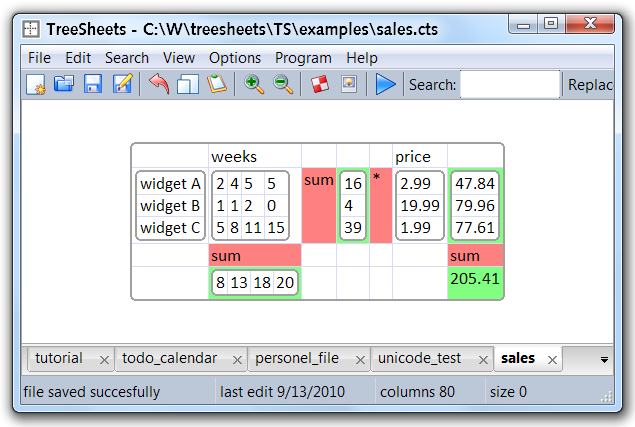
Most innovative in that space I know of, would be TreeSheets. https://strlen.com/treesheets/ And this software is at least 9 years old :)

It is just one of many mind mapping tools and it misses "calc" part. Looks like more lightweight Freemind/Freeplane.

It is a lot of things, mind mapping one of them - just as you can probably use excel for mind mapping as well (never tried that:) )

The calc part is not missing, see here: https://strlen.com/treesheets/docs/images/screenshots/screen... - it's more basic than what excel has.

Re: Excel 2.0 – Is there a better visual data model than a grid of cells?

#112
post #20

Excel is seriously killing humanity. No version control, no debugging, brittle support for automation. Excel, to me, is the single most obvious sign that we must get rid of the giant tech monopolies to re-enable innovation in software.

Time to catch up with modern Excel.

Formula and macro debugging is available for years.

Lambs functions are a thing

Power BI

Re: Excel 2.0 – Is there a better visual data model than a grid of cells?

#113
post #83

Earlier quoted context omitted.

Many things that Numbers seems to me to be better than Excel from a formatting perspective: * Freeze header rows & columns. * Naming header rows & columns. * Graphs that don't overlap the sheet. Things that I find Excel does better than Numbers from a data perspective: * Data validation * Large tables * Formula Error checking

"Excel" is just one specific spreadsheet application out of several. But anyway... * You can freeze header rows and columns in Excel. * You can place charts outside the sheet with data. * I'm not even 100% sure you can't name columns, but let's say you can't. So, Excel has 2 out of its 3 "missing features". Just saying.

Excel has been able to name columns for years.

Re: Excel 2.0 – Is there a better visual data model than a grid of cells?

#114
I posted this a few years ago, asking why there isn't a decent and flexible collaborative outliner like "Google Trees":

https://news.ycombinator.com/item?id=20425970

The thing that's missing from "Google Docs" is a decent collaborative outliner called "Google Trees", that does to "NLS" and "Frontier" what "Google Sheets" did to "VisiCalc" and "Excel". And I don't mean "Google Wave", I mean a truly collaborative extensible visually programmable spreadsheet-like outliner with expressions, constraints, absolute and relative xpath-like addressing, and scripting like Google Sheets, but with a tree instead of a grid. That eats drinks scripts and shits JSON and XML or any other structured data.

Of course you should be able to link and embed outlines in spreadsheets, and spreadsheets in outlines, but "Google Maps" should also be invited to the party (along with its plus-one, "Google Mind Maps").

It should be like the collaborative outliner Douglass Englebart envisioned and implemented in his epic demo of NLS:

https://www.youtube.com/watch?v=yJDv-zdhzMY&t=8m49s

Engelbart also showed how to embed lists and outlines in maps:

https://www.youtube.com/watch?v=yJDv-zdhzMY&t=15m39s

Dave Winer, the inventor of RSS and founder of UserLand Software, originally developed a wonderful outliner on the Mac originally called "ThinkTank" and then "MORE", which later evolved into the "Frontier" programming language, and ultimately the "Radio Free Userland" desktop blogging and RSS syndication tool.

https://en.wikipedia.org/wiki/Dave_Winer

https://en.wikipedia.org/wiki/UserLand_Software

More was great because it had a well designed user interface and feature set with fluid "fahrvergnügen" that made it really easy to use with the keyboard as well as the mouse. It could also render your outlines as all kinds of nicely formatted and stylized charts and presentations. And it had a lot of powerful features you usually don't see in today's generic outliners.

https://en.wikipedia.org/wiki/MORE_(application)

>MORE is an outline processor application that was created for the Macintosh in 1986 by software developer Dave Winer and that was not ported to any other platforms. An earlier outliner, ThinkTank, was developed by Winer, his brother Peter, and Doug Baron. The outlines could be formatted with different layouts, colors, and shapes. Outline "nodes" could include pictures and graphics.

>Functions in these outliners included:

>Appending notes, comments, rough drafts of sentences and paragraphs under some topics

>Assembling various low-level topics and creating a new topic to group them under

>Deleting duplicate topics

>Demoting a topic to become a subtopic under some other topic

>Disassembling a grouping that does not work, parceling its subtopics out among various other topics

>Dividing one topic into its component subtopics

>Dragging to rearrange the order of topics

>Making a hierarchical list of topics

>Merging related topics

>Promoting a subtopic to the level of a topic

After the success of MORE, he went on to develop a scripting language whose syntax (for both code and data) was an outline. Kind of like Lisp with open/close triangles instead of parens! It had one of the most comprehensive implementation of Apple Events client and server support of any Mac application, and was really useful for automating other Mac apps, earlier and in many ways better than AppleScript.

https://en.wikipedia.org/wiki/UserLand_Software#Frontier

http://frontier.userland.com/

Then XML came along, and he integrated support for XML into the outliner and programming language, and used Frontier to build "Aretha", "Manila", and "Radio Userland".

http://manila.userland.com/

http://radio.userland.com/

He used Frontier to build a fully programmable blogging and podcasting platform, with a dynamic HTTP server, a static HTML generator, structured XML editing, RSS publication and syndication, XML-RPC client and server, OPML import and export, and much more.

He basically invented and pioneered outliners, RSS, OPML, XML-RPC, blogging and podcasting along the way.

>UserLand's first product release of April 1989 was UserLand IPC, a developer tool for interprocess communication that was intended to evolve into a cross-platform RPC tool. In January 1992 UserLand released version 1.0 of Frontier, a scripting environment for the Macintosh which included an object database and a scripting language named UserTalk. At the time of its original release, Frontier was the only system-level scripting environment for the Macintosh, but Apple was working on its own scripting language, AppleScript, and started bundling it with the MacOS 7 system software. As a consequence, most Macintosh scripting work came to be done in the less powerful, but free, scripting language provided by Apple.

>UserLand responded to Applescript by re-positioning Frontier as a Web development environment, distributing the software free of charge with the "Aretha" release of May 1995. In late 1996, Frontier 4.1 had become "an integrated development environment that lends itself to the creation and maintenance of Web sites and management of Web pages sans much busywork," and by the time Frontier 4.2 was released in January 1997, the software was firmly established in the realms of website management and CGI scripting, allowing users to "taste the power of large-scale database publishing with free software."

https://en.wikipedia.org/wiki/RSS

https://en.wikipedia.org/wiki/OPML

https://en.wikipedia.org/wiki/XML-RPC
Re: Excel 2.0 – Is there a better visual data model than a grid of cells?

#116
post #85

Trillions of decisions have been made off a tool that has poor error handling and data consistency issues. Blame is not entirely on either the user or the software, but the tool is too trusted without validation. [Study that was at the core for Europe's austerity and European debt crisis contained excel errors when fixed showed the inverse of original hypothesis.]( https://www.nytimes.com/2013/04/19/opinion/krugman-t…

> Programmable commands instead of a data grid would be huge improvement to quality...

Would it? At the end of the day, someone else still has to proofread and QA the commands/formulas/program or it's just blind trust that the decision is being made on. Trust (or ignorance) that the creator knew what they were doing and developed it in an accurate way before action is taken on the decision being made. The interface really makes no difference, it's the human component and "process" for creation that needs to be fine tuned. Things like the London whale situation was a process failure where one person had too much power to execute trades without oversight, review, QA, testing, etc. [0] All things that are pretty standard in a software developer's day-to-day but the rest of the world has not realized or adjusted to the fact that they are now software developers too.

[0] Excel wasn't the problem with the London whale at all, they made a mathematical error "modelers divided by a sum instead of an average"

Re: Excel 2.0 – Is there a better visual data model than a grid of cells?

#117
My own take on spreadsheets2.0 is https://www.jigdev.com

It's mostly inspired from how we use spreadsheets on wall street: a frontend for complex data applications (basically a wysiwyg interface with a DAG repl).

Technically, jig is an observable notebook where the cells are spread on a canvas rather than in top/down notebook.

Re: Excel 2.0 – Is there a better visual data model than a grid of cells?

#119
How about a spreadsheet that's also an outliner?

Here's an article and HN discussion about "Representing and Editing JSON with Spreadsheets" that I posted a few years ago about shoe-horning JSON into spreadsheets so it was easier to edit and process. But ideally I'd prefer a collaborative spreadsheet that's also an outliner (which I described in another post as "Google Trees").

https://donhopkins.medium.com/representing-and-editing-json-...

https://news.ycombinator.com/item?id=21109798

Re: Excel 2.0 – Is there a better visual data model than a grid of cells?

#120
post #76

I don't think you can improve Excel too much, but you could the ecosystem around it: Microsoft should integrate a package manager. Not something public, but something companies can privately maintain and publish packages to, that would contain common functions for their specific business. If I could have a way to download a macro to a spreadsheet that would automate database connection for certain data sets, that wou…

> I don't think you can improve Excel too much

Clearly you've not used an international version of Excel. They translate all the function names, replacing the English ones, and of course not just for display. No, this gets saved in the file.

So in my view, they could improve Excel an immense amount just there.

Then we can talk about how it won't even obey things like an explicit "format this cell as text" command.

Post reply on HN