Live data from Hacker News

EU to mandate public salary information for all job postings [pdf]

europarl.europa.eu

291–300 of 388 posts

Re: EU to mandate public salary information for all job postings [pdf]

#291
post #207
post #2

The meat is page 5 under "The changes the proposal would bring". Highlights: * Job-seekers would have a right to information about the pay range of posts they apply for * Employers would be prohibited from asking about an applicant's pay history * Employees would have a right to ask their employer for sex-disaggregated information on the average pay of other workers doing the same work or work of equal value. * Emplo…

Bullets 1-3 are excellent reforms that should be the case everywhere. Bullet 4 could end up with bad consequences because there's so many ways to fudge the data. And justification is in the eye of the beholder. For instance, in digital marketing, direct response advertising roles tend to be higher paid than marketing roles without strict KPIs (brand, organic social, etc.) Direct response advertising, for whatever rea…

Can this law distinguish between a direct response marketer and a brand marketer

Yes that's not equal work. You have to compare two brand marketers.

Re: EU to mandate public salary information for all job postings [pdf]

#292
post #83

Earlier quoted context omitted.

Salaries might be private here, but taxes sure aren't. A recruiter could feasibly walk into the local tax office and ask to see my taxable income for 2020.

That’s wild, I can’t believe it. Where is this if you don’t mind me asking?

also true in Sweden

Re: EU to mandate public salary information for all job postings [pdf]

#294

Earlier quoted context omitted.

>they publish pay ranges for those titles/ranks. They do? I'd love to see that if you have a link.

Colorado requires disclosure of base salary, so you can look at Colorado job listings at https://google.com/careers to get a ballpark idea. This works for other large companies, too. Of course, pay varies by location, and compensation includes more than just base salary, but it will give you a starting point.

Estonia does that too. Job posts are required to publish a pay range and it is very useful to help decide if a job is financially interesting or not.

Re: EU to mandate public salary information for all job postings [pdf]

#295
post #284

Where does contracting fit into all of this? If you leave the formal structure of employment and don't fit into the set job titles of a company (or within, but as a contractor and so a different pay band), then can you effectively work around this? If so, then will those currently getting paid more move into contracting? They'd probably end up with more pay (even than they get now) if they did, so will we see a decre…

It doesn’t fit in. This is employee protections.

Re: EU to mandate public salary information for all job postings [pdf]

#296
post #103
post #25

Earlier quoted context omitted.

Overall in developed countries the pay gap has largely been closed over the last few decades, but remaining gaps are not fiction. There are still real and unjustifiable gaps in some employment sectors, especially in a region as diverse as the EU. Pay gaps in some Eastern European countries for example still persist.

last time I checked countries like Romania (E Europe) had the smallest pay gap in Europe. the issue is usually in countries like Germany, Switzerland or Netherlands.

It's also important to consider what people mean exactly when they talk about the "pay gap".

Here in Germany, the SPD (social democrats) candidate for chancellor in 2018, Schulz, tried to make the gender pay gap into one of the core issues of his campaign with posters saying women "make 21% less while working 100%"[0].

While this wasn't outright wrong, it used what the Statisches Bundesamt (official state office of statistics) called the "unadjusted" gender gap value (which I saw some people refer to as the "earnings gap"), meaning it calculated the average pay per hour for all women and compared that to the average for men (per sector, region, age group), but it specifically did not try to consider professions, different contracts (e.g. full time vs part time), but does include overtime pay (but not bonuses). It comes with a note that this number cannot be used to compare earnings for women and men in the same or equivalent profession[1].

While this of courses raises questions about why women apparently work more in professions that get paid less on average, and what to do about that (like getting more women in higher paying professions, or adjusting the pay in low paying, undervalued professions that are "typical female" such as child- and elder care or retail), Schulz however ran around suggesting that number shows women get paid a lot less for the same job.

There also is an "adjusted" number (which I think people often mean to refer to when they talk about the "pay gap") that tries to consider things like (equivalent) professions as well, making it a lot closer to "same pay for the same job" metric. That value is then given as the "upper bound" as it still cannot consider some factors such as employment/career breaks[2]. That value was about 6% in Germany in 2018. However, only looking at value alone is misleading as well, as it hides that women on average get paid less for their time (which the unadjusted value points out), among other things. Both numbers furthermore do not consider at all any unpaid work a person may perform (such as raising children), and differences between genders when it comes to participation in the paid labor market.

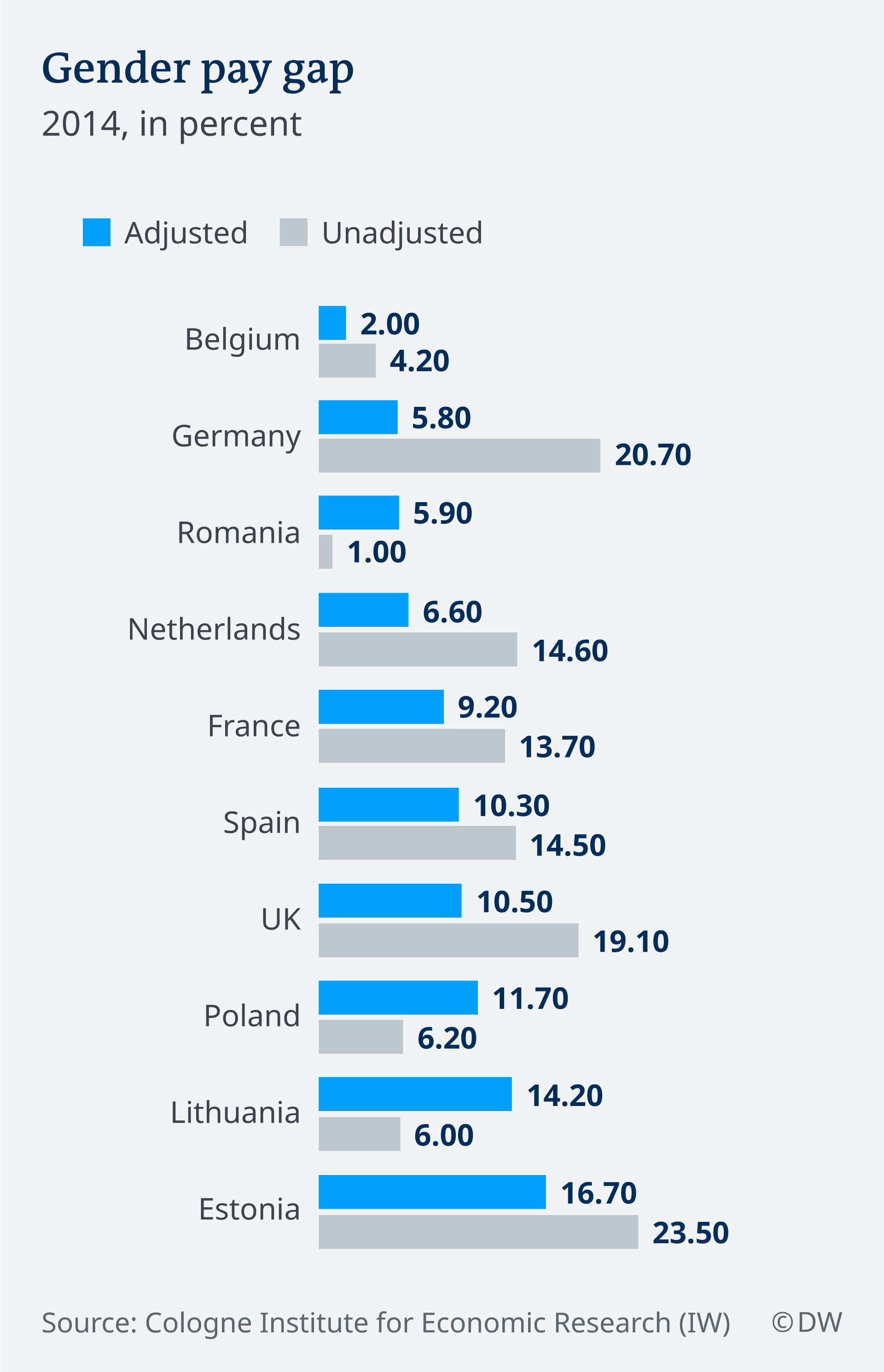
To bring it back to your post specifically, I found this dw infographic[3] showing that in Romania the gap was a mere 1% to Germany's 21% when using the unadjusted value (2014), but both were around 6% when using the adjusted value.

As far as I know the way to calculate the unadjusted and adjusted numbers is mandated by the EU, so these numbers should be calculated the same and comparable. So Germany and Romania seem to be doing about the same in the "same pay for the same job" metric. But I wonder why there is such a large difference in the unadjusted value? Is it because Romania did away with connotations of typically "female" and "male" professions early (maybe even as a result of past communism), are there huge differences in labor participation rates between both countries, is there less difference in what different professions get paid in Romania, etc, or a combination in some form of all of that?

[0] https://correctiv.org/media/thumbnails/filer_public_thumbnai...

[1] "Aussagen zum Un­ter­schied in den Ver­diens­ten von weiblichen und männlichen Be­schäf­tig­ten mit glei­chem Beruf, ver­gleich­ba­rer Tätigkeit und äquivalentem Bildungsabschluss sind damit nicht möglich." https://www.destatis.de/DE/Themen/Arbeit/Arbeitsmarkt/Qualit...

[2] "Es muss berücksichtigt werden, dass der ermittelte Wert eine Obergrenze ist. Er wäre geringer ausgefallen, wenn weitere Informationen über lohnrelevante Einflussfaktoren für die Analysen zur Verfügung gestanden hätten, wie vor allem Angaben zu Erwerbs­unterbrechungen. " https://www.destatis.de/DE/Themen/Arbeit/Verdienste/FAQ/gend...

[3] https://static.dw.com/image/47827459_7.png

Re: EU to mandate public salary information for all job postings [pdf]

#297
post #67

Earlier quoted context omitted.

Gender is a made-up concept with no sensible definition. The defining quality is sex . Having children is simply more burdensome and time-consuming for women, no way around it (except artificial wombs in the distant future). I've advocated "child-bonus" before (i.e. paying companies extra when their employees get pregnant and on maternity leave), but I doubt that idea will gain any popularity. When even in the most e…

> Having children is simply more burdensome and time-consuming for women, no way around it Pregnancy is 9 months, the children live for many years. For that second part, men and women could take responsibilities in an equal way (save for breastfeeding, but pumps exists), but usually the burden tends to fall on the women and that hurts careers more than pregnancy.

In most places maternity leave is a lot longer than paternity leave so that's society influence.

Re: EU to mandate public salary information for all job postings [pdf]

#298
post #168

Earlier quoted context omitted.

That doesn't work very well because if you have a large range then most candidates would be disappointed if they got towards the bottom end, even if that made pratical sense. Maybe you could mitigate this by making the range even larger at the bottom end, below the minimum that you would ever pay, but then you'd put off the best people (who are the people that you most want to avoid putting off).

Why would the best candidates be put off by a low minimum? Their salary isn't going to have anything to do with the minimum. If anything, the best candidates should prefer a wide range. That would mean there is more opportunity for them to distinguish themselves beyond just "years served".

Because a low minimum signals that the position is not as senior and not as serious as the description claims it is.

If you advertise for a senior software engineer and your range is 50k-250k, why would I apply? It's clearly not a senior software engineer position if you're willing to hire someone for 50k.

Re: EU to mandate public salary information for all job postings [pdf]

#299
post #110

Earlier quoted context omitted.

Well I looked my Governor up and he makes $175k. California’s Governor makes the most at $201k. I toyed at the idea of some Federal government IT jobs. An agency was trying their best to pay well and the level was similar to a civilian who has a PhD or MD doing federal work but still only a little more than the median software dev salary.

Usually government contractors can do well since they don't fall in the government pay grades. I interviewed at one paying something like $110-150k, which would be a substantial increase for me. Most government jobs aren't attractive anymore. I think the COLA was like net -2% last year. Pensions are mostly gone. Politics are raging lately.

No this was a federal FTE job with the civilian DOD pay scales and pension.

Re: EU to mandate public salary information for all job postings [pdf]

#300
post #241

Earlier quoted context omitted.

Hahaha I got this once - I was working for a startup in the Bay Area remotely from my place in Oxford and then wanted to see what interesting jobs existed in the local area. There is a small cluster of space startups nearby so I applied to one of those through a recruiter. He didn't seem to understand why I was looking to go from a job paying ~$200k to ~$50k (Oxford does not pay developers well at all!) and saying "B…

If you're still looking to do that I can definitely recommend a company in the same timezone! Alén Space is hiring and I can tell you it's a great team (I used to work with the founders).

I absolutely would love to still deploy code to space but I now live in the Bay Area! And am waiting on my EAD so currently unemployed for ~3 months :) If you know of any open source projects that go to space I have an abundant amount of free time!
Post reply on HN