Live data from Hacker News

How much do construction costs matter to the price of housing?

constructionphysics.substack.com

41–50 of 343 posts

Re: How much do construction costs matter to the price of housing?

#41

Earlier quoted context omitted.

From everything I've heard London has some of most restrictive, bureaucracy laden, red tape filled city building processes out there. I've heard that all of England has "councils" at the local level that basically operate as HOAs with the full force of the law. I don't know that I'd pick anywhere in the UK as a shining example of ease of building.

But then councils can compete with each other, the ones outside even do so. There are tons of high rises coming far from Central London but still reasonable commute to center, but that doesn't necessarily reduce the price of properties inside. Area has a lot to do with prices and unless these outer areas become self sufficient so much that Central London or rich boroughs lose lustre, the inner areas will command a hi…

While demand outstrips supply as now, prices increase. These have a ceiling of the maximum people can afford. If everyone is given a £10k payrise, then rents will increase by £10k, and buying will increase by whatever an extra £10k a year will get you on the mortgage.

Until supply increases enough so that demand is no longer artificially constrained that will be the case. Now there are places where supply is higher than demand, like inner cities in places like Stoke, and prices there are low enough that even a single earner on minimum wage with 6 months salary as a deposit can afford a 2 bed house [0]

[0] https://www.rightmove.co.uk/house-prices/detailMatching.html...
Re: How much do construction costs matter to the price of housing?

#42
post #19
post #8

It's all about consumer preference. It seems this article largely misses this. People want to live in specific locations, or have to in order to find work. This drives land values up as demand increases. Policies can make this worse, but the problem will still manifest itself to some degree. (Potentially as affluent people, especially in suburban areas, buying up more land to create setbacks, or simply buying because…

> For a personal example, my wife complains that an 1800 sqft house is too small. A modern blueprint 1800sqft house, yeah, for sure. But somehow a 1960s split level at 1800sqft is spacious. We are throwing square footage away on multiple large bathrooms, 2 living rooms, 2 dining rooms, and then wonder why the rooms we actually occupy are so small. The recent trend towards 4 story narrow houses doesn't help. A literal…

"A modern blueprint 1800sqft house, yeah, for sure."

This seems to mostly be a difference in preference. The house is 1.5 baths and not large ones. Some layout parts are less efficient, like a master bedroom bigger than it has to be (so opposite of the numerous small rooms issue you brought up). But overall there is plenty of room, even a room dedicated as a play room. But overall this is a great example of shifting preferences over time since an average size house was 1970 was about 200 sqft less that this, and I grew up in an 1100sqft house.

Prices vary by location. You can have a 4 bed house build for a quarter of that in many areas of the country.

Re: How much do construction costs matter to the price of housing?

#43

Thought for conversation: if you are able to work remote but still live in or near a major employment center, are you at least somewhat morally responsible for pricing out those who cannot work remote?

You mean am I morally obligated to take my kids from their school and friends, as well as all the relationships I've made with the community, so that someone else can have an easier commute? nope.

Re: How much do construction costs matter to the price of housing?

#44
post #8

It's all about consumer preference. It seems this article largely misses this. People want to live in specific locations, or have to in order to find work. This drives land values up as demand increases. Policies can make this worse, but the problem will still manifest itself to some degree. (Potentially as affluent people, especially in suburban areas, buying up more land to create setbacks, or simply buying because…

I don't necessarily disagree, but I have been thinking about what it would take to hypothetically limit the ability for people to buy multiple properties within some geographical boundary, or even put some pressure on low density owners in that geographical boundary while the cost of housing/vacancy rates are within some extremely scarce range. It's a naive thought atm, but I would be curious if everyone basically had only one slot for residential ownership in the metro area of the city, how much could regional demand actually push prices?

For example, is it even remotely reasonable as a society to allow extremely wealthy people to own two or more condos in Toronto, when the minimum cost to get any condo is 3/4 of a million and salaries not remotely keeping pace? Is it unreasonable to settle on a definition of excess being that of the multiple residential property owner? Likewise for consideration towards residential property development companies. Maybe it's possible to own a lot of land specifically designated for development, but not for just holding more than one or a few properties.

Re: How much do construction costs matter to the price of housing?

#45
post #34
post #19

Earlier quoted context omitted.

> For a personal example, my wife complains that an 1800 sqft house is too small. A modern blueprint 1800sqft house, yeah, for sure. But somehow a 1960s split level at 1800sqft is spacious. We are throwing square footage away on multiple large bathrooms, 2 living rooms, 2 dining rooms, and then wonder why the rooms we actually occupy are so small. The recent trend towards 4 story narrow houses doesn't help. A literal…

> But somehow a 1960s split level at 1800sqft is spacious. I've actually found the opposite. Modern builds seems to prefer open floor plans and higher ceilings that older homes do not. To me at least, this can make the equivalent square footage seem less cramped. To your point though, it's much more common for newer homes to have more bathrooms than older builds of similar size which obviously erodes living space.

> it's much more common for newer homes to have more bathrooms than older builds of similar size which obviously erodes living space.

Newer homes also seem to be kitchen heavy, and have larger closets (and also bedrooms), all of which reduces shared (and, but for the bedroom part, total) living space with the same square footage.

Re: How much do construction costs matter to the price of housing?

#46
post #37
post #8

It's all about consumer preference. It seems this article largely misses this. People want to live in specific locations, or have to in order to find work. This drives land values up as demand increases. Policies can make this worse, but the problem will still manifest itself to some degree. (Potentially as affluent people, especially in suburban areas, buying up more land to create setbacks, or simply buying because…

>People want to live in specific locations, or have to in order to find work. This drives land values up as demand increases. This ignores the world's giant pool of floating capital ravenous for returns that jumps on trends and amplifies demand by buying up what it thinks will have good resale or rental value. I saw this happen in the area I grew up in recently. Some people I know who were struggling to gather a depo…

How do you implement B) without causing a disproportionately negative impact on existing homeowners?

For example, would you just tax "new" purchases more heavily? Or scale it into existing homes? Give caveats for fixed-income (elderly and disabled)?

Politically, this seems like a tough road, even if it's the best choice. You have to essentially convince people to vote against their own economic self-interest. I think current tax policy around homes is curious because it's one of the few areas that there is a rather clear consensus around economists that it's bad policy that incentivizes the wrong actions, yet we can't seem to change them.

Re: How much do construction costs matter to the price of housing?

#47

Going off on a tangent here: There's a sci-fi novel I want to write some time... You know how some countries have mandatory military service? Well, what if all of the "Essential" jobs, all had mandatory service? I want to do my own cherry-picking, selecting the "Essential" jobs, and especially those that are toilsome but that you can do with not a lot of training, and then do the math to see how many hours each able-…

Have you read Heinlein's Starship Troopers?

While not exactly your setup, it explores what happens in a society like this.

Re: How much do construction costs matter to the price of housing?

#48
post #9

Low rates have created a mechanism where large amounts of housing are built by corporations and entrepreneurs for rent. Most of them borrowed market funds at 1% or even less, often on 100% credit, or ~~2-3% or less mortgages and built condos, houses and apartments. There was such a shortage that this drove up prices - yet since people needed a roof overhead, they were forced to pay 40-50% of household income for rent…

National company built subdivisions like you mention (often 80-200 homes each, all cookie cutter mini mcmansions) are popping up where I live, but there isn't a shortage of other options. People arent moving there "just to put a roof over their heads" as if it were a choice of last resort. People are moving into them because they want to. Lower crime than the city, less lawn to maintain than the country, plenty of ro…

Yes, house construction methods need to get modern. Most construction automation is labor savers, drill, nailers, gluers, foam extruded baseboards - but, people HAVE to have a place to live. The move to online work has helped many.

Re: How much do construction costs matter to the price of housing?

#49

Thought for conversation: if you are able to work remote but still live in or near a major employment center, are you at least somewhat morally responsible for pricing out those who cannot work remote?

Morality is too blunt of a tool for this kind of question. Right now we are way over-moralizing many issues and it's not helpful to a discussion.

Morality is useful to avoid rationalizing things that we know are wrong. For example, killing is wrong -- we don't want individuals making complex rationalizations about how the end justifies the means.

But something as complex as the place a person chooses to live? No, that's a morally-neutral choice. It may not be optimal for the benefit of society, but that's not what morality is about.

Re: How much do construction costs matter to the price of housing?

#50
Some interesting historical context on construction costs:

100 years ago the cost of construction was about $45/sqft when adjusted for inflation and today it is closer to $220/sqft, approximately 5x the cost. Blue collar wedges are pretty similar across time, but the cost of house construction (ignoring land) is dramatically higher.

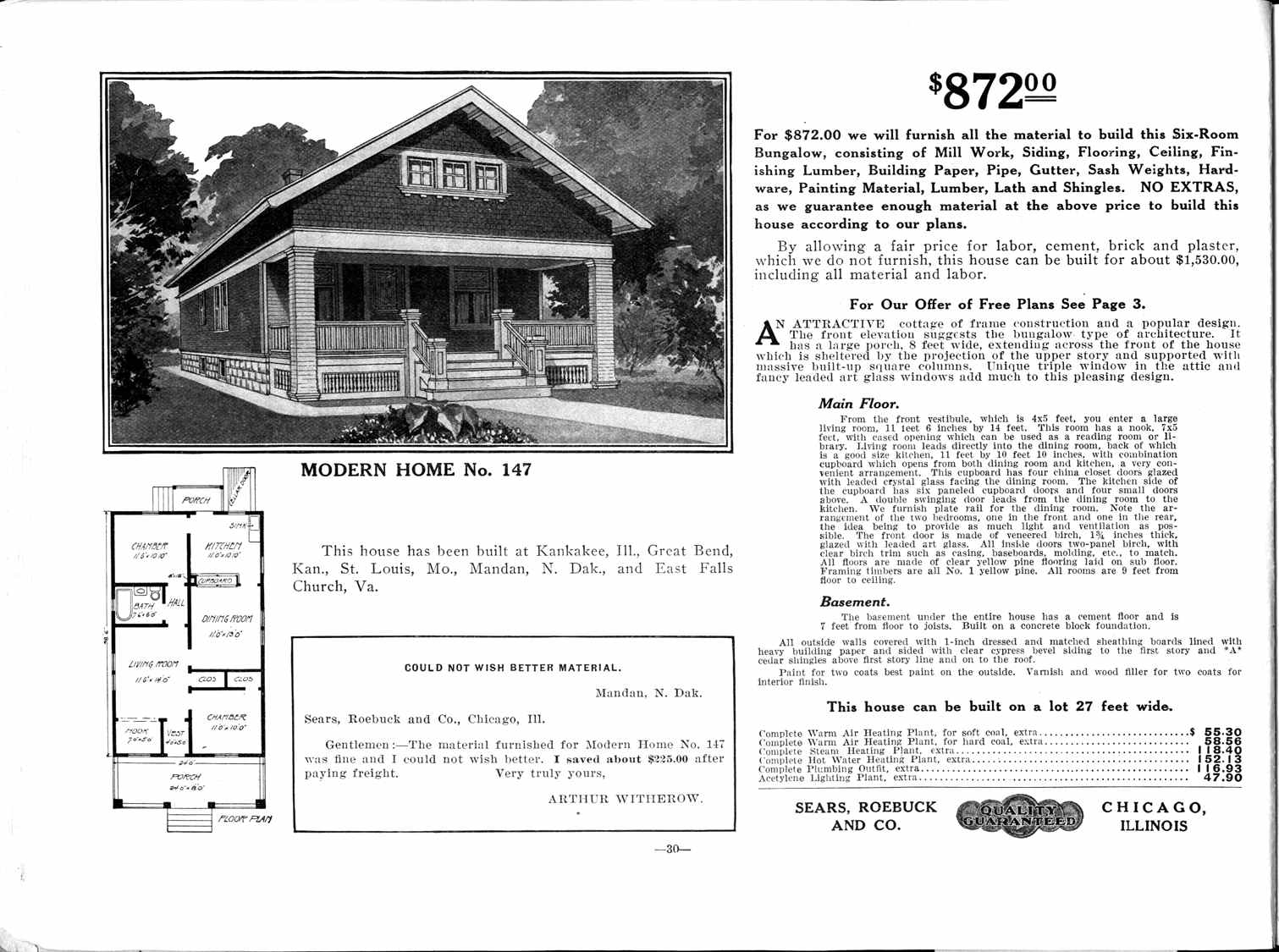
The 1914 sears Model 147 house was 900sqft and cost $872 for materials, estimated at $1,530 with labor.[1] Adjusting for inflation from 1914 to 2020, that is about $22,000 for materials and 40K with labor.

Looking at 1913 US national labor statistics, the average baker in 1913 San Francisco worked 54 hrs/wk and made $0.46 per hour for an annual wage of $1,291[2] (or 33K in 2020 dollars)

The median baker in 2020 California makes 36.5K/yr [3]. The cost of new housing construction is $220/sqft[4], or 200K for the same size house.

http://www.searsarchives.com/homes/images/1908-1914/1913_014...

https://fraser.stlouisfed.org/title/union-scale-wages-hours-...

https://www.careeronestop.org/Toolkit/Careers/Occupations/oc...

https://ternercenter.berkeley.edu/wp-content/uploads/pdfs/Ha...

Post reply on HN