Live data from Hacker News

Nuclear power may be the key to least-cost, zero-emission electricity systems

carnegiescience.edu

51–60 of 88 posts

Re: Nuclear power may be the key to least-cost, zero-emission electricity systems

#51
post #45
post #34

Earlier quoted context omitted.

I'm happy that this is getting some attention. There will never he "just renewable" power grid due to renewables intermittency. The realistic options are renewables + some other energy source, or renewables + a lot of storage. Renewables + storage has a problem: energy storage at scale is not a solved problem at all, either it is hard to build (pumped hydro) not scalable (batteries) or barely in PoC stages (various a…

Pumped hydro is "harder to build"? Fengning cost $1.8 billion for 3.6 gigawatts and took about 7 years to build. Hinkley point C will be about $30 billion dollars for 3.2 GW and will take about 10 years to build. Even prima facie I don't see how building a nuclear power plant could seem easy compared to pushing water uphill.

One of them being in China and the other being in UK would probably explain the costs by itself.

Re: Nuclear power may be the key to least-cost, zero-emission electricity systems

#52
post #2

Why is it so hard to grasp: we don't want to trade our toxic carbon byproduct for toxic fission byproduct?

Contrarily to carbon byproduct, we know how to confine fission byproduct, at least short term (which is still better than neither short term nor long term).

Re: Nuclear power may be the key to least-cost, zero-emission electricity systems

#53

I am curious if there is anyone here who can answer this here. What will happen if a fission reactor is blown as a result of warfare (by a bomb or missile)? Is it Chernobyl-grade hazard or not? Also, how strongly does the danger correlate with reactor size?

They're designed to sustain an airliner crashing into it so I guess bomb or missile is okay, although that's another story if that would happen from inside the reactor.

Interesting, but I doubt these are a majority.

I also don't think a plane is comparable to warfare in this aspect, a falling plane is an accident (or a relatively cheap act of terror), a missile can be a ballistic one, I don't think you can protect anything above ground from targeted destruction intent

Re: Nuclear power may be the key to least-cost, zero-emission electricity systems

#54
post #34

These sentences sum up the article quite well: "Previous studies have shown that curbing 80 percent of carbon emissions can be achieved by ramping up wind and solar power harvesting installations" and "To nail down that last 10 or 20 percent of decarbonization, we need to have more tools in our toolbox, and not just wind and solar," The "more tools" may be nuclear or it may be storage, depending on the cost of both t…

I'm happy that this is getting some attention. There will never he "just renewable" power grid due to renewables intermittency. The realistic options are renewables + some other energy source, or renewables + a lot of storage. Renewables + storage has a problem: energy storage at scale is not a solved problem at all, either it is hard to build (pumped hydro) not scalable (batteries) or barely in PoC stages (various a…

In the US the majority of natural gas comes from "tight gas" which is produced by fracking. It can also be produced as a by-product of crude oil extraction (the alternative is flaring it off) or from biogas (capturing methane from trash), but both of those accounts for very little production [0].

There are industrial processes that need natural gas as part of the chemical reaction, so there will always be a market for it. Using natural gas for electricity or heating is definitely not "green" or renewable.

[0] https://www.eia.gov/energyexplained/natural-gas/where-our-na...

Re: Nuclear power may be the key to least-cost, zero-emission electricity systems

#55
post #45
post #34

Earlier quoted context omitted.

I'm happy that this is getting some attention. There will never he "just renewable" power grid due to renewables intermittency. The realistic options are renewables + some other energy source, or renewables + a lot of storage. Renewables + storage has a problem: energy storage at scale is not a solved problem at all, either it is hard to build (pumped hydro) not scalable (batteries) or barely in PoC stages (various a…

Pumped hydro is "harder to build"? Fengning cost $1.8 billion for 3.6 gigawatts and took about 7 years to build. Hinkley point C will be about $30 billion dollars for 3.2 GW and will take about 10 years to build. Even prima facie I don't see how building a nuclear power plant could seem easy compared to pushing water uphill.

Worth pointing out that pumped storage can store power for months if necessary, but it can generally only supply electricity for several hours before it runs out. Whereas a nuclear powerplant will supply that electricity indefinitely.

So if you have a wind lull that lasts several days you may run into issues unless you have a lot of pumped storage.

Re: Nuclear power may be the key to least-cost, zero-emission electricity systems

#56
post #34

These sentences sum up the article quite well: "Previous studies have shown that curbing 80 percent of carbon emissions can be achieved by ramping up wind and solar power harvesting installations" and "To nail down that last 10 or 20 percent of decarbonization, we need to have more tools in our toolbox, and not just wind and solar," The "more tools" may be nuclear or it may be storage, depending on the cost of both t…

I'm happy that this is getting some attention. There will never he "just renewable" power grid due to renewables intermittency. The realistic options are renewables + some other energy source, or renewables + a lot of storage. Renewables + storage has a problem: energy storage at scale is not a solved problem at all, either it is hard to build (pumped hydro) not scalable (batteries) or barely in PoC stages (various a…

> There will never he "just renewable" power grid due to renewables intermittency. The realistic options are renewables + some other energy source, or renewables + a lot of storage.

On the contrary, in principle there can be. However, even though a napkin estimate says it’s orders of magnitude cheaper, there are a lot of new and exciting problems with building an intercontinental power grid.

And I keep thinking I need to make a video or a blog post about why beamed power is a terrible idea for Earth, but again, technically it’s a way to avoid storage.

But enough batteries for cars is also enough for a renewable grid, so it’s probably not important.

Re: Nuclear power may be the key to least-cost, zero-emission electricity systems

#57
post #14

Earlier quoted context omitted.

Yes we do want to trade that. The toxic carbon byproduct goes into the air and causes massive disruption to the lives of billions of people. The toxic fission byproduct is tiny and goes underground in the middle of the desert and disrupts zero people's lives.

Because constructing nuclear power plants and mining uranium don't have toxic carbon byproducts? What are the toxic byproducts you are talking about specifically? > The toxic fission byproduct is tiny and goes underground in the middle of the desert and disrupts zero people's lives. Haha, if it were that easy. Nuclear waste can be radioactive up to 1 million years. Can you give me an example of a successful long-term…

If it's active for a million years it has to be less dangerous per unit mass out of mathematical necessity. At some point you wind up with something that's about as dangerous as a banana, at which point you can dispose of it however you want.

Re: Nuclear power may be the key to least-cost, zero-emission electricity systems

#58
post #2

Why is it so hard to grasp: we don't want to trade our toxic carbon byproduct for toxic fission byproduct?

We don't want the toxic waste from Solar panel production nor the industrial waste or the noise pollution from windmills either. At some point we'll have to chose the lesser evil, and most of the good rivers have already been dammed so more hydro isn't really the solution. A combination of renewables, nuclear base power, reduced power needs, smart grid load management, and synth fuel production during peak production…

We don't want the toxic waste from Solar panel production [...]

I am really tempted to call this one bullshit. I will admit that I just started reading about this topic half an hour ago because of this thread, so I may be wrong and I will happily change my mind if someone makes the case. I just skimmed the first page of search results for toxic solar panel waste. They mostly seemed rather negative, so I don't think I only got to see the white washed numbers. However most numbers seemed a bit dated, 2016 was a year I repeatedly came across. I will not provide sources as I really just skimmed the articles and collected the numbers.

Solar panels are recyclable but the costs of USD 20 to USD 30 per panel are considered prohibitiv. Doesn't seem to bad to me, it's not negligible but also not outrageous. High recycling costs are attributed to low recycling volume while on the other hand the problem is described as a gigantic pile of toxic waste. Europe seems to mandate the recycling because it is not economically attractive.

For 2016 I found a number of 11,000 tons of lead, I am neither sure for what geographical area nor whether it is cumulative or for that one year. On the other hand I found that in the European Union an estimate 100,000 tons of lead are annually introduced into the environment from sport shooting, hunting, and fishing.

Another thing that gets mentioned is silicon dust during production. Seems a manageable problem to me if we think we can manage the handling of radioactive compounds for nuclear plants. There is admittedly probably a difference in scale and volume, so this might have an impact. Nitrogen trifluoride also gets mentioned, especially because of its carbon dioxide equivalent of about 17,000. I did however not notice any numbers about the amounts used or released. But this again seems not like an unmanageable problem.

Cadmium is also usually mentioned, about one percent of the amount of lead, but there is not much more information than that it is carcinogenic. Finally rare earths are often mentioned and their limited supply, the production condition, and so on just as in the discussion of semiconductor and electronics manufacturing in general. If I am not misremembering the easily accessible supply of uranium ores is also quite limited, especially if one considers a substantial expansion of nuclear power production.
Re: Nuclear power may be the key to least-cost, zero-emission electricity systems

#59
post #7
post #2

Why is it so hard to grasp: we don't want to trade our toxic carbon byproduct for toxic fission byproduct?

Renewables also have toxic byproducts. And also destroy nature. It is mot like they are greenest green all the way.

Why the download? Somebody must mine the heavy metals in solar panels, same way some one must mine uranium. Water dams destroy natural habitats of animals and people, I can continue. Nuclear plants take up quite a little of space compared to their output. And the fuel cycle is completely closed - meaning none of it leaks out by design(gas, coal). Not all countries in the world recycle or eco disposal the solar panels.

Re: Nuclear power may be the key to least-cost, zero-emission electricity systems

#60
post #34

These sentences sum up the article quite well: "Previous studies have shown that curbing 80 percent of carbon emissions can be achieved by ramping up wind and solar power harvesting installations" and "To nail down that last 10 or 20 percent of decarbonization, we need to have more tools in our toolbox, and not just wind and solar," The "more tools" may be nuclear or it may be storage, depending on the cost of both t…

I'm happy that this is getting some attention. There will never he "just renewable" power grid due to renewables intermittency. The realistic options are renewables + some other energy source, or renewables + a lot of storage. Renewables + storage has a problem: energy storage at scale is not a solved problem at all, either it is hard to build (pumped hydro) not scalable (batteries) or barely in PoC stages (various a…

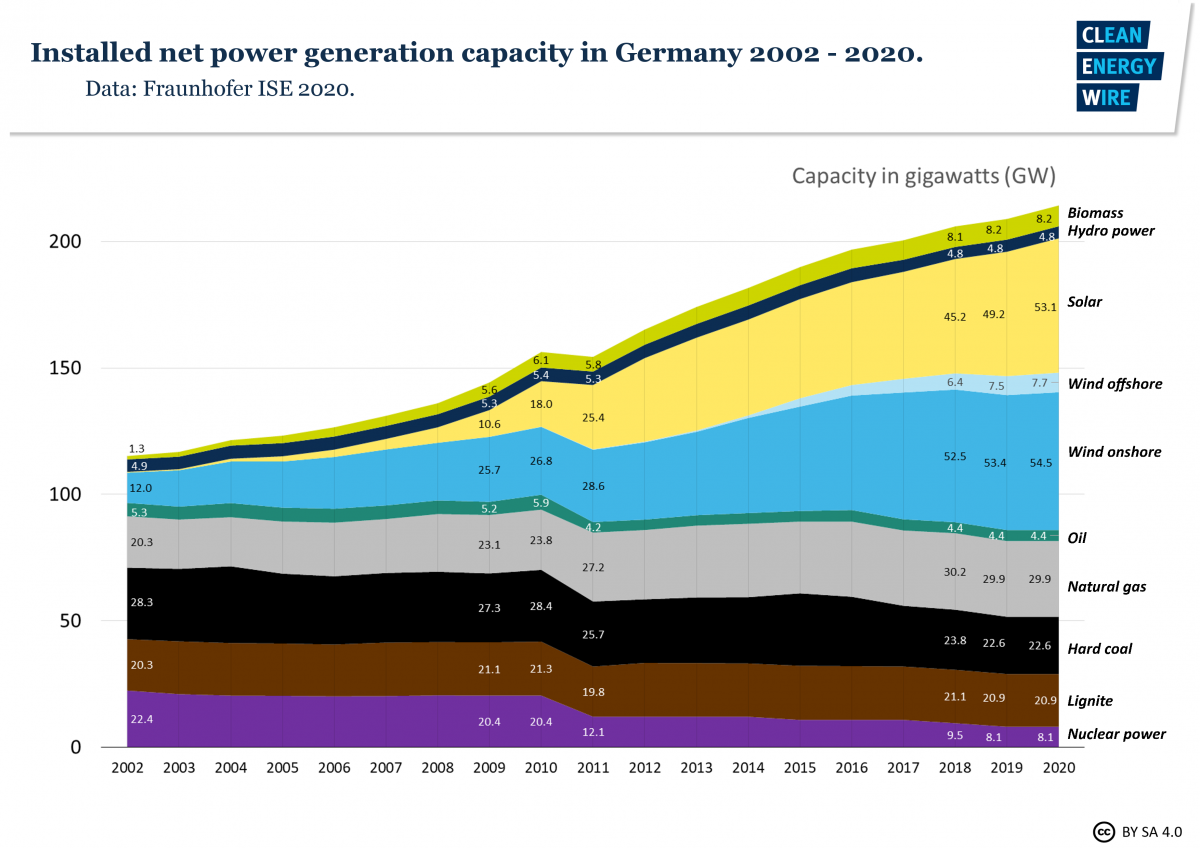
There is also a major issue with the current way renewables are used. They aren't used to replace existing sources, they're used on top of existing sources:

https://www.cleanenergywire.org/sites/default/files/styles/g...

Renewable would only work if we stopped our quest for constant growth, which won't happen any time soon, in the meantime it's 90% marketing: "keep consuming it's green"

Post reply on HN