Live data from Hacker News

What to know about the stock market (2007)

betterexplained.com

31–40 of 372 posts

Re: What to know about the stock market (2007)

#31

I have a book written by André Kostolany, which taught me one thing and I believe I've forgotten the rest, because only this one fundamentally matters: Don't hunt for rising stocks, but chase the falling stocks. Everything that goes down either eventually goes up again, or dies. While this sounds like it's not helpful, all that's required is figuring out if a company is likely going to die. Even without any manual re…

This is a strategy for ruin. You can easily backtest this yourself. Just go back in time and buy a stock that was -20% and see how many times you make a profit.

The market has inertia. What goes up usually continues going up and what goes down usually continues going down.

Re: What to know about the stock market (2007)

#32
post #8

the only thing you should know about the Stock Market: it favors those with more capital, if you don’t have much to begin with, don’t expect making life-changing amounts

I thought the same, but then I've seen this article :) https://12ft.io/proxy?q=https%3A%2F%2Fqz.com%2F2108874%2Fthe...

That article is… useless. But actually, it shows exactly what the parent poster said: the real riches came only after you had a lot of capital.

Sure, $1,000 to $85,000 is a great performance, but not life changing in itself.

Re: What to know about the stock market (2007)

#33
post #13

Earlier quoted context omitted.

Why? Clearly, no one is actually willing to trade at those prices. Sometimes, one illogical price in illiquid markets drive the orderbook to illogical extremes. Without a transaction, all are meaningless.

Bids and asks are making bold predictions about the current value of an asset. If they are wrong then anyone can enter the market and make a profit. Bid/ask of 99.90/100.10 means that the true value of the asset is between 99.90 and 100.10, because if it was really worth $100.20 someone would come in and buy up all the offers through $100.19 (give or take a bit for risk management, fees, and minimum profit targets).…

[deleted]

Re: What to know about the stock market (2007)

#34
Just curious:

Suppose there is some difference between buying price range and selling price range. The dealer (middle man) could become temporary in-between buyer or seller and take some of the profit due to this price difference.

For example this could happen at a stockbroker or at a crypto exchange.

Is this behavior regulated, and if so, how?

Re: What to know about the stock market (2007)

#35

Am I the only one in HN who is not into the stock market? I live in Western Europe and I would say 75% of my acquaintances don't do stock market. People I have known in the past (old people) didn't do stock market either. They all seem to have lived a normal life (decent jobs, decent house, decent family). Nothing extravagant but they got enough money to be "happy" in life.

You don't have to be "into" the stock market i.e. doing day trading. That's unlikely to make you rich unless you do it as a full-time job (and even then...). You can get lucky, but that's usually about it.

Instead, invest a regular amount of money monthly into ETFs. Those are relatively low-risk, but should still yield significant returns over the course of decades.

It's true that most people (at least in Germany) don't trust the stock market. The problem is that your wealth is being eaten up by inflation and interests on savings are low or even negative. You will lose money. In addition, Germany's mandatory pension funds are in a bad shape and most private insurances (e.g. Riester) are not worth it.

The situation is not the same as in my parents' generation and unfortunately, a lot of people are not realising that.

Re: What to know about the stock market (2007)

#36
post #27

Am I the only one in HN who is not into the stock market? I live in Western Europe and I would say 75% of my acquaintances don't do stock market. People I have known in the past (old people) didn't do stock market either. They all seem to have lived a normal life (decent jobs, decent house, decent family). Nothing extravagant but they got enough money to be "happy" in life.

I live in Germany and its the same. Not that that's a good thing. People here are old-fashioned and still believe in "Concrete gold." Fact is, as soon as you've got a meaningful amount of wealth, you're going to want to invest it so you can either get income from it or grow the principal. It could be in a home, multiple properties, or the stock market. > People I have known in the past (old people) didn't do stock ma…

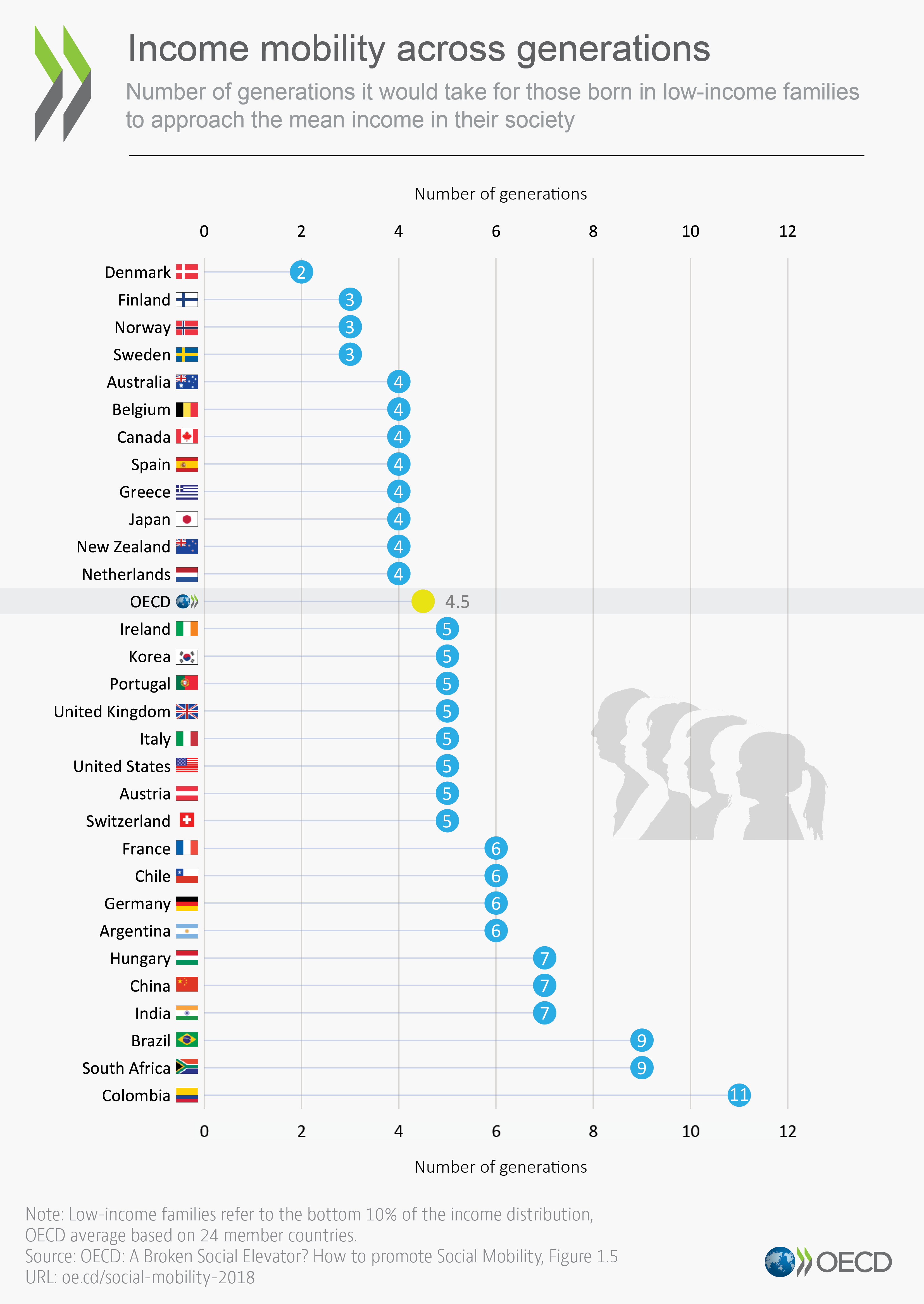
> Meanwhile in most European countries, punitive taxation makes it extremely difficult to move up in social class, even from middle class to upper middle class.

This is not true. Several of the highest taxed countries in Europe also have the best social mobility in the OECD: https://www.oecd.org/els/soc/1-5%20generations.png

It might be the case that Germany is particularly rigid, but that is not transferable to most of Europe and certainly can't be attributed to taxes.

Re: What to know about the stock market (2007)

#37
post #16

Earlier quoted context omitted.

Do any of them have private pensions? In the UK almost everyone will have been moved over to a "defined contribution" pension whose value is determined by the stock market, usually in the form of a "stakeholder pension". I don't "do" the stock market but I do have such a pension. And every few months sweep spare cash out of my current account into an index fund. Effectively I pay people to worry about this stuff on m…

Even with DB schemes their funding often relies on exposure to equities.

Yes, although the recipient is not supposed to be exposed to that - see the UCU strike starting today.

Re: What to know about the stock market (2007)

#38

Just curious: Suppose there is some difference between buying price range and selling price range. The dealer (middle man) could become temporary in-between buyer or seller and take some of the profit due to this price difference. For example this could happen at a stockbroker or at a crypto exchange. Is this behavior regulated, and if so, how?

I'm not sure what you're saying, but the spread between buying price and selling price is exactly how the temporary middle man gets paid for the risk they take in matching up buyers and sellers. The size of the spread depends on how large the perception of that risk is.

Re: What to know about the stock market (2007)

#39

Earlier quoted context omitted.

It's all about the outside influence. When the media doesn't push it, people aren't going to do it. Don't believe it? When the media started pushing GME, people went and bought GME. When the media started pushing btc, people went and bought btc. Stocks aren't being encouraged, therefore most people don't do it and instead cluelessly dismiss it mostly as gambling. Same goes for cryptos. Right until the media pushes it…

It is also the case that professional traders make a lot of money out of retail investors. The percentage of retail investors that actually make money are, iirc, quite small. It doesn't make sense to do something when you don't have the time to get good at it, and being bad at it means you're going to lose money. Sometimes you're forced to (when an investment is tied into a basic necessity, like a house), but you're…

Retail _traders_ tend to lose money, retail _investors_ who buy and hold tend to do OK in the long run.

> investment is tied into a basic necessity, like a house

? What does this refer to?

Re: What to know about the stock market (2007)

#40

Am I the only one in HN who is not into the stock market? I live in Western Europe and I would say 75% of my acquaintances don't do stock market. People I have known in the past (old people) didn't do stock market either. They all seem to have lived a normal life (decent jobs, decent house, decent family). Nothing extravagant but they got enough money to be "happy" in life.

As a Swede in Switzerland, I think the main difference to the US is the cost. European commissions is mostly "buy and never look again." That fosters a culture where only a few people care and talk about it.

In Switzerland, I have to pay ~0.1% stamp duty on every purchase and sale of stocks and ETFs (in a Swiss broker). The UK has a 0.5% stamp duty on stocks. The idea for these brokers to compete on price doesn't make much sense at that point. It's "fine" that the normal fund has a 0.5-1% fee. There's some movement here, but only if you care to engage outside your existing bank (IBKR in the UK, Avanza++ in Scandinavia, Degiro in Europe in general).

Investing is good, and---as has been said---pensions are often invested in the stock market, whether you know it or not. But you just don't talk about it, because being active is costly. In Sweden, the defined contributions are auto-invested in a balanced fund unless you engage. There's something to be said about having sane defaults when you create a system.

As for the US, I'm not sure Robinhood was a step in the right direction. We should encourage people to own companies, not try to profit from Brownian motion. But that's perhaps a topic for another discussion.

Finally, I'm heavily into the stock market. I have several accounts across the world (though not really by design). I'm fascinated about this oddity that I can buy more food in the future just by having a different piece of paper, compared to someone else. But I also spend a stupid amount of time trying to find ways to reduce cost of investments. My guess is that most people don't, and it's kind-of the first step for a European that's paying >1% in fund fees. Or who don't even know how much they're paying.
Post reply on HN