Live data from Hacker News

Does the human lifespan have a limit?

nature.com

121–130 of 227 posts

Re: Does the human lifespan have a limit?

#121
post #105

My grandparents are now 95 and 96 (just shy of their 75th wedding anniversary). They are wonderful people, but it is clear that life is hard for them now. They have chronic pain and nothing can really be done about it. They have very limited opportunities for enjoyment or activity. Watching them, and also my mother struggle with health issues at 73, has really changed my perspective on aging. I am very focused on enj…

That's where my grandparents are right now. They retired in their early 60s, and they have a solid income between ss, pension, and 401k, but their healthcare takes up more-and-more of that money and they still struggle with their health. And just what have they done with their 30-odd years since they retired? They didn’t travel, pick up new hobbies, or finish their educations.

Retirement isn’t my goal. I want to work full-time until my late 70s, and die in my early-to-mid-80s at the latest. In the meantime, I’ll spend my money flying, traveling, and on my apartment and a fast car.
Re: Does the human lifespan have a limit?

#122

The half-life of a DNA strand is purportedly to be about 542 years. So, it’s probably like 250 years with intensive DNA repair effort.

Aren't cells constantly being replaced, including their DNA?

Cells are self-replacing under the control of their own DNA; not pumped out of a factory. Slowly accumulating errors in the DNA can compromise the ability of cells to make good copies of themselves, potentially leading to cancer calls instead.

Re: Does the human lifespan have a limit?

#123

Earlier quoted context omitted.

Aren't cells constantly being replaced, including their DNA?

Cells are self-replacing under the control of their own DNA; not pumped out of a factory. Slowly accumulating errors in the DNA can compromise the ability of cells to make good copies of themselves, potentially leading to cancer calls instead.

Right, that makes sense, but that's not really relevant to what I assume is the half life of a specific strand of DNA, right?

Re: Does the human lifespan have a limit?

#124

Earlier quoted context omitted.

> As a non Christian this always baffles me. I don't understand how this is in any way baffling. There were plenty of humans around for people to observe when the bible was being written, and some of them probably lived to be quite old.

How many 120 year olds do you think the average person would be exposed to several thousand years ago? Especially in an age where birth certificates did not exist. I have never seen a supercentenarian myself, and I have been in a lot of nursing homes. I only know they exist because of the internet to be honest.

Personally, probably not very many. But traditions of information sharing and story telling between humans have been strong long before the internet. This isn't some obscure information about space or DNA or something. This is something that would have been relatively accessible without technology.

Re: Does the human lifespan have a limit?

#125
post #73

There's an old quip that the greatest correlation for a country to have supercentenarians is them not issuing proper documentation at birth 120 years ago. So yeah, currently there's a hard limit - around 100, more or less, but with life seldom being worth living after 90. I really wish we'd start investing in breaking this. I'll happen at some point, the only question is when, and I'd think it's obvious why we'd want…

I don’t think the point of living beyond 100 years old is the years that come after you are 90 (pretty bad years), but that one has more “nice” years to live. Example: - average person who dies at 80. Middle point in his life at 40. At 20 the person has already lived a 1/4 of his life. - imagine a supercentenarian who dies at, for the sake of examples, 120. This person at his 60s is like the average person at his 40s…

That's quite an assumption. Plenty of examples exist of people with decay starting later than average that eventually went through a short "off-ramp" earlier, plenty of examples of people who experienced significant decay very early but then dragged it out very long, seeing their "still seemed so young ten years ago!" peers disappear one by one.

Re: Does the human lifespan have a limit?

#126
Extending life is a fantasy of the middle-aged who are still feeling great and imagine it forever.

You won't get it until you pass a certain year, where like an old car, things suddenly start failing one at a time where everything was fine for years.

Diseases, illnesses like Covid can cause radical aging, one year you are turning 55 but Covid now makes it like you are 65 because all your organs, body and brain have been stressed and damage beyond self-repair.

And endless common problems have no cure, ie. Raynalds, Small-Fiber Neuropathy, no cures, no prevention, many people get them when they are older.

Quantity of life is meaningless without quality of life.

We may reach a point where many people live past 100 but that will be because they are genetically engineered from birth to have great health.

Doesn't help we are poisoning the water and air, willingly and openly, not in third world countries but right here in USA like Texas: https://www.fastcompany.com/90692691/this-super-detailed-map...

Re: Does the human lifespan have a limit?

#127
post #111

Earlier quoted context omitted.

Dr. Sinclair's book Lifespan ( https://www.amazon.com/Lifespan-Why-Age_and-Dont-Have/dp/150... ) talks about extending the health span of people. I've been personally taking 1g/day of NMN for almost 3 years now, and I feel like aging has paused or is going backwards slowly.

Where can you get NMN?

Don't bother. Sinclair is considered a quack by even some life-extension enthusiasts.

He owns part of the company that makes patented NMN which is just another form of NR which is a another form of very cheap Niacin.

He also owns part of the company that claims he is rolling back his biological clock.

That's not science, that's marketing and profiteering.

NAD production slows down with age and illness. All he is doing is supplementing what was produced more easily by a younger body.

There are a many other factors to aging, most of which cannot be changed (yet) by science.

Re: Does the human lifespan have a limit?

#128
post #111

Earlier quoted context omitted.

Dr. Sinclair's book Lifespan ( https://www.amazon.com/Lifespan-Why-Age_and-Dont-Have/dp/150... ) talks about extending the health span of people. I've been personally taking 1g/day of NMN for almost 3 years now, and I feel like aging has paused or is going backwards slowly.

Where can you get NMN?

https://www.prohealthlongevity.com/collections/nmn-bulk-and-...?

Re: Does the human lifespan have a limit?

#129
post #111

Earlier quoted context omitted.

Dr. Sinclair's book Lifespan ( https://www.amazon.com/Lifespan-Why-Age_and-Dont-Have/dp/150... ) talks about extending the health span of people. I've been personally taking 1g/day of NMN for almost 3 years now, and I feel like aging has paused or is going backwards slowly.

How old are you? How are you gauging “aging has paused or is going backwards slowly”?

Mid 30s. Gauging by how my joints feel and how quickly I recover from physical exercise and injuries.

Re: Does the human lifespan have a limit?

#130
post #74

Earlier quoted context omitted.

Didn't most people live to their 60s if they survived childhood and pregnancies?

The child ( Life expectancy at birth was around 30-35 for at least the several preceding centuries in Europe.

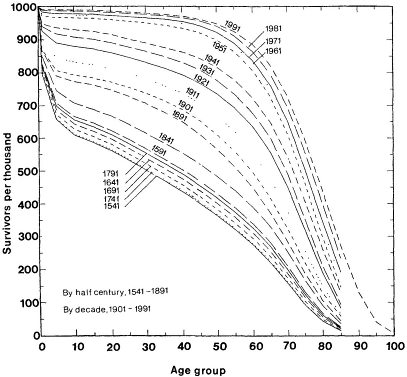
This is a nice graph from the Modern Age (mid-1500s to late 1900s) in England.

https://publishing.cdlib.org/ucpressebooks/data/13030/tf/ft0...

Basically, until the 19th century, between 25-35 % of people lived to be 60 or more. In the 20th century, this grew rapidly up to 90 per cent.

80 y.o.-s would be very rare even in the 19th century, while now about half of the population lives to be eighty.

Note that this is the Modern Age. In the Middle Ages, survival would have been worse. A more primitive agriculture, less developed long distance trade and fewer staple foods (no potatoes etc. in Europe prior to the Columbian exchange) would result in frequent famines that took the infirm first.

Things would be yet worse in the Early Middle Ages, the period of frequent nomadic incursions and warfare in most of Europe. At least the High Middle Ages were relatively peaceful compared to the period before.

Post reply on HN