Live data from Hacker News

Starlink lost 40 satellites to a geomagnetic storm

spacex.com

451–460 of 508 posts

Re: Starlink lost 40 satellites to a geomagnetic storm

#451
post #391

Earlier quoted context omitted.

Solar flares should be a lot lower on the list, as the bulk of the risk can actually be mitigated in the electric grid. Every few years the IEEE publishes an article on the risk solar flares pose to the electric grid, and how it can be mitigated by installing capacitors on the multi-ground neutral. Remember: solar flares induce current in long wires, not short ones, so the risk is not so great to individual electric…

I'm a big proponent of the DOE's suggestion for a national strategic transformer reserve. They estimate $500mil (2017) would cover buying enough redundant transformers to resuscitate the power grid after a nationwide failure. Pre-covid, the typical lead time for a full scale transformer was ~2 years. I'm assuming it would take even longer now. I can't imagine how long it would take to replace our transformers if ~1/4…

THIS!!

Having a full set of spares requires zero re-engineering of the existing grid, and will turn a multi-year grid failure catastrophe into a few days to restore critical components and some weeks of restoring full function.

Since our solid solar observation capabilities now give several days notice before arrival of such storms, some could even be pre-positioned at critical substations.

And you are absolutely correct that the DOD would have very good reason to do this - losing the grid nationwide would be an insane level national security risk.
Re: Starlink lost 40 satellites to a geomagnetic storm

#452

Earlier quoted context omitted.

I'm very confused about this comment - how is losing 40 operational satellites a "great way to test the resilience of Starlink launches during a predicted geomagnetic storm"? And what part of this is "great PR"?

They lost only recently launched sats that had not yet raised their orbits. They did not lose other sats. That is a test of starlink's resilience!

The OP stated this was a test of the resilience of Starlink launches, not the system itself. In either case, surely there are better ways of testing this than letting 40 brand new spacecraft burn up.

Re: Starlink lost 40 satellites to a geomagnetic storm

#453

Earlier quoted context omitted.

That's part of the reason there's just so much junk flying around in orbit. https://en.wikipedia.org/wiki/Kessler_syndrome

If you read the article, SpaceX specifically designed the process to avoid orbiting junk.

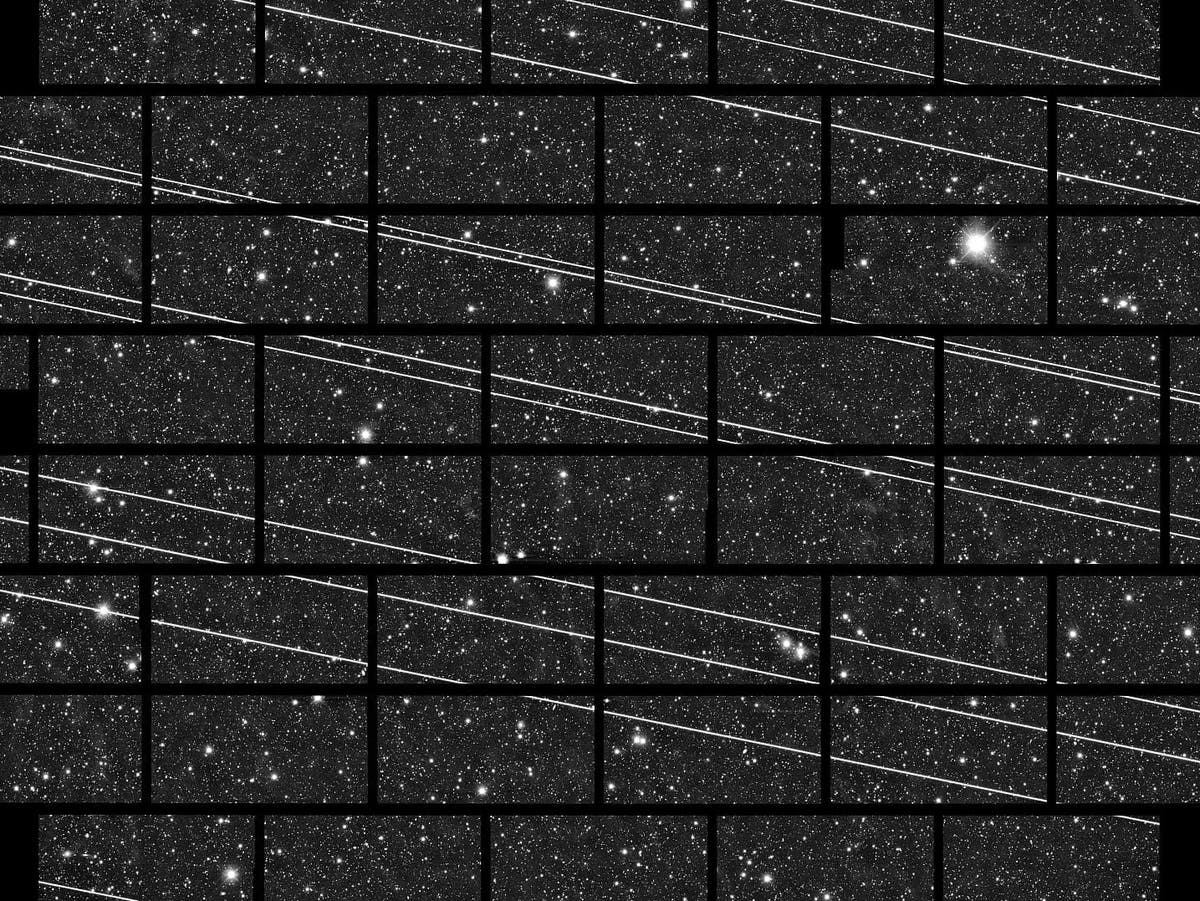
There is no guarantee of this. Very possible the satellites can break up and cause junk/collisions. They are too bright and block astronomers already:

https://static.independent.co.uk/s3fs-public/thumbnails/imag...

https://www.labroots.com/trending/space/22175/spacex-starlin...

Re: Starlink lost 40 satellites to a geomagnetic storm

#455

> "…meaning no orbital debris is created and no satellite parts hit the ground." How is this possible? Maybe I'm missing something, but the satellite parts have to go somewhere

Burned up on entry, rendered down to heat, gas, and ash. Debris would usually be considered chunks of the original, so ash doesn't count. In this context it also means none of that is left in orbit either, which may be the more significant advantage of their procedures.

That makes sense. The forces involved are just mindblowing that it would be sufficient to make this happen.

Re: Starlink lost 40 satellites to a geomagnetic storm

#456

It must be noted that the satellites were not directly damaged by the geomagnetic storm. The storm warmed the atmosphere which caused it to expand, leading to additional drag that prohibited the satellites from leaving their low "safe mode" orbit. Shortened excerpt: "These storms cause the atmosphere to warm and atmospheric density at our low deployment altitudes to increase.... speed and severity of the storm caused…

Given Musk's email about SpaceX being close to bankruptcy, how will this affect them financially? Can SpaceX survive without a bailout? What would a bailout look like, another Solarcity? https://spaceexplored.com/2021/11/29/spacex-raptor-crisis/ "Unfortunately, the Raptor production crisis is much worse than it had seemed a few weeks ago. As we have dug into the issues following the exiting of prior senior management…

[dead]

Re: Starlink lost 40 satellites to a geomagnetic storm

#457

Earlier quoted context omitted.

"So…we have the Space Weather Prediction Center [0] and raw data from NOAA for this exact purpose. Does SpaceX not review the data / warnings before launch?" is not just asking questions; it's full-on passive-aggressive. Being pseudo-anonymous and safely behind a screen depersonalizes the experience enough that we get tempted to take swipes for some reason (I do too), and it diminishes the experience on places like H…

Fine, I'll be direct. Why does it appear that SpaceX failed at risk management in the presence of readily available data to suggest delaying launch?

You don't know what SpaceX's risk models show. They likely have to balance launch delay costs with launch risk costs, among other variables.

Re: Starlink lost 40 satellites to a geomagnetic storm

#458

Earlier quoted context omitted.

Out of curiosity, where would you rank the climate crisis on this list? It has already irrevocably caused the extinction of lots of species, and while certainly humans will continue to live, "modern humanity" will be replaced by something else.

My list: 1. Solar flares 2. Rogue AI 3. World war 3. Water scarcity (tied to war above) 5. Pandemic 6. Climate disasters My naive perception heavily weighs future possible technological progress. Solar flare collapse is basically unmitigable due to a combination of unpredictability and deep systemic interdependence and dependence on susceptible technologies. Some governments paid lip service to this risk in the past,…

Climate disasters should get a boost because it can lead to war and water scarcity. Consider India and Pakistan. Both of them greatly depend on water from Himalayan glaciers, a source that is rapidly declining due to climate change.

They could end up at war over this, and they both have nukes. They have relatively small stockpiles with relatively small nukes so you might not think this would be a big deal globally--a terrible tragedy still but just a regional tragedy.

Not so. Here is an article [1] and a paper [2] that looks at global consequences of India and Pakistan exchanging 100 nukes (about 1/3 of what they have) each the size of what the US used on Hiroshima at the end of WW II and directed at major population centers in the two countries.

Based on the amount of combustable material in those areas, they estimate that the resulting firestorms would put 1.8 Tg of soot aerosol into the upper atmosphere.

Climate models say the effect of that would be a 1.8℃ temperature reduction and an 8% precipitation reduction lasting for many years.

They then apply state of the art crop models to predict the effect on agriculture. The result would be a serious reduction in yield which would be largest in temperate regions of the US, Europe, and China for 10-15 years.

There would be food shortages and famine in rich countries that normally do not see famine. That can be pretty destabilizing and it is not a stretch to imagine some first world countries might go to war over food--including countries that have a lot more than small stockpiles of Hiroshima-sized nukes.

[1] https://blogs.ei.columbia.edu/2020/03/16/even-limited-india-...

[2] https://www.pnas.org/content/117/13/7071

Re: Starlink lost 40 satellites to a geomagnetic storm

#459

Seems like a great way to test the resilience of Starlink launches during a predicted geomagnetic storm. And great PR considering how much negative press they’ve been getting over space junk. https://www.google.com/search?q=starlink+space+junk&rlz=1CDG...

I'm surprised they're not spinning the PR angle further - there's a lot to be contested; they could boast how they're more careful than competition, launching Starlink sats in low, very rapidly decaying orbits, and slowly boosting them to their still low orbits, taking on a weather-induced hit of ~$50M to their bottom line by limiting margins so that there's no way their satellites contribute to space junk.

Re: Starlink lost 40 satellites to a geomagnetic storm

#460
post #20

40 sats makes up about 2% of the current fleet - so a rounding error in cost and time. The important part of this news is how those 40 sats deorbit and leave no junk either in orbit or on earth.

If we end up losing 2% of the population due to covid, I look forward to the news briefing that this loss is just a rounding error.
Post reply on HN