Live data from Hacker News

Royal Society cautions against censorship of scientific misinformation online

royalsociety.org

531–540 of 970 posts

Re: Royal Society cautions against censorship of scientific misinformation online

#531
post #24

Earlier quoted context omitted.

> because we don’t have time This part is a huge society-wide problem that can theoretically be fixed so people can become more informed and active participants in the framework of their daily lives. Don’t ask me how, though, because I just got off work and am too exhausted to do anything except let the news tell me what to be afraid of today, then probably binge The Office and slam a few brewskis until I fall asleep…

Even if I do have time and energy, my lack of knowledge on the subject matter would probably lead me to waste that time on dead ends, wrong conclusions, or learning things I will never use again outside of fact-checking one study.

> dead ends, wrong conclusions

You have to trust yourself to try anyway. Beats doomscrolling even if both are equally meaningless in the long run. Something that helps me is refusing to accept any narrative or conclusion about any topic where it would require a specific named group of people (e.g. members of any nationality, profession, corporation, ancestry, presentation, etc — anything) to be uniformly dumb or malicious.

That might sound silly but it means there’s no downside to entertaining any consideration, not even the downside of my own bad feelings from negative ideas. It totally removes a layer of mental latency I didn’t even realize I had until recently, even about topics where that wouldn’t ever be a question that’s possible to ask.

Instead of getting bogged down checking one story after another it’s easier to ignore entire storyline arcs at a time once they’re more obviously one set of jangling keys after another all vying for my attention at a higher priority than any self-directed interests :)
Re: Royal Society cautions against censorship of scientific misinformation online

#532

Earlier quoted context omitted.

It doesn't seem possible to me to ban general purpose computers. Any society that tries would at best, lose to the ones that don't. It seems impossible to me to have enough surveillance to both prevent unauthorized code and also still allow effective/competitive software development.

It may not be technically possible, but that won't stop misguided people from trying to regulate Turing machines and exploit their vulnerabilities. Rather than putting so much energy into in regulation, surveillance and offensive measures, I suspect the "winning" strategy is to focus on secure, verifiable computing. Whoever masters this first will grow an immunity to (human and AI) cyber-threats and gain a significan…

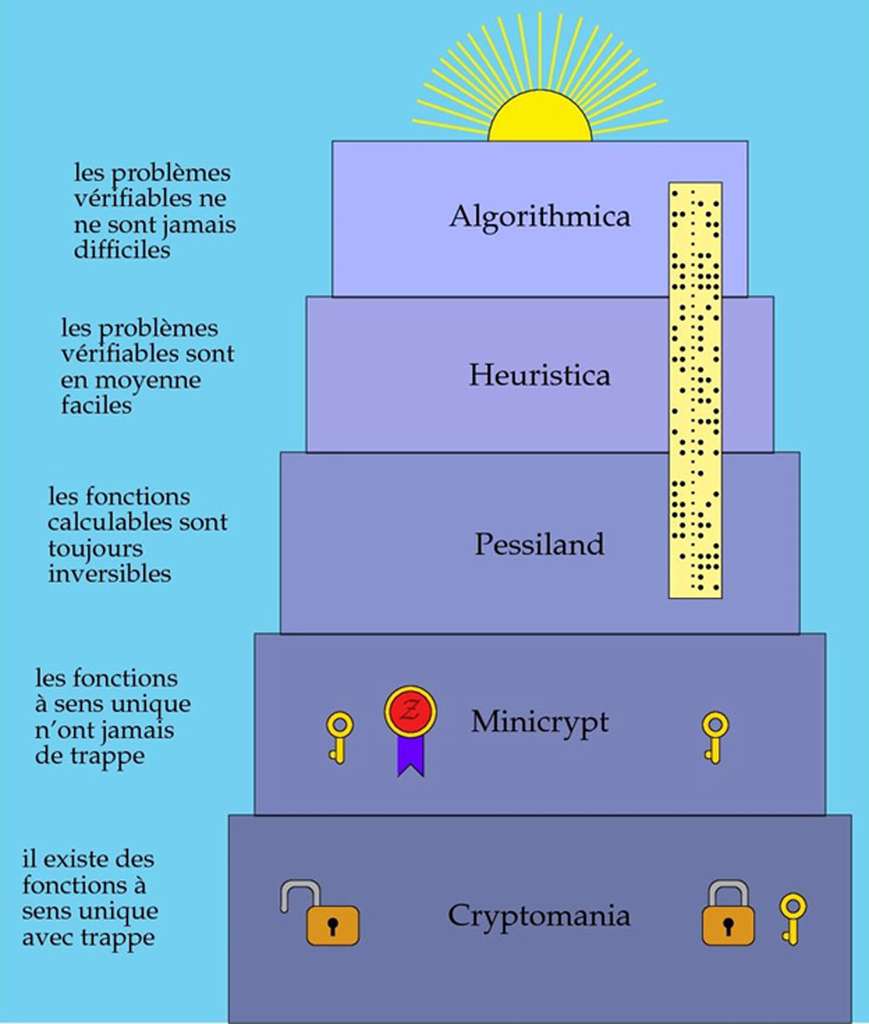
The extent to which truly secure computing is possible depends in large part on which of the many possible "cryptographic universes" we live in (based on how the algorithmic complexity categories like P and NP are).

https://cdn.futura-sciences.com/buildsv6/images/mediumorigin...

Re: Royal Society cautions against censorship of scientific misinformation online

#533
post #400

Earlier quoted context omitted.

Sharing source code for a HEP experiment is not that easy or possible at sometimes. A lot of stuff is done by different group and whole framework used and overall a lot of raw data collected and reconstructed involved. To analyze those even if available you willl need a lot of people with a lot of resources. So even it made available (which would be a lot of efforts itself) it wouldn't make much sense for replication…

How is it possible to peer review a paper when the only people qualified to do so are the one's involved in the research. Seems like a massive issue. Don't want to cast to much shade here, but there's a fair number of people that called out high energy physics for having problematic methodology. See Constructing quarks by Andrew Pickering. Ultimately, it should be CERNS job to release the data, yes even if it is tera…

>How is it possible to peer review a paper when the only people qualified to do so are the one's involved in the research. Seems like a massive issue.

Peer review isn't what it's chalked up to be. Basically it's two other people in the same field saying "There's no blatantly obvious issues with this paper" and even that isn't always guaranteed. Reviewers don't make any efforts to actually replicate the research, crunch the data, etc.

Re: Royal Society cautions against censorship of scientific misinformation online

#534

Earlier quoted context omitted.

With current Covid pandemic. I could be wrong but it seems most studies are looking at effectiveness of vaccines and little to nothing on effectiveness of natural immunity. I say this as someone who was one of the first to get vaccinated. Not that I am saying the pharmaceutical companies sponsored the studies. So to answer your question sometimes it is what is not funded that is probably more telling.

There are studies on "natural immunity" and even how it compares with the vaccines. (here's an example: https://www.medrxiv.org/content/10.1101/2021.08.24.21262415v... ) A lot of the antivax folks cling to the idea of natural immunity being better somehow, but who in their right mind would choose immunity from getting infected with a virus that can make you very very sick (or dead) and cause you to infect many others…

I am in South Africa. We initially struggled to get the vaccine and first phase was literally a clinical trial for health workers. We eventually did get stock but it seems by then a significant number of the population got Covid. Omicron variant doesn't seem to have affected us as much and surveys have shown that up to 80% South Africans have natural immunity from having had Covid. Yes there are some papers on the topic but government policy does not feature anything related to natural immunity. It wasn't a case of get intentionally infected rather it was a case of getting vaccines later than other nations.

Re: Royal Society cautions against censorship of scientific misinformation online

#535

Earlier quoted context omitted.

Op sounded very confident that the persons allegedly involved _are_, in no uncertain terms, not just definitely total frauds but also definitely engaged in a giant fraud conspiracy that definitely goes all the way to the top. If what they meant was "someone told me once that..." they could have said that instead, but they've chosen to word things very very differently. At best they've drastically overstepped reasonab…

Yes. Exactly. Thank you for sharing what I was going to share. Corruption exists where it is allowed by the people who act out of cowardice. As an aside, I've worked with plenty of academics and while I sometimes thought their research area was stupidly low stakes, the only researchers that I thought were truly wasting time were the ones that had to do research for a medical degree. Basically forced research. Now I w…

> There is a reason the West is incredibly wealthy and it isn't because our best and brightest are faking it.

The reasons for that can be myriad. Actual or false scientific success of the last 30 years is not necessarily it.

Also, don't you feel the ship has kind of been slowly going down during the last 10 years, wealth-wise ?

Re: Royal Society cautions against censorship of scientific misinformation online

#536

Earlier quoted context omitted.

> 1. Do you actually give a shit about this big fraud you’ve brought up but not revealed? To expose it directly here would likely have little effect generally, but would have an outsized effect personally (damaging trust). If it did have an impact it would likely expose those involved (many careers). I am not in the command chain, I have seen the evidence and it's overwhelming. But I'm not in a position to enact the…

> To expose it directly here would likely have little effect generally, but would have an outsized effect personally (damaging trust). If it did have an impact it would likely expose those involved (many careers). I am not in the command chain, I have seen the evidence and it's overwhelming. But I'm not in a position to enact the requisite change. Sorry, I don’t mean to pick at you but… what? If you were to anonymous…

Not sure why people are that hostile. I'm sure that identifying someone also can identify you if the circle around the person is small enough, and if said person is powerful enough, people choosing to believe them over him would end careers, yes. He'd have to say "well, i worked on this particular study with him, and the data was made up vs actually collected."

I think its more "how dare you hint scientists are corrupt!" that kind of drives the outrage.

Re: Royal Society cautions against censorship of scientific misinformation online

#537
The three recommendations are literally the antithesis of what modern news media does today, which is, in turn, largely due to the political motivations of the media organisations and their owners. I very much doubt that the royal society does not know this already.

Re: Royal Society cautions against censorship of scientific misinformation online

#538
post #213

Earlier quoted context omitted.

As long as vaccination comes with no strings attached, i have no problem with recommending it. Each individual should be allowed to make an informed decision about taking the vaccine and the booster shots. Just the same way as we have done with seasonal influenza all these years.

No and this is where I disagree. The people that disagreed with my opinion believed that I was trying to censor theirs with my own. I posted my opinion and a lot of people made assumptions about it without asking questions and made their own response. I have an extreme opinion according to some people. I'm also not the best authority on all of this but the people that pile on are assuming my opinion is an affront to…

I see your point, here in Europe it's different, since health care is usually free.

For me the infinite booster shots, is something that i want to skip, as an informed decision based on available data.

That might change further down the road, but i have an equally strong opinion that people should decide for themselves.

The financial viewpoint however, should convince some people that taking the vaccine is a sound choice.

Re: Royal Society cautions against censorship of scientific misinformation online

#539

Earlier quoted context omitted.

> Some well intentioned papers share code which is hard to run years afterwards. Umm, not really? How many years are we talking about here? Because even Cobol is runnable. Sure some OS related quirks may need changing but getting the raw source is much more likely to expose a subtle flaw in the researcher's method than just the equations. For example, an incorrect negative check (to string vs < 0) or an off by one er…

Don't think COBOL; think Python 2.1 (not 2.2) with this specific version of PIL, and some of the code implemented as a CPython module (for speed) in C that only compiles properly with one specific EGCS fork that adds support for IA-64. Parts of the code are written in slightly-buggy inline IA-64 assembly, but it's okay because after a system call, that particular operating system makes sure those registers are zeroed…

This comment could well have come from Chief O'Brien's mouth.

Re: Royal Society cautions against censorship of scientific misinformation online

#540
post #128

Earlier quoted context omitted.

I wasn't social media that eroded the trust in research and science, it was the introduction of politics. We need to separate research from politics. It needs to be a separate pillar of the state. You don't want reseachers chasing funds continously and doing short-term research for local sponsors. You want sizeable investments in long-term research projects, high autonomy and following of the scientific method. This…

The amount of resources available to spend on research is finite. Distribution of limited resources is politics. Historically, scientists either were well-off and independent (e.g. Ulug beg, Newton, Cavendish), or worked at the expense of very rich personal patrons (e.g. Tycho). This limited the number of potential scientists, and the amount of science done, quite drastically. In 18th-20th centuries it was somehow ov…

How about giving the institutions very top-level goals, on say 20 or 50-year basis, and then just give them a bag of money?

Research is a high stakes, high rewards type of game. You need to pursue many potential ways forward, and most likely only one will win.

Rewarding short term wins makes academia no different from industry, and prevents finding anything but the local maxima.

Post reply on HN