Live data from Hacker News

How bad is QWERTY, really? A review of the literature, such as it is

erichgrunewald.com

41–50 of 148 posts

Re: How bad is QWERTY, really? A review of the literature, such as it is

#41

> One week or so ago I switched from Colemak to typing on QWYRFM due to the reduced load it places on the pinkies. I typed Dvorak for 10 years before I started getting RSI again in my right ulna. It turns out that the 'S' key being hit by the pinky in Dvorak caused me a lot of pain. I ended up switching to BEAKL, a pretty obscure layout which is specifically made to alleviate stress on the pinky. It moves the relativ…

I wonder if changing your keyboard to use lighter switches is another way to alleviate that

Re: How bad is QWERTY, really? A review of the literature, such as it is

#42

> One week or so ago I switched from Colemak to typing on QWYRFM due to the reduced load it places on the pinkies. I typed Dvorak for 10 years before I started getting RSI again in my right ulna. It turns out that the 'S' key being hit by the pinky in Dvorak caused me a lot of pain. I ended up switching to BEAKL, a pretty obscure layout which is specifically made to alleviate stress on the pinky. It moves the relativ…

Did you ever try Colemak? I've been Colemak for probably 5 years now, I can't speak to pinkie specific pain but I get much less tired on long typing sessions. It's interesting to me how everyone seems to know of Dvorak over Colemak. But I never heard of BEAKL, thanks. For me the issue with Dvorak was that I wasn't ready to give up my function keys (control x, c).

Re: How bad is QWERTY, really? A review of the literature, such as it is

#43

I had been programming since I was 11 years old (now 30 years old professional programmer). I’ve spent innumearable hours at computer keyboard. I can type QWERTY and Russian layout blindly both and I constantly use both. Never had any issues with my wrists or finger pain. What am I doing wrong? Just to be clear I am not trying to say that people who use DVORAK are wrong. It’s just that you tend to forget there’s a hu…

As another commenter posted, it's not the typing that gets you, it's other stuff.

Like for example: you switch office space for a day, at the same time you got anew phone and you keep resting it on your pinky. You have a bad setup that day and think that it's no problem. Those in combination could easily cause a doctors visit because you can't use that pinky.

Do what you can to keep your hands in good shape and avoid weird static positions. Avoid weird movements. Try to use your back when lifting/pushing things, even small things like you coffee cup, lift close to the body not far away. Getting RSI is such a sucky thing have to deal with.

You are not doing anything wrong, you've just dodged bullets properly. So keep that going for you and make sure you keep on doing it!

Re: How bad is QWERTY, really? A review of the literature, such as it is

#44
post #16

> In other words, the idea is that QWERTY was designed so that humans would type as slowly as possible in order to prevent mechanical jamming. Nope. That's an oft cited story but it's not true. The point of QWERTY was actually to increase typing speed. The debunking of this is pretty well documented these days (there even a note on wikipedia: https://en.wikipedia.org/wiki/QWERTY#Properties ) so it's disappointing an…

The point of the QWERTY layout was to prevent jamming; the prototype layout was roughly alphabetical on the keyboard and jammed constantly, so it was refined to fix that mechanical problem.

The part that is a myth was that they prevented jamming by “slowing typists down”. What they did is moved commonly adjacently pressed letters apart from each-other so they wouldn’t be pressed at about the same time. This was not done explicitly to speed or slow typists (at the time, there was no established typing technique and there were no expert typists), except insofar as a constantly jammed keyboard was extremely slow.

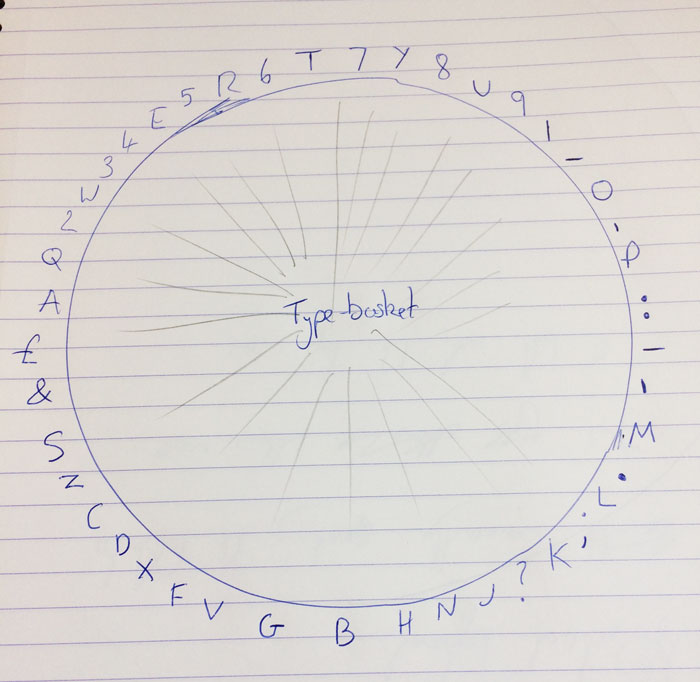
But the nearness that mattered was in the ring of typebars on the Sholes/Glidden/Schwalbach/Densmore typewriter, not the nearness of the keys on the keyboard per se. This typewriter connected the keys to typebars which were placed around a ring and struck upward at the platen. The association between keys on the keyboard and the positions around the ring is not obvious.

https://blog.nms.ac.uk/app/uploads/2018/08/Figure-13.jpg

https://blog.nms.ac.uk/2018/08/11/re-typing-history-the-shol...

They started by trying to place common English digraphs onto typebars at opposite ends of the ring, then swapped keys around via trial/error until they got the jamming problem mostly under control. Later the Remington company did a few more swaps so that "TYPEWRITER" could be typed entirely on the top row, as a marketing gimmick.

See https://en.wikipedia.org/wiki/Sholes_and_Glidden_typewriter#...

The true part of the common QWERTY criticism is that the layout of the keys was not decided primarily based on the positions on the keyboard or human hand anatomy. As a result, the keyboard layout per se (both the positioning of the physical keys themselves and the choice of association between letters and keys) is not especially efficient or ergonomic.

A related (milder) criticism can be leveled at the Dvorak layout, which was designed for the typewriter technology of ~1930, where the home row and top row of the keyboard were easy to press but the bottom row was much slower and less convenient, based on the consistent steep step between rows of keys. Computer keyboards have always had a different physical shape compared to 1930s typewriters, so the relative difficulty of typing different key combinations is different, and an optimized layout therefore looks different.
Re: How bad is QWERTY, really? A review of the literature, such as it is

#45
I switched to Colemak 4 years ago or so, and I think it is one of the best investments of my time ever made. Yes, you will feel similar to that feeling you get when you write with your left hand (something like, why tf I'm doing this, if i'm perfectly capable of living my life as I have been doing before), but it is a skill that will benefit you all your life and I would recommend you to do so.

Still, it is not perfect. The pinky getting tired is something that happens, but it is still so much better than QWERTY. I don't think I will try that QWYRFM layout, as I haven't felt big pain since switching (before switching I felt some pain, but after, I slightly feel something, but after a lot of effort, and not enough to feel worried). And I think if I start feeling something to worry, there are some things I could do before, like using a split keyboard, or optimizing the desk height, before switching to another layout.

Again, try Colemak (or if you want to try any other layout, welcome). It will do good for you.

Re: How bad is QWERTY, really? A review of the literature, such as it is

#46
post #28

Earlier quoted context omitted.

It does, but the article is pretty cagey in its retraction (including following up with the comment "Though on the other hand, jamming is really bad for typing speed!"). The author seems to me to at least partly still believe its true, merely acknowledging that it's a difficult position to maintain.

i am the author and i didn't mean to be wishy-washy about it. i read several of the papers involved and think it's more likely than not that qwerty was designed for fast typing, or at least not designed to type slowly. but i wouldn't say it's a done deal -- the paper i cited gives the most convincing argument, imo, but it didn't move me up to 100% confidence or anything. i didn't want to give the appearance of being…

QWERTY was designed for enabling fast typing by avoiding typebar jams. See http://widespacer.blogspot.com/2015/11/the-hidden-secrets-of...

Re: How bad is QWERTY, really? A review of the literature, such as it is

#47
post #37

> One week or so ago I switched from Colemak to typing on QWYRFM due to the reduced load it places on the pinkies. I typed Dvorak for 10 years before I started getting RSI again in my right ulna. It turns out that the 'S' key being hit by the pinky in Dvorak caused me a lot of pain. I ended up switching to BEAKL, a pretty obscure layout which is specifically made to alleviate stress on the pinky. It moves the relativ…

That’s interesting. I guess I never really thought about it, but on dvorak `ls` is a double tap with the right pinky, and it’s often immediately followed by [enter] with the same pinky… I type that key sequence a lot

Highly recommend you look into keyboards that have "Enter" and "Backspace" reachable by thumb/index fingers. I've been dailying a TECK for nearly a decade, and it's helped immensely with RSI.

Their new Clevo keyboard is a bit different, so can't vouch for it, but my SO likes it so far as first foray into ergo keyboards: https://trulyergonomic.com/

Re: How bad is QWERTY, really? A review of the literature, such as it is

#48
post #9

I switched to Dvorak in my 20's. I don't think i got faster, but my right-hand wrist which would irritate me and was one reason for the switch, definitely was more comfortable after, and hasn't given me any problems since. That said, switching was a huge pain in the ass.... like horrible for the first two months, and i promised myself i'd keep typing in both. However, i eventually lost the ability to type in qwerty,…

I've never had issues with typing. It's the mouse that irritates my wrist. I swap it from side to side to alleviate the problem. i do have wider hands...

Re: How bad is QWERTY, really? A review of the literature, such as it is

#49
post #18

Earlier quoted context omitted.

"Been smoking 20 years, still no lung cancer!" You're only 30. Give it 10 years. Not being snarky, the damage is being done, you're just not at that point yet. 38, been programming since the same age and I'm starting to feel it. Change your habits now and start focusing on ergonomics.

Mid 40s, gaming and programming since I was 6, including FPS and RTS (clickclickclickclick), always QWERTY, no RSI. Biological luck of the draw.

Point taken, but 30 is very young to be having issues with ergonomic injuries unless you're genetically predisposed to carpel tunnel or tendonitis or something.

Re: How bad is QWERTY, really? A review of the literature, such as it is

#50
post #37

> One week or so ago I switched from Colemak to typing on QWYRFM due to the reduced load it places on the pinkies. I typed Dvorak for 10 years before I started getting RSI again in my right ulna. It turns out that the 'S' key being hit by the pinky in Dvorak caused me a lot of pain. I ended up switching to BEAKL, a pretty obscure layout which is specifically made to alleviate stress on the pinky. It moves the relativ…

That’s interesting. I guess I never really thought about it, but on dvorak `ls` is a double tap with the right pinky, and it’s often immediately followed by [enter] with the same pinky… I type that key sequence a lot

You don't use your ring finger for l?
Post reply on HN