Earlier quoted context omitted.
I simply said I liked the guy, and I disagree with him on something specific. I am sure he believed what he said. I simply disagree with it.
Your original comment: > "Ryan Petersen is a very smart person and is fun to listen to. It was sad to see him spewing BS on Twitter against taxing the rich. But he's got to protect his money I guess." You didn't actually "[say] you liked the guy", and you didn't "disagree with him on something specific". You said he is "a very smart person" and that he was "spewing BS... to protect his money".
Interview with CEO of Flexport: Supply chain crunch, modern logistics
11–20 of 58 posts
Re: Interview with CEO of Flexport: Supply chain crunch, modern logistics
#12Re: Interview with CEO of Flexport: Supply chain crunch, modern logistics
#13I used to work for UPS and tried to understand Flexport business model, but could not find any value that Flexport bringing to the table. Can someone explain to me what value Flexport is bringing ?
Re: Interview with CEO of Flexport: Supply chain crunch, modern logistics
#14I used to work for UPS and tried to understand Flexport business model, but could not find any value that Flexport bringing to the table. Can someone explain to me what value Flexport is bringing ?
Re: Interview with CEO of Flexport: Supply chain crunch, modern logistics
#15Quoted post unavailable.
Re: Interview with CEO of Flexport: Supply chain crunch, modern logistics
#16I used to work for UPS and tried to understand Flexport business model, but could not find any value that Flexport bringing to the table. Can someone explain to me what value Flexport is bringing ?
UPS delivers the end product from a warehouse to the customer's house.
But first the company selling that product had to get thousands of units of the product from the manufacturing facility to its warehouse. Before that they had to get all of the components or raw materials for that product to the manufacturing facility. Many of those components would have been manufactured by a different company that had to get its own components and raw materials to its own facility, and on and on down the chain. And these could be huge quantities of materials that require heavy machinery to transport and a lot of coordination to make sure that's available at the right time. They can't just get dropped off at the front door like a UPS delivery.
As far as I understand it, Flexport is basically building the rails for all of the different logistics and freight companies involved in this kind of commercial shipping to talk to each other more efficiently. Apparently many of them are still using phone calls and fax machines to organize these kinds of deliveries.
Re: Interview with CEO of Flexport: Supply chain crunch, modern logistics
#17Re: Interview with CEO of Flexport: Supply chain crunch, modern logistics
#18And it seems that root cause is ships bring more containers than they take with them.
So maybe, part of the solution could be a mandate of ships to take an amount of empties?
Re: Interview with CEO of Flexport: Supply chain crunch, modern logistics
#19What I don’t understand: There are two ways to get empties out of a port: On a truck or on a ship. And it seems that root cause is ships bring more containers than they take with them. So maybe, part of the solution could be a mandate of ships to take an amount of empties?
Re: Interview with CEO of Flexport: Supply chain crunch, modern logistics
#20What I don’t understand: There are two ways to get empties out of a port: On a truck or on a ship. And it seems that root cause is ships bring more containers than they take with them. So maybe, part of the solution could be a mandate of ships to take an amount of empties?
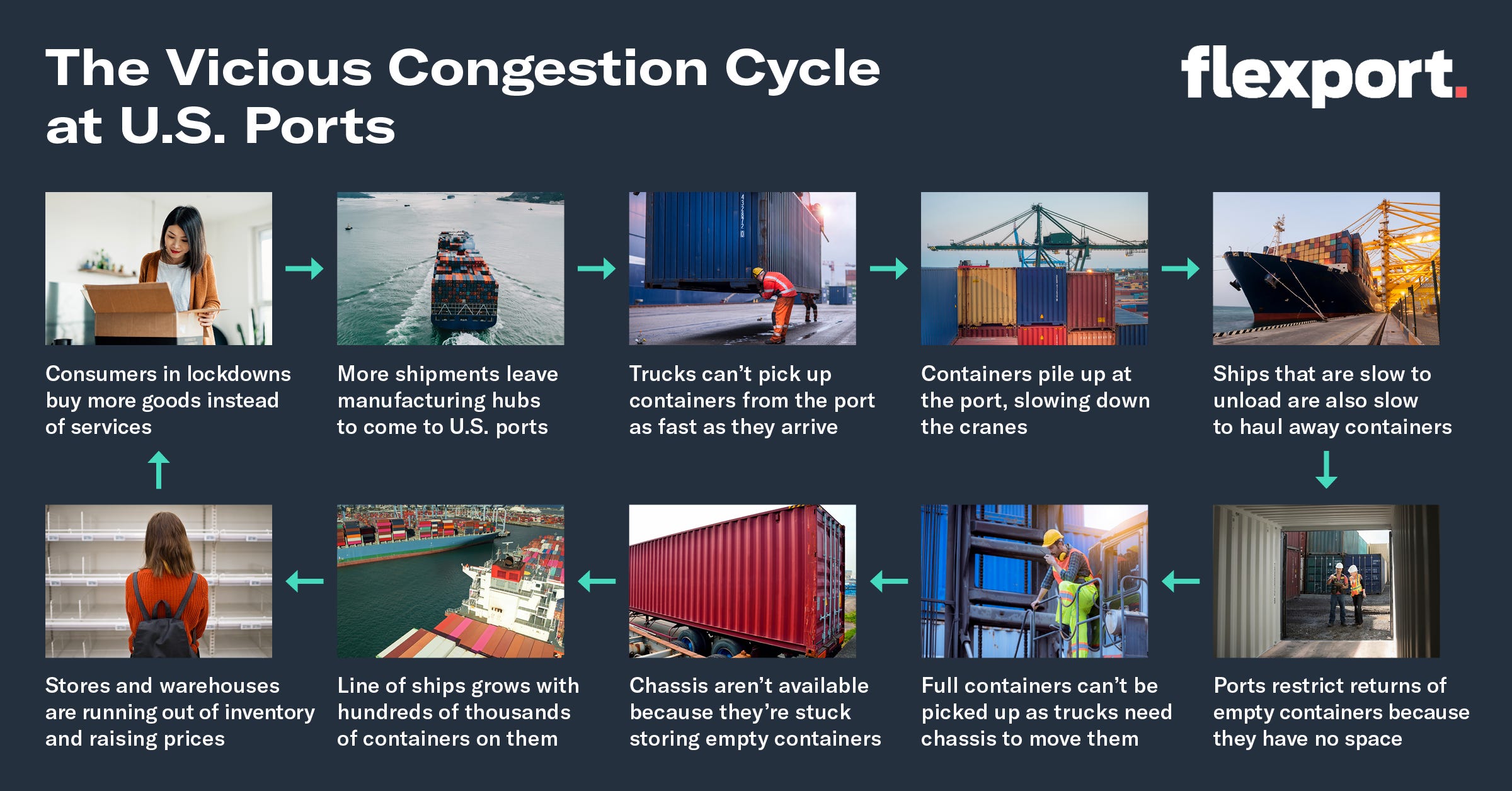
No, that's not the root cause. The root cause seems to be a combination of cascading events that causes a deathspiral: https://cdn.substack.com/image/fetch/f_auto,q_auto:good,fl_p...
"ships bring more containers than they take with them" is a symptom, not a cause. Mandating "ships to take an amount of empties" doesn't really fix the problem because shipping companies already want the ships to fill with empties, but can't because of other factors (see chart). Forcing ships to fill ships with even more empties presumably also makes things worse, by causing ships to occupy dock space.