Live data from Hacker News

Krugman on BitCoin

krugman.blogs.nytimes.com

151–160 of 306 posts

Re: Krugman on BitCoin

#151

He's just begging the question. That a fixed currency supply creates deflation is not a new insight. The idea that this causes 'hoarding' is highly questionable. Prices in consumer electronics fall significantly every year. Does this cause people to hold onto their money instead of buying computers, tvs, and iphones? Of course not. Why would other types of goods be any different? People still need what they need and…

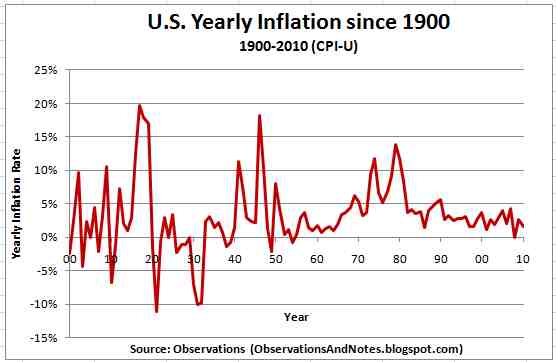
I've never seen convincing evidence that inflation is a good thing (to be honest I haven't spent my life searching for it). It is however pretty easy to see why inflation is good for people in power, in particular governments; it's a hidden tax. And yes it does encourage people to spend, in fact it encourages people to borrow and then spend. Even borrow so much that it crashes the system. So as far as I'm concerned t…

One could make a case that moderate inflation isn't a bad thing. Inflation generally happens when the economy is producing close to its capacity (think of a factory working overtime to meet a lot of demand - at some point they make the same amount of money in fewer hours simply by raising their prices). This means that you'd also expect pretty decent employment, etc. You certainly don't want runaway inflation, but a healthy economy would have some.
Re: Krugman on BitCoin

#152
post #61

Earlier quoted context omitted.

"There's a difference between some goods -- electronics -- getting cheaper every year and all goods getting cheaper every year." Which is what exactly? People buy electronics even though they get cheaper every year but they wouldn't buy Xs if they got cheaper every year? Can you give me an example of some Xs?

If houses got cheaper every year, very few people would want to buy them, and people stuck with mortgages would have a powerful incentive to walk away from them. If cars got cheaper every year, then people would put off buying new cars for longer. If gold got cheaper every year, then a lot of gold coins would be dumped on the market. If everything got cheaper every year, then people with money in the bank (or under t…

The flaw in your argument is that currency is subjected to demand pressures as well. How so? When demand for housing, food, electronics is high, then it automatically implies demand for currency is low. That is another way of saying people are willing to give up currency for real goods; which is another way of saying people are putting less value on the currency over physical goods; which means the barter power of the currency is decreasing; which means lower buying power with respect to the currency. That is key point. This means that there is rise in prices (without monetary intervention) when there is preference to own goods. And we all want goods and services in the end game. But this rise in prices do not spiral out of control because there is demand for currency as well - which really is demand for time preference, that being the choice to consume later on. We also know the demand for time preference is not unlimited because ultimately have to consume to make good of the money. Therefore, with greater population, comes with greater demand for money, but also comes with greater demands for owning/consuming goods. So that is why price levels will not absolutely decline over time because money supply is fixed. In fact, history proves this point -- look at the USA data in pre-federal reserve era.

Re: Krugman on BitCoin

#153
post #84

Earlier quoted context omitted.

> Perhaps when Bitcoin reaches supply maturity the value will stabilize I absolutely hate Krugman, but this is Econ 101 and even he gets it right. Bitcoin was a flawed experiment from the start because it has an absolute supply limit. Reaching that limit won't help. It'll make things worse. The money supply needs to expand for healthy economic activity and growth. If it doesn't, weird shit starts to happen. Here's an…

The problem isn't the psychological effects of needing to constantly lower prices – this happens all the time in the tech industry, and everyone in that industry is doing just fine psychologically. Rather, it has to do with the fact that constantly down-shifting prices cause people not to buy nearly as often as they would if prices were stable or slightly inflationary. As a result of that, the economy slows down (som…

The total number of bitcoins in circulation is capped, even though the total quantity of wealth in the world continues to increase. If bitcoins were the only currency used, then yes, this would cause hoarding problems. Does this mean bitcoins are flawed? No. It just means that there is a cap on how much wealth can be purchased with bitcoins.

Re: Krugman on BitCoin

#154
post #143

Earlier quoted context omitted.

He also touches on a great point: What we want from a monetary system isn’t to make people holding money rich; we want it to facilitate transactions and make the economy as a whole rich. By that logic the best money will be hot potatoes.

You're not wrong. In one prison, for example, cans of Mackerel served as an internal currency precisely because they had no inherent value. http://online.wsj.com/article/SB122290720439096481.html

As long some commodity (X) gains monetary value (demand for X is demand for a medium of exchange) it no longer needs any other value to function.

Still I doubt that cans of mackerel have no other use than monetary in prisons. Not many McDonalds around, beside if those were never consumed their supply would be grow continually which will to "mack" inflation.

P.S. Have you missed the point about the hot?

Re: Krugman on BitCoin

#155
post #84

Earlier quoted context omitted.

> Perhaps when Bitcoin reaches supply maturity the value will stabilize I absolutely hate Krugman, but this is Econ 101 and even he gets it right. Bitcoin was a flawed experiment from the start because it has an absolute supply limit. Reaching that limit won't help. It'll make things worse. The money supply needs to expand for healthy economic activity and growth. If it doesn't, weird shit starts to happen. Here's an…

But isn't one rule of money that it should at least hold it's value? Isn't that the main reason gold was used before? What is the point of using something as money if it keeps decreasing in value?

http://3.bp.blogspot.com/-_KuUh8iKx_c/TX_URc8gLpI/AAAAAAAAA6...

Please cite a source on this "one rule of money" you're thinking of?

Re: Krugman on BitCoin

#156
post #84

Earlier quoted context omitted.

> Perhaps when Bitcoin reaches supply maturity the value will stabilize I absolutely hate Krugman, but this is Econ 101 and even he gets it right. Bitcoin was a flawed experiment from the start because it has an absolute supply limit. Reaching that limit won't help. It'll make things worse. The money supply needs to expand for healthy economic activity and growth. If it doesn't, weird shit starts to happen. Here's an…

The problem isn't the psychological effects of needing to constantly lower prices – this happens all the time in the tech industry, and everyone in that industry is doing just fine psychologically. Rather, it has to do with the fact that constantly down-shifting prices cause people not to buy nearly as often as they would if prices were stable or slightly inflationary. As a result of that, the economy slows down (som…

Rationally, people should wait as long as possible to buy tech because they'll get more later. Instead, they buy it at a furious rate. Why is that?

Re: Krugman on BitCoin

#157
post #84

Earlier quoted context omitted.

> Perhaps when Bitcoin reaches supply maturity the value will stabilize I absolutely hate Krugman, but this is Econ 101 and even he gets it right. Bitcoin was a flawed experiment from the start because it has an absolute supply limit. Reaching that limit won't help. It'll make things worse. The money supply needs to expand for healthy economic activity and growth. If it doesn't, weird shit starts to happen. Here's an…

But isn't one rule of money that it should at least hold it's value? Isn't that the main reason gold was used before? What is the point of using something as money if it keeps decreasing in value?

If money is decreasing in value, it gives people a huge incentive to do something with it - buy something or invest. As long as the decrease to the value is small (1-3%) and predictable, this is a good thing.

Re: Krugman on BitCoin

#158

Earlier quoted context omitted.

But isn't one rule of money that it should at least hold it's value? Isn't that the main reason gold was used before? What is the point of using something as money if it keeps decreasing in value?

If money is decreasing in value, it gives people a huge incentive to do something with it - buy something or invest. As long as the decrease to the value is small (1-3%) and predictable, this is a good thing .

Since deflation is an obvious tax on investment and purchasing, arguments that increases in the value of a currency are "obviously" a good thing serve as a sort of litmus test for why people are interested in things like Bitcoin.

The subtextual motivation for Bitcoin advocacy has always been "it's a speculative asset and I hold a position in it". Everything else is just rhetorical cover.

The unfortunate reality is that even by reasoning through Bitcoin's programmed-in deflation, we're dignifying Bitcoin. Bitcoin itself is a sham. The original paper may have been a good-faith contribution to the state of the art in cryptocurrencies, but the "economy" is a trap; a realistic-looking distributed transaction clearing system built on a deliberately volatile wholly synthetic "asset" that exists for the purpose of creating pump-and-dump scams.

Re: Krugman on BitCoin

#159

Earlier quoted context omitted.

I'm well aware of how bitcoin works, and for starters bitcoin isn't completely anonymous. It's semi-anonymous. Secondly, a bank doesn't have to practice fractional reserve banking, they can practice Full-reserve banking. In this case the deposit to the bank is really a loan to the bank, with the bank promising an interest rate on the loan. On your point of interest rate, interest rate can't be truly guaranteed in any…

> they can practice Full-reserve banking. ??? A bank makes money by taking deposits (giving interest) and then lending them out (collecting a higher interest). The reserve percentage is that amount that remains unlent. Full reserve = no loans = no profits = no bank. Edit: Yes, you can practice full-reserve with a negative interest rate, which is effectively a safe-deposit box does (they charge a fee for the box). Tha…

A negative interest rate actually makes sense in the presence of deflation, and if bitcoins turn into a serious currency, deflation is pretty much guaranteed.

Re: Krugman on BitCoin

#160
post #95

He should have added a link to this alltime classic - a good macroeconomics, deflation 101 tutorial: http://www.slate.com/id/1937/

I was going to mention that article too. It's a great explanation.

Money and monetary systems are human creations, not laws of nature.

Post reply on HN