Live data from Hacker News

Does Georgism work? Is land a big deal?

astralcodexten.substack.com

151–160 of 375 posts

Re: Does Georgism work? Is land a big deal?

#151
post #91

Earlier quoted context omitted.

IMO the biggest issue with property taxes, land taxes, or any other similar idea, is that they arbitrarily tax one kind of wealth over others. Why should a person who owns a house worth $500k (and perhaps has a mortgage on it) pay not only the exact same tax rate, but also the amount of tax as a person who owns a house worth $500k (and doesn't have a mortgage on it), but also has $5 million in other assets? (This isn…

This is a great question. Land taxes are great because there is less of a deadweight loss. Governments need money to operate. All else equal, we should get governments the money they need without wasting people's time to comply with complicated tax laws. Humans also generally agree that progressive taxation is a good idea. Rich people should pay more to fund the government. Rich people own a lot of land, so they'd pa…

> Humans also generally agree that progressive taxation is a good idea.

Fairly bold assertion. I'd say most humans don't even really know what progressive taxation means.

> Rich people should pay more to fund the government.

A static tax regime (i.e., taxes calculated by a simple fixed percentage of wealth or income) leads to the same outcome. E.g., in a 10% fixed tax regime, someone making $10k/a pays $1k in tax and another person making $1mm pays $100k in tax, meeting your desire to have the rich pay more--no progressive taxation required.
Re: Does Georgism work? Is land a big deal?

#152

I really liked this article. I had a question about it. Could there be a case where existing unpleasant rental properties in highly dense urban cities suddenly have negative rental value? For example, imagine there was a run-down house that is livable, but is one of the most undesirable in SF. Adjacent to it, let's say there's a shiny desirable house with the same land characteristics. If I understand correctly, thes…

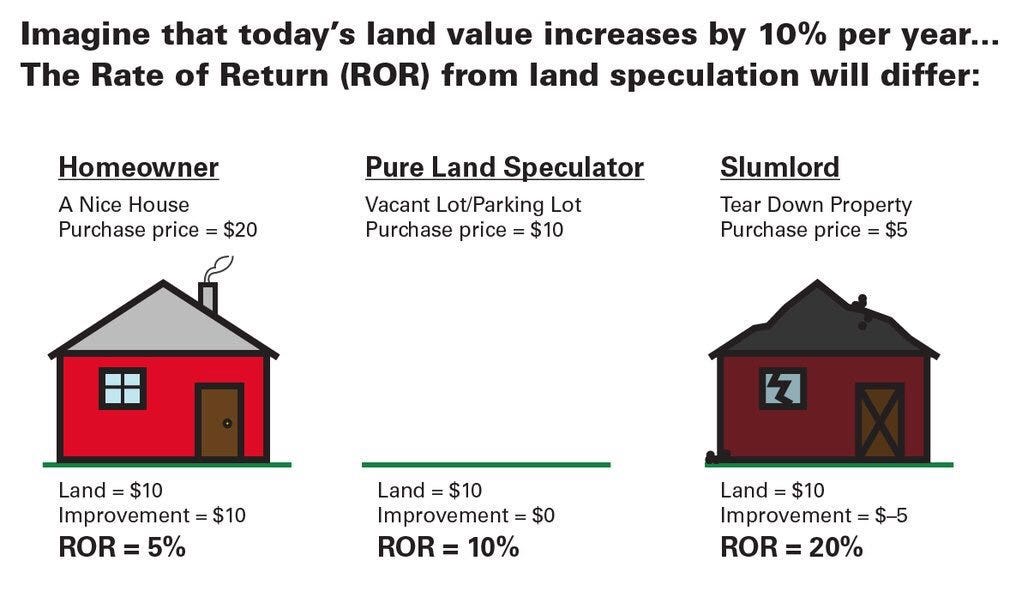
So you're basically describing the slumlord situation. Let me grab a figure from the book review:

https://cdn.substack.com/image/fetch/w_1456,c_limit,f_auto,q...

So imagine that the return from land was taken away. The only thing a landlord can charge rent on now is providing a nice building (capital) and good service & maintenance (labor).

The first property, "a nice house" would be able to charge rent -- because it now has value above the value of an empty field.

The second property, an empty lot, would be able to charge approximately nothing (the government collects the land rents, and this is capitalized into the price such that you can't charge any additional rent above that).

And yes, the third property (teardown property) you'd have to actively pay people to occupy, because you can't charge for access to the land, and the place sucks and is hazardous to your health.

What's the incentive in this situation for a landowner who wants to make money? Build something good (capital) and provide good service (labor), both are things we want to encourage.

Of course, the above assumes that land value taxes are fully capitalized into land prices and thus can't be passed on to tenants. This isn't discussed in this article (Part I) but will be discussed tomorrow in Part II.

Re: Does Georgism work? Is land a big deal?

#153

I really liked this article. I had a question about it. Could there be a case where existing unpleasant rental properties in highly dense urban cities suddenly have negative rental value? For example, imagine there was a run-down house that is livable, but is one of the most undesirable in SF. Adjacent to it, let's say there's a shiny desirable house with the same land characteristics. If I understand correctly, thes…

In areas of housing shortages, the rent with LVT would be whatever it currently is without LVT. Theoretically, landlords are already extracting the maximum rent price possible in housing-constrained markets like NYC/SF/etc.

What would change is that the land-owner would make less profit. Potentially, a unit which is currently renting for $1100/mo in Manhattan might be assigned an LVT of $1500/mo. In that case, the landowner will lose $400/mo. However, if they stop renting it out, they will lose $1500/mo.

The rational thing to do would be to improve the accommodations so that someone would be willing to pay $2000/mo to rent it. Then the landlord would profit on the improvements they made (rather than profit on merely owning high-value land). They would be rewarded for the value they added on top of the land.

Re: Does Georgism work? Is land a big deal?

#154
post #24
post #19

Earlier quoted context omitted.

If we're talking about no political restriction, I would go even further. Get rid of the mass market cars and implement trams as the basic suburban and urban feature. It could even carry some light freight for last mile logistics. As for the rest, it's bicycles, even velomobiles.

Trams suck, IMO. The only good thing about them is they often get right of ways, which can also be given to busses. Subways are where it's at. Long trains that don't have to deal with traffic lights.

Buses can be rerouted at the stroke of a pen, so it's difficult for people to build their lives around them. Trams are often overrated (and don't get me started on tram-trains), but they're a good fit for small towns or corridors that don't have the traffic to justify a subway.

Re: Does Georgism work? Is land a big deal?

#155
post #39
post #28

I think the biggest problems with Georgism are 1. in some sense it calls for the expropriation of land by the government 2. it's unfair to change the rules in the middle of the game and 3. it's logistically difficult to carry out. As far as unfairness goes, imagine a couple, 65, retired, paid off their mortgage, paid income taxes all their lives until retirement, now living off their savings. It's unfair to start tax…

> 2. it's unfair to change the rules in the middle of the game Is that not the very purpose of legislation? Laws are not written in stone

Sure, but the US constitution also prevents "taking" without compensation. That "taking" can also include you keeping the property but the government imposing new rules that lower it's value.

Re: Does Georgism work? Is land a big deal?

#156

I really liked this article. I had a question about it. Could there be a case where existing unpleasant rental properties in highly dense urban cities suddenly have negative rental value? For example, imagine there was a run-down house that is livable, but is one of the most undesirable in SF. Adjacent to it, let's say there's a shiny desirable house with the same land characteristics. If I understand correctly, thes…

So you're basically describing the slumlord situation. Let me grab a figure from the book review: https://cdn.substack.com/image/fetch/w_1456,c_limit,f_auto,q... So imagine that the return from land was taken away. The only thing a landlord can charge rent on now is providing a nice building (capital) and good service & maintenance (labor). The first property, "a nice house" would be able to charge rent -- because it…

Thanks for the concise explanation! You must be the original author. I've shared the article with many friends.

A few follow up questions:

- I'm interested to see how this affects multi-family housing. Do the same mechanics come to play? In an apartment complex, I assume that the positive or negative value of the property would be way greater than the land value, no?

- Do the resulting effects of the 3rd property only apply for teardown and straight up unliveable properties? Or would it be the blanket bottom x% of all houses in SF? If it was the latter, could this count as an inefficiency under the proposal? As "bad but livable" units today are now taken off the market?

- Does the "good house" now lose re-sale value now simply by virtue of being next to a "bad house"? Let's say that the house issues are internal, and the outside is fine. Is this okay?

Looking forward to part II. If these questions get answered then, I'll just wait until I read it and ask more questions.

Re: Does Georgism work? Is land a big deal?

#157
post #132

Earlier quoted context omitted.

Those are ten thousand paintings which the public cannot experience or enjoy! In many ways, the paintings are more precious, as they could go on worldwide tours, and be experienced by millions of people; most land has virtually no uniqueness, and cannot be shared.

See: Owning huge amounts of land is uniquely antisocial . The point here is to maintain a society and some things must come first, namely material things which paintings are not. Of course, art history shows us time and time again the vital importance of material sustenance in creating and preserving works of art. If you really care about art, you have to care about the material foundations that make rich and meaning…

You emphasize "antisocial", and I am not sure why. I looked it up to double-check, and the main definition is "contrary to the laws and customs of society; devoid of or antagonistic to sociable instincts or practices." Could you please explain what you mean by "uniquely antisocial"?

>"If you really care about art, you have to care about the material foundations that make rich and meaningful social livelihoods possible."

I care about all the tiers of Maslow's hierarchy of needs, and I think that many paintings are worth a lot more than most 10k acres. The paintings also have the benefits of being able to contribute to shared experiences all over the world, and fulfilling more challenging needs.

Re: Does Georgism work? Is land a big deal?

#158

I really liked this article. I had a question about it. Could there be a case where existing unpleasant rental properties in highly dense urban cities suddenly have negative rental value? For example, imagine there was a run-down house that is livable, but is one of the most undesirable in SF. Adjacent to it, let's say there's a shiny desirable house with the same land characteristics. If I understand correctly, thes…

In areas of housing shortages, the rent with LVT would be whatever it currently is without LVT. Theoretically, landlords are already extracting the maximum rent price possible in housing-constrained markets like NYC/SF/etc. What would change is that the land-owner would make less profit. Potentially, a unit which is currently renting for $1100/mo in Manhattan might be assigned an LVT of $1500/mo. In that case, the la…

I see.

Could it be possible in areas like Detroit where the cost of renovating the house for profitability is just too prohibitively expensive that the house itself just isn't sellable? Could home-owners now somehow be stuck in situations where they are forced into debt by holding a property that just sucks money out?

Especially if implemented too suddenly?

Re: Does Georgism work? Is land a big deal?

#159
post #96
post #91

Earlier quoted context omitted.

IMO the biggest issue with property taxes, land taxes, or any other similar idea, is that they arbitrarily tax one kind of wealth over others. Why should a person who owns a house worth $500k (and perhaps has a mortgage on it) pay not only the exact same tax rate, but also the amount of tax as a person who owns a house worth $500k (and doesn't have a mortgage on it), but also has $5 million in other assets? (This isn…

Georgism makes a distinction between Capital (value produced by labor) and Land (value that existed before humans showed up). Rewarding owners of capital incentives people to make more, but rewarding owners of land benefits nobody other than the landowner.

> value that existed before humans showed up

I'm not sure that meshes with the way it's actually described in the article. They give examples of a small piece of land worth $2M and then another plot in a different location that's worth far less, purely due to proximity to other improvements on the land (i.e. being prime real estate in a city) rather than something inherent to the land itself (e.g. fertility/use for growing crops).

And even then, something like fertility isn't really all natural any longer, given how it's impacted by so many farming practices (fertilization, tilling/no-till, crop rotation/nitrogen fixing crops, etc.).

Resource extraction (e.g. oil) seems a lot closer, though the actual labor of it vs. the resources of it are another thing. I do see more reason there why the benefit ought to be largely public--and to some extent it is in, e.g., Alaska via the Alaska Permanent Fund.

But I think that labor, improvements and whatever the intrinsic value might be are a lot more tied together than seems to be accounted for by the theory. Otherwise why is the intrinsic value of Manhattan's land not measured in some number of beads, with everything else being due to improvements (including those made by neighbors)? And yes, I do realize that beads actually were money for a time due to a lack of actual currency, but still.

Re: Does Georgism work? Is land a big deal?

#160
post #91

Earlier quoted context omitted.

IMO the biggest issue with property taxes, land taxes, or any other similar idea, is that they arbitrarily tax one kind of wealth over others. Why should a person who owns a house worth $500k (and perhaps has a mortgage on it) pay not only the exact same tax rate, but also the amount of tax as a person who owns a house worth $500k (and doesn't have a mortgage on it), but also has $5 million in other assets? (This isn…

This is a great question. Land taxes are great because there is less of a deadweight loss. Governments need money to operate. All else equal, we should get governments the money they need without wasting people's time to comply with complicated tax laws. Humans also generally agree that progressive taxation is a good idea. Rich people should pay more to fund the government. Rich people own a lot of land, so they'd pa…

Another key factor is enforcement cost. Enforcing a land tax is really easy for a government. You just... Go there and get it. There's no moving the land offshore or having complex relationships or offsets. If someone won't pay the government just assigns the ownership to someone who will and goes on.

Compliance costs with many other taxes are quite high.

Post reply on HN