Live data from Hacker News

Groups never admit failure

nav.al

221–230 of 370 posts

Re: Groups never admit failure

#221
post #165

> I’m hard pressed to find examples in history of large groups that said, “We thought A, but the answer’s actually B.” End of the Soviet Union?

Did the group in power decide to end it?

Yes.

The final round of the Soviet Union's collapse began on December 1, 1991. That day, a Ukrainian popular referendum resulted in 91 percent of Ukraine's voters voting to affirm the independence declaration passed in August and formally secede from the Union. The secession of Ukraine, long second only to Russia in economic and political power, ended any realistic chance of Gorbachev keeping the Soviet Union together even on a limited scale. The leaders of the three Slavic republics, Russia, Ukraine, and Belarus (formerly Byelorussia), agreed to discuss possible alternatives to the union.

On December 8, the leaders of Russia, Ukraine, and Belarus secretly met in Belavezhskaya Pushcha, in western Belarus, and signed the Belavezha Accords, which proclaimed the Soviet Union had ceased to exist and announced formation of the Commonwealth of Independent States (CIS) as a looser association to take its place. They also invited other republics to join the CIS. Gorbachev called it an unconstitutional coup. However, by this time there was no longer any reasonable doubt that, as the preamble of the Accords put it, "the USSR, as a subject of international law and a geopolitical reality, is ceasing its existence."

The final dissolution occurred on 25 December 1991 as General Secretary and President of the Soviet Union, Mikhail Gorbachev, resigned and transferred power to Russian Presiden Boris Yeltsin.

https://en.wikipedia.org/wiki/Dissolution_of_the_Soviet_Unio...
Re: Groups never admit failure

#222
post #154

I've got an amateur interest in nuclear disasters, and I've noticed an echo between TMI and Fukushima... in both cases, the plants were substantially mismanaged by the electric company, who seemed more interested in downplaying and covering up the issues than in solving them, even as the emergency continued.

Chernobyl also.

You'll also find that mode in numerous "near miss" nuclear accidents, as well as power-plant disasters of other modalities, including the Vaijont and Banqiao dams. Denial of a not-yet-realised risk is a very common failure modality.

Charles Perrow's work in this area, specifically in the role of organisational dysfunction in disasters (Normal Accidents and The Next Catastrophe among other works) is highly recommended.

Re: Groups never admit failure

#223
post #56

> A group will never admit they were wrong. A group will never admit, “We made a mistake,” because a group that tries to change its mind falls apart. I’m hard pressed to find examples in history of large groups that said, “We thought A, but the answer’s actually B.” Just because the author can't think of an example doesn't make it true. In fact groups of people, typically businesses, admit failure all the time. And i…

This is such an ignorant perspective, it really makes me mad. Literally a google search will provide hosts of examples of groups admitting they were wrong and ironically many for-profit companies not admitting they were wrong. It's amazing how someone can be ignorant of history, make a pronouncement that justifies their priors and think they have reached some sort of enlightenment. There is this whole constellation o…

The Rationalist community in particular is very good at rationalizing.

Re: Groups never admit failure

#224
I with my team always admit failure as progress, because it is impossible proceed without failure being the catalyst toward success. To succeed without consequence is to learn or experience nothing. Failure while bad is its own reward.

Re: Groups never admit failure

#225
post #212

Earlier quoted context omitted.

Again, dang, the article is flamebait . If you're going to remove something, start with the problem.

I don't think the article is flamebait. In fact it plainly isn't, because people have been having interesting conversation and reactions to it. It's possible to disagree, even strongly disagree, without getting sucked into generic tangents or flamewars. (I know you know this.)

TFA is a shallow, fact-free, ideological rant based on the premise that "If you want to change the world to a better place, the best way to do it is a for-profit because for-profits have to take feedback from reality." The author is at best uncritically free-market favourable, if not considerably more so, based on this and other writings.

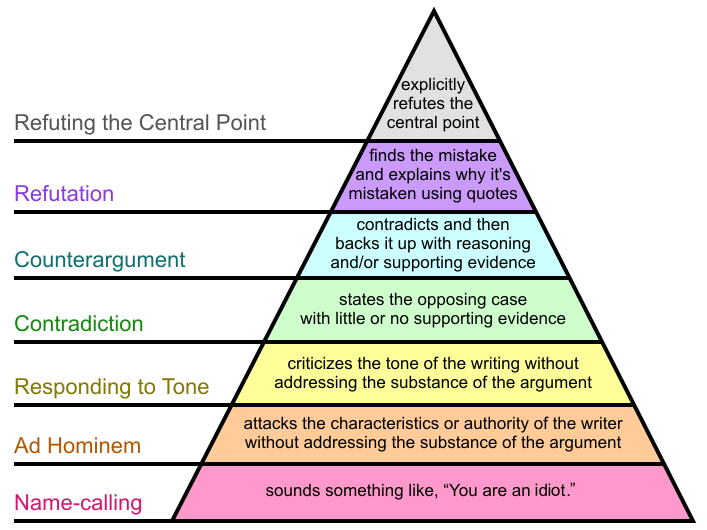
User poetically, in the best pg sense, critiqued the core of the argument:

Truly refuting something requires one to refute its central point, or at least one of them. And that means one has to commit explicitly to what the central point is. So a truly effective refutation would look like:

The author's main point seems to be x. As he says:

But this is wrong for the following reasons...

http://www.paulgraham.com/disagree.html

https://upload.wikimedia.org/wikipedia/commons/a/a3/Graham%2...

poetically is practicing pg's highest form of disagreement precisely to specification and form. The post was flagged (groups never admit failure, after all), and you as moderator stepped in and admonished them. You're wrong, dang.

The refutation reads as a "generic ideological tangent" strictly because the article is a generic ideological tangent. The refutation is absolutely on point. The gericism and ideology are in the source, and must be pointed out as such to be an effective refutation.

If a submission cannot be properly refuted without descending into "generic ideological tangent" then the fault lies with the submission.

At the very least, restore poetically's comment and withdraw your admonition.

Re: Groups never admit failure

#226
post #56

> A group will never admit they were wrong. A group will never admit, “We made a mistake,” because a group that tries to change its mind falls apart. I’m hard pressed to find examples in history of large groups that said, “We thought A, but the answer’s actually B.” Just because the author can't think of an example doesn't make it true. In fact groups of people, typically businesses, admit failure all the time. And i…

This is such an ignorant perspective, it really makes me mad. Literally a google search will provide hosts of examples of groups admitting they were wrong and ironically many for-profit companies not admitting they were wrong. It's amazing how someone can be ignorant of history, make a pronouncement that justifies their priors and think they have reached some sort of enlightenment. There is this whole constellation o…

You are welcome to share a couple of prominent examples.

Re: Groups never admit failure

#227
post #31

Earlier quoted context omitted.

Please don't take HN threads on generic ideological tangents. I'm not saying you're wrong, but these lead to reliably repetitive and tedious discussion, which is not on topic for a site focused on intellectual curiosity. https://hn.algolia.com/?dateRange=all&page=0&prefix=true&sor... https://hn.algolia.com/?dateRange=all&page=0&prefix=false&so... https://hn.algolia.com/?dateRange=all&page=0&prefix=false&so... Separat…

so basically, no questioning of capitalism on HN, got it.

HN has tons of that.

The issue is comment quality, not ideological whatever. The GP was a tedious, generic ideological rant - it could appear almost anywhere.

Re: Groups never admit failure

#228
post #220

Earlier quoted context omitted.

Really? Was Dresden a military target? Most major German cities were reduced to rubble.

Cities are major industrial centers. In the twisted logic of the generals at the time, destroying them wholesale was a legitimate way to strike at the military-industrial strength of a country

Countervalue was a thing in nuclear planning too - tie down enemy AA/missile defense defending cities

Re: Groups never admit failure

#229
post #73

Earlier quoted context omitted.

The author is Naval Ravikant who is a wealthy VC and pseudo-philosopher. He's clearly a smart guy but also seemingly disconnected from reality at this point in his career.

A piece that has no facts backing the point, which exploits confirmation and conformity biases in readers, is just a badly researched and biased piece, regardless of author.

Write a counter piece then, or don't. ¯\_(ツ)_/¯

Re: Groups never admit failure

#230
post #55

Earlier quoted context omitted.

But governments have improved, and improved radically over the years. And the advantages of small groups over individuals are so comprehensive they have been a primary source of evolutionary progress in humans. I'm not sure Friedman knew what he was talking about.

> But governments have improved, and improved radically over the years. In the 1960s and early 1970s, there was a sizable research field devoted to trying to help make human organizations function better (it was most of what used to be called "operations research", but went far beyond the for-profit corporation version of this concept). For reasons I don't understand, that project appeared to almost completely shutdo…

OR does survive, largely as a study of technical operations, far less social, organisational, or political ones.

The other major similar school was Norbert Wiener's cybernetics, and also systems theory (Jay Forrester/MIT). These took a far broader approach, and were even considered for integration into (and ultimately redefinition of) the social sciences. A fascinating book I have is Alfred Kuhn's The Study of Society: A Unified Approach (1963), which tackles political science, sociology, and economics head on.

Wiener butted heads with the military establishment, in which he'd worked during WWII. Systems Research was closely associated with the Limits to Growth team and Stanford Beer's Project Cybersyn, enacted in Salvador Allende's Chile, and lost when Pinichet (advised by University of Chicago economists) overthrew the government in a coup and assassinated Allende.

Complexity research also was (and sometimes still is) criticised for being vague and nonpredictive. Not entirely without merits. That said there's been something of a resurgence, notably through the Santa Fe Institute.

But the anti-military, Malthusian, and socialist branding has somewhat stuck, and made the approaches if not precisely taboo, highly unpopular at least within mainstream US academia.

OR itself however is a fairly vibrant study and practice, largely by virtue of having avoided the social and political areas. My view is that this has stunted its application even if it's permitted the development and continuation of the field.

Post reply on HN