Nassim Nicholas Taleb put out a video explanation of how Simpson's Paradox applies here, which is more direct and less tongue-in-cheek compared to the post: https://m.youtube.com/watch?v=XVRfBhy5vGI
Is watching the 1984 Ghostbusters movie killing people?
201–210 of 248 posts
Re: Is watching the 1984 Ghostbusters movie killing people?
#202Earlier quoted context omitted.
It seems to me that Berenson didn't "fall" for Simpson's paradox. He's a smart person. He peddles inflammatory rhetoric to build an audience. For example, he portrayed New Zealand's 2-week quarantine requirements for incoming travellers to New Zealand as "indefinite confinement for New Zealanders". When people pointed out the gulf between what he was saying and what the law was, he doubled down. I'd share the exact t…
What's the motivation for that? Infamy?
It would make burning your credibility more permanent.
Deleting banned accounts whitewashes the history of the person that got banned, allowing them to repeat the cycle without changing names/pseudonyms.
That’s probably a win for engagement and trolls, but a loss for everyone else.
Re: Is watching the 1984 Ghostbusters movie killing people?
#203Earlier quoted context omitted.
There is a huge spike in active cases right before and after Dec 11th. More cases = more deaths.
That's true, but what you can't tell from this graph was that in this period we went from 10.000 tests per day to almost 200.000, so I think that might account for must of the uptick in active cases in this period. During some of our biggest spikes the infection% has hovered around 2 - 3%. Present day we have about 430k active cases, which is almost 10% of the population, but the % is still 2.3%.
Testing more will uncover more benign cases, that's true, but it is also possible that people are testing more due to having more symptoms.
Vaccination has continued in Denmark so if vaccines were killing people we'd expect to see that rocketing as Denmark has one of the highest vaccination rates.
I think the causality is:
More illness -> More people get tested
More illness -> More people get vaccinated
More illness -> More people die
Re: Is watching the 1984 Ghostbusters movie killing people?
#204There's no way on earth they can actually know the movie-viewing history of those who recently died. So the data must simply be fabricated. It undermines the point they're trying to make. They should have used a real example.
They didn't fabricate their data.
They simply switched the labels.
Not very well. You can see they didn't change the axis labels in this image here: https://static.wixstatic.com/media/cf58cd_449149dafb04485eb2...
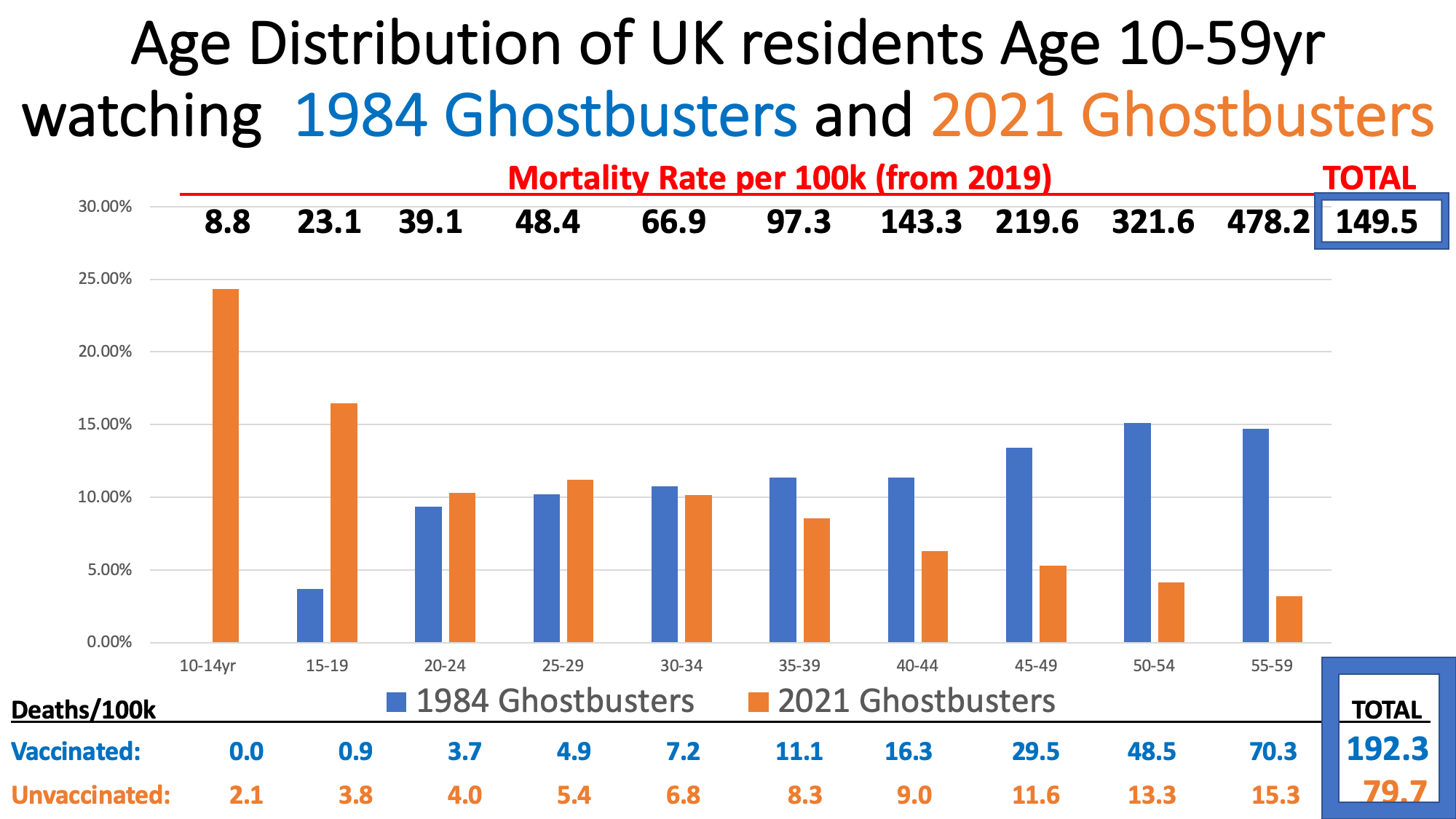
So the data is valid, the point is valid, but the point isn't about ghostbusters.
Re: Is watching the 1984 Ghostbusters movie killing people?
#205This reminds me of the sort of light poking of common "correlation is not the same as causation" and "beware of confounding factors" statistical failures behind the Church of the Flying Spaghetti Monster "clearly reduction in pirates has caused global warming!" [0]. But it's a major in modern public discourse, and one for once that I'm quite willing to lay heavily at the feet of the public education system. Easily on…
Statistics is probably more useful than Calculus for just about everyone.
Statistics and probability are formally defined using calculus, so that doesn't really work.
Maybe basic introductory statistics is more useful than basic introductory calculus though.
Re: Is watching the 1984 Ghostbusters movie killing people?
#206Earlier quoted context omitted.
That's true, but what you can't tell from this graph was that in this period we went from 10.000 tests per day to almost 200.000, so I think that might account for must of the uptick in active cases in this period. During some of our biggest spikes the infection% has hovered around 2 - 3%. Present day we have about 430k active cases, which is almost 10% of the population, but the % is still 2.3%.
Testing more will uncover more benign cases, that's true, but it is also possible that people are testing more due to having more symptoms. Vaccination has continued in Denmark so if vaccines were killing people we'd expect to see that rocketing as Denmark has one of the highest vaccination rates. I think the causality is: More illness -> More people get tested More illness -> More people get vaccinated More illness…
I agree that if the vaccine was killing people, we'd be seeing mass death. Currently we are experiencing +15% all-cause mortality, where 2020 was around 0%.
The reason we are testing 200k/day is because you don't have many options for moving around without a valid test or vaccine. Ie. school, shopping, work etc requires it.
Re: Is watching the 1984 Ghostbusters movie killing people?
#207Earlier quoted context omitted.
Statistics are meaningless without a rigorously examined causal model of the phenomenon under investigation. In my experience of statistics education, the art of crafting causal theories was scarcely addressed.
The average citizen doesn't need to craft casual theories, they need to be able to look at them critically. Yes, an introductory statistics course doesn't cover everything, but it's absolutely the 20% effort that gets 80% of the results. Most of the worst misinformation I've seen lately surrounding covid, vaccines, etc, would be solved if everyone had a basic understanding of introductory stats as currently taught. I…
I think you underestimate the fact that most of the people we are talking about are more accustomed to "magical thinking". Any stats education that didn't align with their core beliefs would be dismissed as wrong. Even if you could proof out everything and they had the core intellectual horsepower to understand there is a level of belief in belief that underlies their worldview that you can't overcome.
Re: Is watching the 1984 Ghostbusters movie killing people?
#208Earlier quoted context omitted.
I took high school statistics. I don't think it really had the kind of effect on students that you're going for. Statistics like any math class was just another pointless and imposed game of symbol manipulation, for most. Not something that affects how they see the world or how they process disinformation (which disables rational thinking by appeals to emotion, so rational capabilities aren't necessarily even the iss…
The best (and only) thing I learned in high school statistics is that no matter how many times you flip a coin, each flip has an equal chance of landing on heads or tails.
A fair coin.
It is important because if you flip a coin 20 times and get 20 tails, there is probably something fishy with that coin and you probably should bet tails. If it is 100 out of 100 (or even 95 out of 100), there is effectively zero chance that the coin is fair.
This can be modeled using Bayesian statistics. You start by assuming with a reasonably high probability that the coin is fair, then you revise your assumptions as you get more and more data.
The general idea is: if a coin flip lands on tails for too many times, you should probably bet on tails. You shouldn't try that in casinos: games are seriously checked for fairness (of course, the rules make it so that the house has an edge). But in an informal setting, it can get you a small advantage.
Re: Is watching the 1984 Ghostbusters movie killing people?
#209This reminds me of the sort of light poking of common "correlation is not the same as causation" and "beware of confounding factors" statistical failures behind the Church of the Flying Spaghetti Monster "clearly reduction in pirates has caused global warming!" [0]. But it's a major in modern public discourse, and one for once that I'm quite willing to lay heavily at the feet of the public education system. Easily on…
Statistics are meaningless without a rigorously examined causal model of the phenomenon under investigation. In my experience of statistics education, the art of crafting causal theories was scarcely addressed.
Sometimes it's so hard it seems almost impossible. People are still debating whether there is casual relationship between lead and violence.
Re: Is watching the 1984 Ghostbusters movie killing people?
#210Earlier quoted context omitted.
I don't get this attitude, if things are correlated, it should at least make a scientist wonder why. It certainly could be random chance, but correlation can also lead to establishing a causal model or discovering a third variable. If two things keep happening in conjunction, it at least merits further investigation. It seems like there's this extreme reaction against people behaving like correlation equals causation…
I share this criticism. It's almost like you have to scream at people that although correlation doesn't imply _direct_ causation, it most certainly does imply some causal chain. Ruling out chance through significance and power, what phenomenon in the world is correlated without being causally related _somehow_?
Well, it can also be pure randomness