Earlier quoted context omitted.
And skipped Xi
Xi was the original variant
I almost corrected you before realizing how brilliant you are. Well played.
171–180 of 337 posts
Twitter thread from a vaccine developer: https://threadreaderapp.com/thread/1464222680731820043.html A lot of speculation still, but it's not all bad so far.
>vaccine developer >Chair of ...Maryland's Newest Anthropomorphic Convention! Not sure how I feel about this. Are many vaccine developers also furries?
Earlier quoted context omitted.
Imagine there was a fire near where you live, constantly spreading and endangering lives in your community. Would you say people can just "learn to live it"?
Imagine being given almost 2 years to build capacity to put that fire out so the community could go back to normal life but instead zero additional capacity was built? Hospitals had almost 2 years to build capacity. Where is it? Why is society being asked to continue bailing out institutions that have had an enormous amount of time to prepare?
You might have built the 90.000 beds you need, but where will you find the doctors?
>Using this approach, this variant has been detected at faster rates than previous surges in infection, suggesting that this variant may have a growth advantage. Really? I wonder how much of this is "it's very easy to spot in the pcr" and we don't have to Redeploy tests..
I don’t know what to make of the WHO statements anymore. There has been so much retractions, flip-flops, politically-driven actions, half-truths, etc... I don’t know how assign any meaning, good or bad, to what comes out of that organization.
This is a multinational organization, funded by member states, built around consensus that we're talking about here. It seems unreasonable to expect international organizations to be simultaneously accepted by multiple parties with divergent and conflicting interests... and somehow not be subject to politics.
So how much can you trust them? Probably about as much as you can trust who they’re loyal to.
Earlier quoted context omitted.
> Will people ever get over sensationalism and learn to live it? You see, that's the crux of the matter: Not everyone can live with it. Literally. So far, it killed more than 5 million people globally. There is also the issue with possibly lasting brain damage (even occuring in cases that weren't severe enough for hospitalization) and life-wrecking long covid. Compassionate people have a problem ignoring all that.
Assuming you're going to live for 50 more years from today, wasting a year of your life is only worth it if it prevents a 2% chance of death.
Earlier quoted context omitted.
Also known as B.1.1.529 Variant21K appears to have arisen in November 2021, possibly in South Africa. Early sequences are predominantly from South Africa, though also detected in Botswana and Hong Kong. 21K is primarily of concern due to the large number of mutations it has in the Spike gene. Many of these variants are in the receptor binding domain and N-terminal domain, and thus may play key roles in ACE2 binding a…
>This literally reads like post apocalyptic fan fiction. I find it incredibly fascinating how fast this virus can mutate in order to throw curveballs around our natural and engineered defenses and become more efficient at killing us. How is this even possible in such a short amount of time? I thought evolution takes tens of thousands of years. It's not like viruses have giant brains with massive IQs to come up with a…
The variants arise randomly and proliferate with the current major strains. The infected population adapts to reduce the transmission of the most virulent/contagious strains. Selective pressure (tug of war between infecting people and people fighting off the infection) increases on the new variants until one or a few maintain or exceed the transmission of the progenitor strain.
That's the problem with the, "I'll get over it/I'm not worried/My segment of the population doesn't die from it" mentality. The more infections - subclinical, asymptomatic, severe, fatal, undetected - the more rolls of the dice. We (humans) are selecting variants that are worse for us, hoping we can snuff out the infection before some key mutation that eludes our immune system and/or testing develops.
Two other thoughts with internal conflicts/points worth mentioning - First, recovered patients should be more resistant to new strains. Their immune systems threw everything at the virus to defeat it, so their response will be more diversified than those with mRNA vaccines targeting a specific protein sequence. (The magnitude and usefulness of the variations in immune response can negate that advantage.) Second, the reasons that a 'novel' virus is dangerous are that we, as a species, don't know if we can (naturally/innately), and we don't know how much the virus can change in protein sequence (to evade our defenses) or our response to infection.
Anyways, I'm rambling. Not a virologist, but a PhD (and as such, I think I know more about stuff than a really do) and that's how I think about it. :)
Earlier quoted context omitted.
>The grim reality is that there hasn't been a single policy that's been shown to have made any difference at all. NONE. BULLSHIT. How delusional can you be? There is plenty of evidence that masks and contact reduction in various forms have a massive effect on how quickly the virus spreads. Infection numbers and their development over time varied wildly between countries, clearly correlated with such measures, long be…
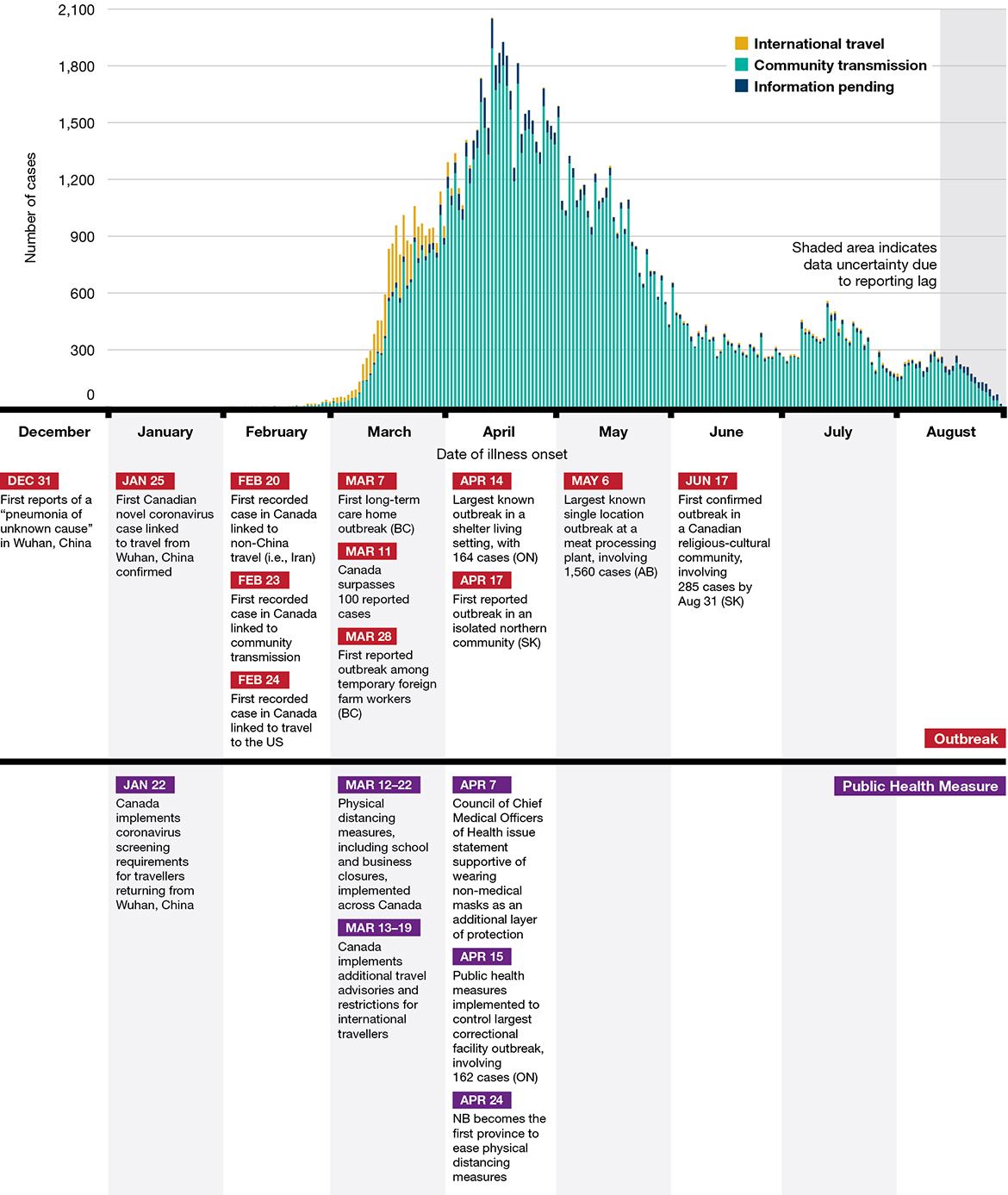
> There is plenty of evidence that masks and contact reduction in various forms have a massive effect on how quickly the virus spreads. If this is true, why is it when showing a chart of data it is almost impossible to pick when any of these measures went into effect? If these measures worked to any worthwhile degree their effect on any data should be absolutely profound. Thus far, you'd have a hard time picking flor…
Quite exactly the opposite is actually true: it's always very clear from such charts that the measures are very effective.
Some examples:
https://www.canada.ca/content/dam/phac-aspc/images/corporate...
https://www.nejm.org/na101/home/literatum/publisher/mms/jour...
https://coronavirus.jhu.edu/data/state-timeline
Doesn't take "PhD level math" either, just some basic understanding how the effects are delayed by incubation period, testing and reporting, and how an exponential function changes shape as the exponent changes