Earlier quoted context omitted.
> We're stuck with images stored in the display profile of old CRTs by default, because that was the most practical option at the time. The analogue in photography is photographs lose color clarity and fade as they age. Why should I care if this is the case in images as display technology evolves when this is already a problem with every physical medium? > For correct editing operations, and correct display. Sadly, i…
The sRGB color #ffffff should never mean "the brightest white on this monitor", unless you're using an average CRT. Just imagine you're using an HDR display, where the brightest white is as bright as the sun.
QOI: Lossless Image Compression in O(n) Time
181–190 of 303 posts
Re: QOI: Lossless Image Compression in O(n) Time
#182Earlier quoted context omitted.
> We're stuck with images stored in the display profile of old CRTs by default, because that was the most practical option at the time. The analogue in photography is photographs lose color clarity and fade as they age. Why should I care if this is the case in images as display technology evolves when this is already a problem with every physical medium? > For correct editing operations, and correct display. Sadly, i…
> When I say (255, 0, 0), I expect the display to show me its best approximation of red. Which red? There isn't a single, true "red". And different materials produce different reds (my work's Sony BVM-X300's reddest red is going to look way different than your monitor's red). Not all displays use only RGB color primaries, too. For example, at Dolby's office in San Francisco they have a projector in their theater that…
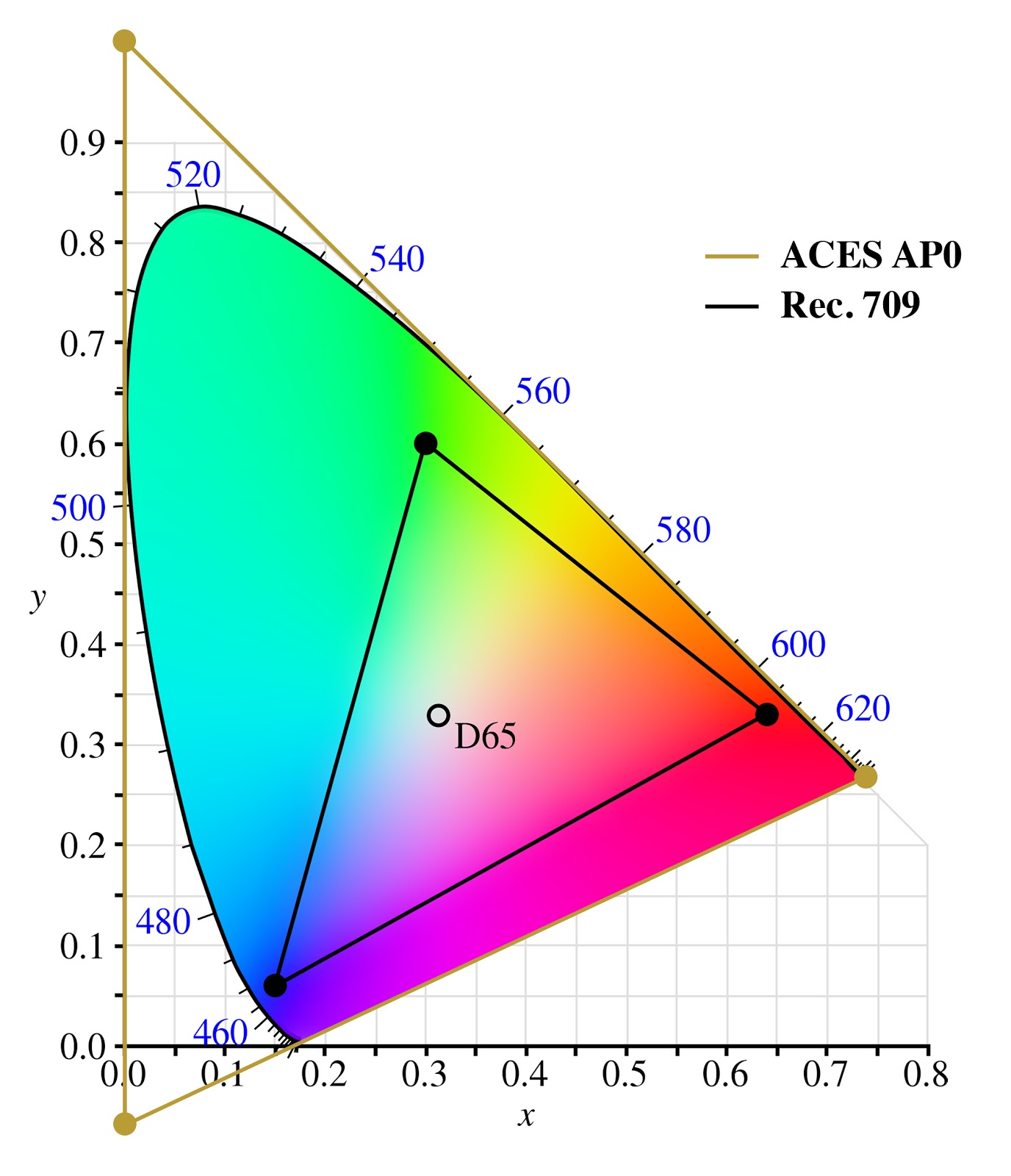
XYZ is really annoying to work in though. ACES is a pragmatic solution here, quite literally: https://blog.frame.io/wp-content/uploads/2019/09/ACES-APO.jp...
Okay, fair enough two out of three primaries are imaginary colors, but nobody said you have to use the whole color space when your processing pipeline is meant to be using 32 bit floats. Delivery formats might want to be using a more real color space.
Re: QOI: Lossless Image Compression in O(n) Time
#183Earlier quoted context omitted.
The sRGB color #ffffff should never mean "the brightest white on this monitor", unless you're using an average CRT. Just imagine you're using an HDR display, where the brightest white is as bright as the sun.
OK but then when will you use that "bright as sun" color? If not, why provide them? If so, what color will you use ?
Re: QOI: Lossless Image Compression in O(n) Time
#184Earlier quoted context omitted.
No single color space is complete. Each has trade-offs. I would actually say that color profiles help get closer to ground truth, that is, rendering intent.
CIE XYZ is complete.
I guess when I said "no color space is complete" I meant "no color space is faithfully bijective to nominative human visual sensory response." Because such a thing is basically impossible (or insanely nonlinear and unwieldy).
Also these color systems all or almost all assume a "norminal" (to steal a word from Everyday Astronaut, normal+nominal) average human vision system. If your system isn't norminal, average, human, or even visual (visible light), then your color space is an incomplete map of the territory.
So for any given array of pixel channel, there is either an implicit assumption or explicit color space of what those values "mean".
Re: QOI: Lossless Image Compression in O(n) Time
#185Earlier quoted context omitted.
Because your pixels need to transform from the image color profile to the display color profile. By default this all falls back to sRGB, which is not the "ground truth pixel value" you may be assuming it is.
Right, which begs the question why on earth would there be more than one image color profile. The image color profile should just be implied and the same everywhere.
When I say #ff0000, do I mean "sRGB red", as a TV would display in pure red phosphors back in the 1970s, or do I mean "1000K" / 700nm red (daylight is 6500K), which can only be reproduced by specialized displays?
Most people from the time before Apple made Display P3 wide color displays standard in all their products — so, most HN commenters — believe that #ff0000 just means "only red, no green or blue" — but all web browsers currently are left to invent their own answer for what #ff0000 means, and they do not all invent the same answer. Yet.
So it is with images.
In the beginning times, people made sixteen-color images for NTSC monitors, and then other people learned you could display synthetic colors that don't exist by mangling the image bitstream to the monitor, and those sixteen colors were hard-coded but varied by like +/-5% per device due to acceptable manufacturing tolerances, so they were internally consistent anyways.
And so we end up, today, trying to solve color profiles for file formats that specify colors as RGB hex values — which are, by definition, restricted to sRGB and thus wildly insufficient. But if we plan too far, we get file formats that are totally ridiculous - TIFF comes to mind - that can represent anything under the sun, at the cost of having a 1:1 mapping of "pixels" to "bytes" or worse.
You may also find the history of the EXR format relevant here, as it supports a functionally infinite amount of dynamic range in images, and there are definitely good niche use cases for it — but pragmatically, it's ridiculously overkill for normal everyday purposes. You could argue that everyone should use EXR in Lab, but then someone would suggest Oklab (since it makes better perceptual compromises) or HSLuv (what a great name), or you could try storing raw CIE 1931 chromaticity coordinates, which has been deprecated by CIE 170-2 to address serious flaws in the 1931 system.
Tying this back to engineering, there are often very good reasons for designing a processor or a byte store to be RISC or CISC, big or little endian, and we simply cannot predict what will work most pragmatically for all cases universally ahead of time, any more than the metric system was invented early enough in time to prevent miles per hour from being a unit of measure.
Re: QOI: Lossless Image Compression in O(n) Time
#186I wonder if the author tried making pixel diffs capable of using lookback. They'd be one byte longer but would possibly happen a lot more often than full pixel values. It's also reminiscent of the delta blocks from MPEG. If anything I would trade the 5-bit run for delta-from-lookup on a whim (the cases where the ratio between short runs vs. exact lookback is extreme seems like it might only happen for pinstripe patte…
The hard part here is figuring out which pixel to diff to. You would almost certainly have to look at all 64 pixels which would be a lot slower. That said, you can probably get noticably better compression from it.
Re: QOI: Lossless Image Compression in O(n) Time
#187Earlier quoted context omitted.
The sRGB color #ffffff should never mean "the brightest white on this monitor", unless you're using an average CRT. Just imagine you're using an HDR display, where the brightest white is as bright as the sun.
OK but then when will you use that "bright as sun" color? If not, why provide them? If so, what color will you use ?
Re: QOI: Lossless Image Compression in O(n) Time
#188Earlier quoted context omitted.
> Yes, also store the DPI. I don't think that's a good idea. Most images, like photos and screenshots, don't have physical dimensions. Some image tools like to put in bogus default DPI values that are guaranteed to be wrong, and it can be a bit of pain.
How else would you reproduce images at exactly the right size? Without DPI, the format would be useless for many scientific purposes. But I get your worries. As a compromise, DPI could be optional.
Re: QOI: Lossless Image Compression in O(n) Time
#189Are there compression algorithms that take longer than O(n)? My impression is that even two-pass encoding is O(n) with a large constant factor in front of it, but I’ve never actually thought this much about it.
Some LZ variants such as LZ77 and LZW are O(n), but LZH, for example, is O(n*logn) because of Huffman encoding. I agree that O(n) is not revolutionary, but the simplicity of this algorithm makes it faster to execute.
Re: QOI: Lossless Image Compression in O(n) Time
#190Earlier quoted context omitted.
I think the author's intending to use this only as a data packing format (ex. for app/game development) and not a general-purpose exchange format. If all you want to do is pack image/texture data for your game then I totally get why they assume RGBA8 storage and leave out metadata such as color space information.
I wonder if color profiles will be important to images used for AI. Right now, as far as I can tell, people generally ignore details like that but I wonder if someday people are going to say, "oh wait, we've been completely ignoring color profiles. We could have been using that" or "we didn't realize how ignoring that messed things up"
People had basically exactly the epiphany you described. For example, there are several color models which try to be more lighting-invariant or (racially) color blind (this is a very similar problem, humans are all more or less "orange" hue-wise due to melanin's spectrum). TSL is one such space, there are others.