Live data from Hacker News

80386DX ISA single board microcomputer

alexandrugroza.ro

71–80 of 139 posts

Re: 80386DX ISA single board microcomputer

#71
post #15

Earlier quoted context omitted.

None of the 386 models had on-chip FPU. That came with the 486.

Moreover, there was an 80387SX copro to go with the 386SX.

And, for us oldies the Weitek as well as the DSP32 board.

https://en.wikipedia.org/wiki/Weitek

and
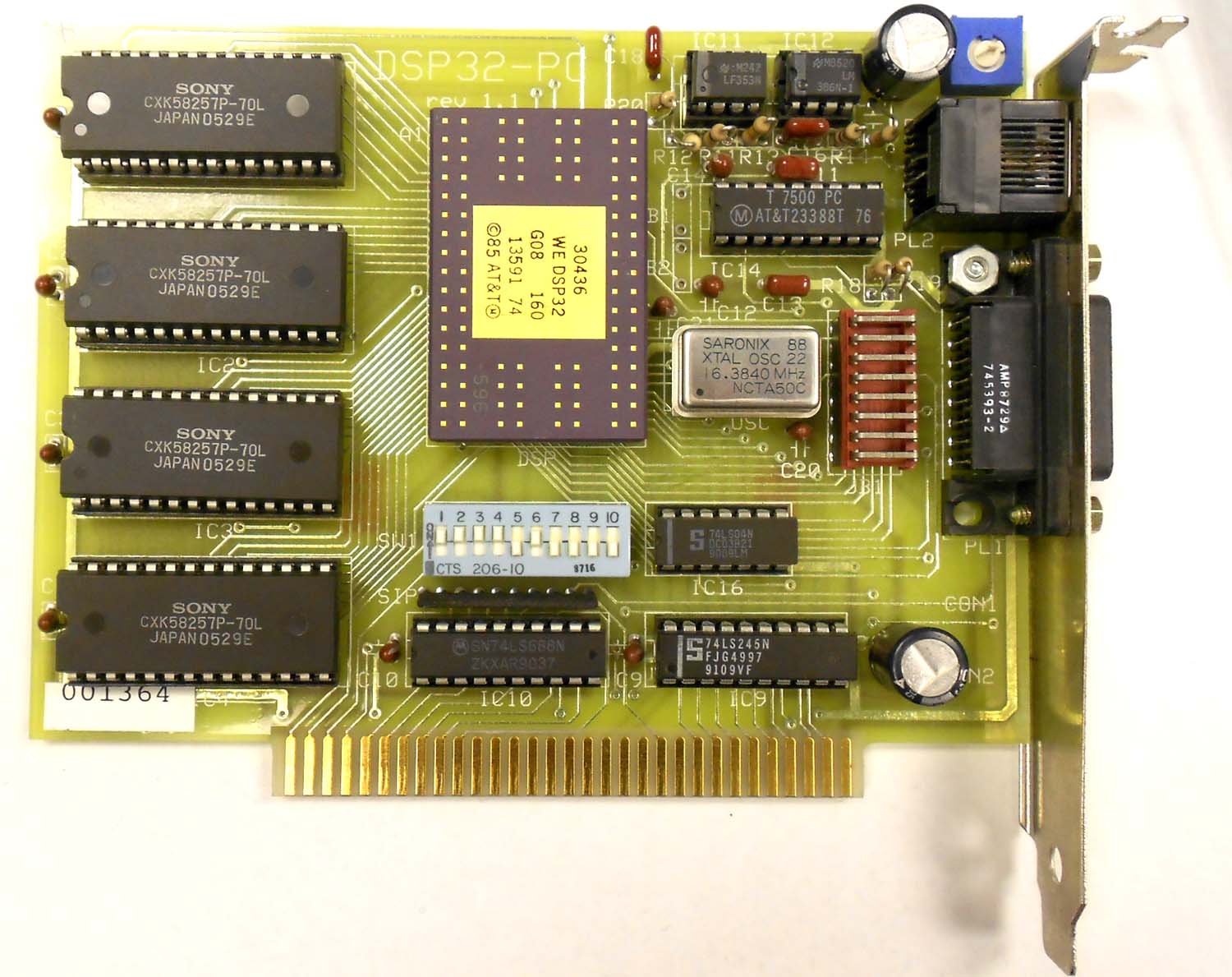
https://www.signalogic.com/images/Ariel_DSP32-PC.jpg

Re: 80386DX ISA single board microcomputer

#73
post #51

Earlier quoted context omitted.

Good story! Everyone were correct about being afraid of opening CRT monitors. Repairing them is a whole other domain than PC electronics. A CRT ZAP from the cathode ray components can kill. That is not a place one should poke around trying to find solutions.

I wonder if I just got lucky in my youth trying to repair a mac classic II (at the time it was about 10 years old), or if the 9" CRT that must have not been turned on for years at that point didn't have enough of a charge? That machine eventually lived and functioned perfectly for quite a few more years (ended up just needing a new HDD) until finally dying.

A level of high voltage in CRTs is directly related to the size of tube and whether it's B/W (monochrome) or color (higher for color as you need to attract 3 electron beams instead of one.) In small monochrome CRTs (like 9"-10") cathode voltages would be in single digit kilovolts range, while for large color CRTs (19"+) would be in tens on kilovolts (like 25kV.) Bottom line is that in 9" CRT lower voltages are a bit safer and dissipate quicker after power off.

Re: 80386DX ISA single board microcomputer

#74
> 12" AOC monochrome VGA monitor

That brings a huge grin to my face. I had one of those, precisely of that vintage, which was my first VGA monitor of any type. The only thing different would be that it was 120V/60 Hz.

It lingered on as a console monitor for many years, and still worked when I finally took it to the recycler a few years ago. In its final years, it didn't get along with some graphics cards or BIOSes since it was purely 640x480 VGA and nothing else, and DDC didn't exist when it was built.

Re: 80386DX ISA single board microcomputer

#75

Earlier quoted context omitted.

The dangers of aquadag charge are enormously exaggerated. The real danger is not that the shock will instantly vaporize you and everyone you love, but that when you disconnect the anode improperly the spark jumps to something-not-quite-ground and destroys electronics, or, when it jumps to you, you hurt yourself because you hit something or drop something. Off-line SMPS are far more dangerous because their main caps a…

You need to discount here for CRT size. A 9" will zap you, a big 30" Barco will happily kill you if you are not going to be careful, those things will put out HV at appreciable current. Ditto for old glass tube large screen color TVs.

Yes, with big picture tubes there's certainly a potential for receiving a lethal shock (of course, depending on the circumstances even very weak shocks can become lethal). My point is more about risk, respect and understanding what you're dealing with instead of apocryphal stories and fear. The former is imho more conducive to safe procedures being followed.

Re: 80386DX ISA single board microcomputer

#76

Although this seems to be a 33MHz CPU, the 386DX40 was the first "decent" processor I had access to when growing up so was quite memorable for me. In my teenage years the PCs my brothers and I had access to were two 386DX40s each with 8MB of RAM and several hundred MBs of hard disk space (can't remember exactly, but pretty sure less than a GB). We really loved Blizzard's Warcraft II, which despite having a minimum re…

A little late but you could also have used the Crynwr plip packet driver to run IPX over the parallel cable avoiding the significant overhead of running Windows 95 on a 386 system.

Re: 80386DX ISA single board microcomputer

#77
post #30

It is truly amazing that one person can bring up a 386DX board system. It is true that there are tons of docs available, but still to bring everything together and to get it running is truly amazing. The team size at any of the PC OEMs doing a 386DX design when it was the state of the art would be at least 25 engineers and managers, easily. Congrats to Alexandru for hitting this out of the park.

I've always wondered why no one came up with cheaper / mass produced 386/486 SOCs; are there any still-valid patents preventing that or is it too much work when we have powerful & cheap ARM SOCs that can emulate them...

I also think it would be interesting to see how small, or how fast, you could make a standard 486 by applying modern manufacturing.

Re: 80386DX ISA single board microcomputer

#78
post #14

I wonder, apart from having fun and scratching some nostalgia itches, what are the outcomes of this? Do any of the things learned by doing this project help in working with present day hardware?

You can run Windows 3.1 which has a GUI more advanced than win 10 GUI. But 32 MB RAM ? Is there any Win 3.1 app which can use so much RAM ?

That much RAM on a 33Mhz 386DX would run OS/2 very comfortably, and you could actually use all of it. Or very early Linux distributions, of course. Imagine a Beowulf cluster of them!

Re: 80386DX ISA single board microcomputer

#79

Awesome project, although I personally can’t identify with putting such effort into reinventing the past instead of making something new. I suspect different people live in different periods. I’ve known people who always dwell on the past, those who are preoccupied with the future and those who are in the present and not overthink too much in either direction.

"Interesting History" is just before your own time (of sentience). I would consider rebuilding 1972 computer a worthy task. But not some 1990 beige box from China.

I kind of wish I had my 1990 beige box, even though it was a hunk of junk even for the time.

Re: 80386DX ISA single board microcomputer

#80
post #30

It is truly amazing that one person can bring up a 386DX board system. It is true that there are tons of docs available, but still to bring everything together and to get it running is truly amazing. The team size at any of the PC OEMs doing a 386DX design when it was the state of the art would be at least 25 engineers and managers, easily. Congrats to Alexandru for hitting this out of the park.

I've always wondered why no one came up with cheaper / mass produced 386/486 SOCs; are there any still-valid patents preventing that or is it too much work when we have powerful & cheap ARM SOCs that can emulate them...

Not an SOC per-se but PC/104 SBCs were quite common about 20 years ago. I'm sure they're still around now, but ARM is obviously dominant. We used a PC104 SBC running Linux to control a rack of wireless radio amplifiers via CAN network at a job I had in 2001. I rolled our own custom Linux distrib to fit on small compact flash, and worked on the middleware.

(aside, the manager / senior engineer there was quite forward thinking; the whole stack was Python before it was cool, and there was a proto-AJAX front end that only worked in IE because the other browsers didn't support it yet... dashboard that was super nice. Met some really smart people there).

Post reply on HN