Live data from Hacker News

Will real estate ever be normal again?

nytimes.com

261–270 of 620 posts

Re: Will real estate ever be normal again?

#261

Earlier quoted context omitted.

In the early 80s a 13% mortgage rate was not uncommon. People survived. Very little blood was spilled

There's a world of difference between high interest rates (which are good and healthy) and rising interest rates (which implode the economy). You gotta look at the derivative. Rising interest rates are really, really bad. Anyone who relies on revolving business debt, credit card debt, or other non-fixed-rate debt goes bankrupt. I kinda wish I entered the economy when we still had 12% interest rates. Each time a reces…

The reason we had a 12% interest rate was because we had a 13% inflation rate.
Re: Will real estate ever be normal again?

#262

Earlier quoted context omitted.

> Part of the problem with the first item you mentioned is that developers don’t really want to build cheap housing (I guess this is an assumption, but it makes sense financially.) This is like saying that Toyota would rather sell Lexuses than Camrys. Yes, it's true, but they sell Camrys anyway. Why? Because the market for luxury is only so big. They can make more money total addressing other parts of the market. So…

Can only speak for my city (Seattle), but no one’s building Camrys and building is constant. It’s not because any zoning prevents building affordable units. It’s because there’s limited land to develop at all and demand for property of any kind is extraordinarily high. All of the development in residential neighborhoods is already zoned for everything that could accommodate 4-10 times as many tenants. But they’re bui…

Seattle development is absolutely constrained by zoning. Not sure why you think otherwise.

https://www.seattle.gov/opcd/population-and-demographics/abo...

> As of 2019, there were 367,806 housing units in Seattle, representing a 19 percent increase since 2010 (according to Washington State Office of Financial Management). The growth in the number of housing units in Seattle from 2010 to 2019 surpassed the 14 percent growth seen between 2000 and 2010. However, even with the rapid increase this decade, expansion of our housing stock has not kept up with Seattle's population growth of 22 percent between 2010 and 2019.

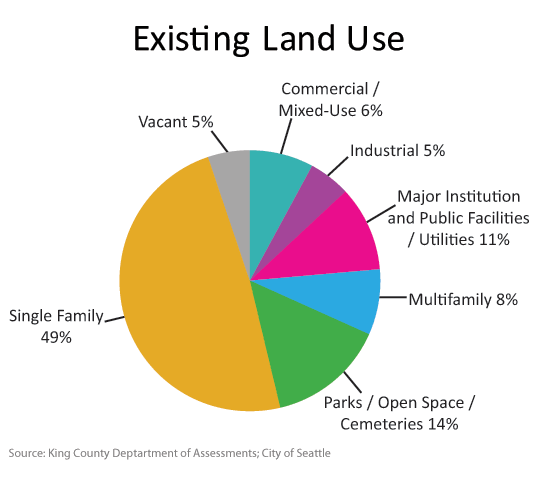
And here's Seattle's land zoning ("Land Use" tab on the same website):

https://www.seattle.gov/Images/Departments/OPCD/Demographics...

50% is zoned SFH. Only 14% is zoned for any kind of (residential) density.

Re: Will real estate ever be normal again?

#263

Earlier quoted context omitted.

Also if they do 1) just imagine how much interest payment that would mean for US Govt and all the dollar denominated debt. I think a mere rate raise to 5% will cause the US Treasury to have to pay for another military.

I’m wracking my brain trying to figure out how we’ll ever raise interest rates again due to this issue. Does anyone know? Any tricks I’m not aware of? Was there way less gov debt in the early 80s when they massively raised rates?

We could have a dual/varied interest rate policy where different rates are set for different policy ”targets”. Tltros - targeted long-term refinancing is one example in Europe. Banks receive extra yields on government debt for lending that money in specified ways.

Re: Will real estate ever be normal again?

#264
post #175

The Fed at this point controls the whole economy and they have two options: 1. Raise interest rates and stop printing. Crazy inflation stops, but asset prices crash and we enter a major recession or depression. The end result will likely be unrest and blood in the streets. 2. Do nothing, keep printing. Inflation picks up massively. The economy keeps humming along but young people, including myself, are permanently pr…

Is there no middle ground? Like... raise interest rates a little, but not too much, and keep printing money, but slow down on how fast?

The OP's #2 is actually an exponential growth in money printing.

If the growth stops being exponential, it moves away from the target in an exponential way. If the growth just becomes an exponential with a smaller exponent, it moves away from the target in an exponential way.

In theory you could have an exponential that grows in a very slow, controlled way. On practice, it will get out of control, because nobody has any idea what the target actually is, so you either always correct towards it, or deviate.

Re: Will real estate ever be normal again?

#265

I don't have any economic theories to offer. All I know is I love my house, with all of its land, trees, and nice quality living. I will protect this thing to my death, because it is so much better than living in an apartment. I don't care if it costs me $4,000 a month.

Jesus Christ, for the last time, upzoning isn't about taking away anyone's home away from them. It's about allowing homes that are currently illegal, not forcing anything. Some people want what you want, others are fine with less space if it means less money. Upzoning means they get to choose what to do with what property they own.

Note the

> > land, trees, and nice quality living.

I have the feeling they're talking about land in their area that they don't own, that for whatever reason is prevented from being used for new homes, and their worry is that zoning changes allowing it would ruin the quality of life there by removing the greenery and open spaces.

Re: Will real estate ever be normal again?

#266

I am surprized no one me tioned we could just limit home ownership to 2-3 for individuals and lets say 20 or so for a company. The actual limits can be decided based on discussion and metrics but just having a limit, any limit could stop companies or rich assholes from buying real estate as "assets" as opposed to a place where people live. Also a limit on just holding property that is meant to be rented out. Either u…

Instead of artificially limiting demand I think it'd be better to stop artificially limiting supply (zoning). If there was enough housing to meet demand, then it would naturally be a poorer investment, and so rich assholes would stop buying so much of it.

Re: Will real estate ever be normal again?

#267
post #180

Earlier quoted context omitted.

Canada already did #2. Average home prices in almost all metro areas are around 10x yearly income. There is no blood on the streets and it is still considered a destination country.

10x isn't terrible, though, is it? Assuming 20% down on a mortgage, if you're frugal, you can save for a down payment in 4 or 5 years or so. Not ideal, of course, but not impossible. In some places in the US folks could save for a decade or more and still not be able to afford a down payment.

The rule of thumb I have heard is 3x.

If you buy a house 10x your income and put 20% down, your monthly payments are 40-45% of your income before tax. That's a lot

Re: Will real estate ever be normal again?

#268

Earlier quoted context omitted.

> Part of the problem with the first item you mentioned is that developers don’t really want to build cheap housing (I guess this is an assumption, but it makes sense financially.) This is like saying that Toyota would rather sell Lexuses than Camrys. Yes, it's true, but they sell Camrys anyway. Why? Because the market for luxury is only so big. They can make more money total addressing other parts of the market. So…

Can only speak for my city (Seattle), but no one’s building Camrys and building is constant. It’s not because any zoning prevents building affordable units. It’s because there’s limited land to develop at all and demand for property of any kind is extraordinarily high. All of the development in residential neighborhoods is already zoned for everything that could accommodate 4-10 times as many tenants. But they’re bui…

50% of the developable land in Seattle is designated for single-family homes, and not one single inhabitable SFH in Seattle city limits is what anyone would call "affordable". The fact that it's illegal to replace those SFHs with duplexes, quadplexes, or midrises is a primary driver of housing unaffordability.

Seattle's population growth has outpaced its housing growth for multiple decades. There's a huge amount of "catching up" to do, and SFH zoning is blocking that from happening.

Once enough there's enough housing to hold all the rich people that want to live here, of which there are many, you will see some downmarket construction happening. But we're a long way away from that.

Re: Will real estate ever be normal again?

#269

Earlier quoted context omitted.

Part of the problem with the first item you mentioned is that developers don’t really want to build cheap housing (I guess this is an assumption, but it makes sense financially.) They can make way more money catering to the people who can “afford” to build a $500k home, and people who want a very custom design and lots of space. On the renting end, “luxury” apartments will make more money than really basic cheap unit…

We have the same problem with the car market. I can only afford a $5,000 car, but the car manufacturers make all their money building $20,000 cars. I just can't see how Honda making another $20,000 fit is going to help me afford a $5,000 car.

I mean VW makes $100,000 Porsches and $20,000 Jettas. At some point it’s not economical to make cheaper cars due to materials and workmanship. You can certainly buy an e-bike for half that, I did.

The cost of construction in America is $150/sqft. We’re not even close in cities. Off by an order of magnitude.

Re: Will real estate ever be normal again?

#270

Earlier quoted context omitted.

Part of the problem with the first item you mentioned is that developers don’t really want to build cheap housing (I guess this is an assumption, but it makes sense financially.) They can make way more money catering to the people who can “afford” to build a $500k home, and people who want a very custom design and lots of space. On the renting end, “luxury” apartments will make more money than really basic cheap unit…

It doesn't really matter if you add new stock at the top end or at the bottom end, people from the bottom move up, and make space at the bottom for new entrants. Any new stock you add increases supply, which leads to lower prices across the board. [edit] and btw, I think builders aren't tripping over their shoelaces to service the low end of the market because they know the city is so aggressively capping how much th…

> It doesn't really matter if you add new stock at the top end or at the bottom end, people from the bottom move up, and make space at the bottom for new entrants. Any new stock you add increases supply, which leads to lower prices across the board

I could definitely see that being how it works in a lot of cases, but it seems like a stretch to assume that's some sort of natural law of prices. If I have a market of ten potential buyers, the first who has $1, the second who has $2, and so forth until the tenth buyer has $10, I could put an infinite number of goods for $10 for sale, and none beyond the first would be able to be purchased. Sure, you could argue that it would be silly of me to price in that way, and you would be right, but in reality you don't know the exact financial details of every potential buyer of your whole market. GP is hypothesizing that basically this exact scenario is happening with housing, and I don't know if they're right or not, but your rebuttal doesn't seem very convincing that this is an impossibility.

Post reply on HN