So they're just giving up. Carbon needs to stay in the ground, this is just fantasy until there's a real proven technology. See you all in hell.
U.S. sets goal to drive down cost of removing CO2 from atmosphere
271–280 of 347 posts
Re: U.S. sets goal to drive down cost of removing CO2 from atmosphere
#272Earlier quoted context omitted.
Bear in mind that (a) you're just pulling it from the atmosphere and burying it, not splitting the C from O2 so you can use it as fuel again, and (b) there are applications like long-haul jets and cement production where eliminating emissions isn't that easy. To put some numbers on (a), David MacKay's book has some numbers[1]: > The laws of physics say that the energy required must be at least 0.2 kWh per kg of CO2..…
> there are applications like long-haul jets and cement production where eliminating emissions isn't that easy. I disagree, there's an easy solution to eliminating those emissions: have zero long-haul jets and zero cement production. Before this gets (inevitably) downvoted, the more interesting question is why do we need either, what alternatives are there, how fundamentally we're willing to question our biases and e…
[deleted]
Re: U.S. sets goal to drive down cost of removing CO2 from atmosphere
#273Earlier quoted context omitted.
Bear in mind that (a) you're just pulling it from the atmosphere and burying it, not splitting the C from O2 so you can use it as fuel again, and (b) there are applications like long-haul jets and cement production where eliminating emissions isn't that easy. To put some numbers on (a), David MacKay's book has some numbers[1]: > The laws of physics say that the energy required must be at least 0.2 kWh per kg of CO2..…
> there are applications like long-haul jets and cement production where eliminating emissions isn't that easy. I disagree, there's an easy solution to eliminating those emissions: have zero long-haul jets and zero cement production. Before this gets (inevitably) downvoted, the more interesting question is why do we need either, what alternatives are there, how fundamentally we're willing to question our biases and e…
I would say it's pretty dang tough to not have cement.
What do you use for a house foundation? Many apartments are made of cement and essentially every building uses a cement foundation.
Luckily, cement is not a big part of the total emissions.
Neither is long haul travel, particularly. Short haul flights are about half of all passenger-miles in air travel, can be made fully electric, and long-haul and medium haul flights can be split up into multiple legs for almost every route.
EDIT:I will say there are ways to reduce CO2 emissions from cement. You can make clinker with electric heat just fine. But half the CO2 is from the clinker itself. Over time, cement will absorb the CO2 it emitted as it fully cures, but that can take a century. It’s possible to accelerate that process. It’s also possible to use alternatives, like sulfur cement.
Re: U.S. sets goal to drive down cost of removing CO2 from atmosphere
#274Maybe instead of paying 100$ for a ton of CO2 captured, add a CO2 tax of few $ to every ton released
Ok, you just killed the US steel industry and several others. Massive amounts of manufacturing have moved to other industries to avoid the tax. US economy is now significantly less competitive. What's the next move?
that's what things like COP26 should have been for - breaking the borders between our made up nations and agreeing to solve this problem together as global citizens
Re: U.S. sets goal to drive down cost of removing CO2 from atmosphere
#275Earlier quoted context omitted.
> there are applications like long-haul jets and cement production where eliminating emissions isn't that easy. I disagree, there's an easy solution to eliminating those emissions: have zero long-haul jets and zero cement production. Before this gets (inevitably) downvoted, the more interesting question is why do we need either, what alternatives are there, how fundamentally we're willing to question our biases and e…
Upvoted, because I think it's a legitimate question. I don't think you're actually saying let's stop all long-haul flights and cement production . You're saying that if we actually believed something was an existential risk to civilization, we'd put almost any option on the table for mitigating it, even if only to rule it out. I assume there is a list of sacred things we wouldn't even consider doing without, no matte…
Concrete and jet travel are not existential. They're a few percent of the total. 3% for cement and 2% for aviation. Less than 1% for long haul aviation.
If that was it the only thing left, we'd have no problem. That's at pre-industrial emissions level. https://ourworldindata.org/uploads/2020/09/Emissions-by-sect...
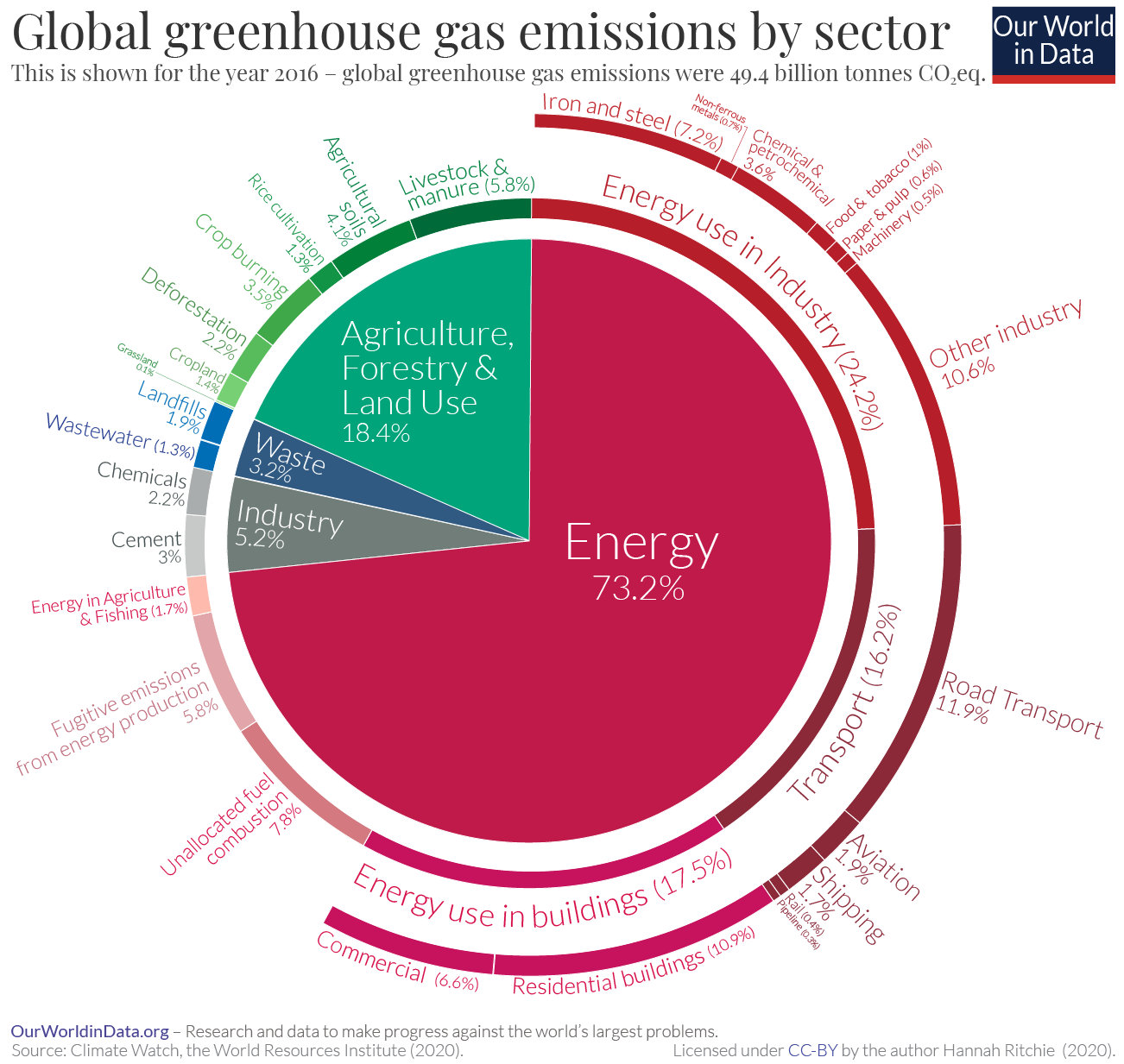
Long haul aviation makes immigration feasible without dangerous long ship trips, which are worse emissions than long haul aviation. So we should keep them around in some form, but we can improve the efficiency and even electrify them.
Re: U.S. sets goal to drive down cost of removing CO2 from atmosphere
#276Earlier quoted context omitted.
We can drastically reduce our usage of jets though. There is no reason why people should be flying between SF and LA, or NYC and Boston. Those are well within comfortable range of high speed rail, which is electric. Once we’ve shifted all the excess air travel over to rail, that will leave a much smaller set of jet travel to offset.
If you look at a map of all airline flights there are many thousands of short-range flights. Replacing them all with trains would be interesting. Just the right-of-way property transactions would be daunting. Look at California as a lesson in how this can't be easily done. The other thing is, people move around. Airlines can change flights easily to map to demographic changes; that's a major strength of air travel. N…
It's much easier, IMHO, to switch over these short haul flights to electric aircraft than to High Speed Rail in the US. By the time even one major new HSR route will be finished, we'll have certified and be flying electric passenger aircraft with just as much speed and just as long of a route (500 miles) BUT with ability to go anywhere in the country by hopping.
Re: U.S. sets goal to drive down cost of removing CO2 from atmosphere
#277Earlier quoted context omitted.
It's very important to consider the impact on marginalized groups and offset any impact through transfers.
Here are some options: - Provide relocation subsidies to areas with public transit - Increase public transit - Treat bike lanes as first class infrastructure - Provide direct gas assistance and carbon tax rebates for low income earners
This tracks for cities and looks good, but also looks like just a start.
What about rural areas? They have higher logistical costs, so cost of goods would go up. Things being sold to rural businesses also require someone to traffic their way out there. Point of reference: https://www.nytimes.com/2018/12/06/world/europe/france-fuel-...
Re: U.S. sets goal to drive down cost of removing CO2 from atmosphere
#278> The Department of Energy's Carbon Negative Earthshot seeks to slash the cost of carbon removal to $100 a tonne by the end of the decade At 40 gigatonnes a year, that would be $4 trillion, which is about 5% of Gross World Product.[0] It's probably still cheaper to avoid emitting the CO2 in the first place, but that does put an upper bound on the cost of reaching net zero. Of course, no one wants to take a voluntary…
> It's probably still cheaper to avoid emitting the CO2 in the first place, but that does put an upper bound on the cost of reaching net zero. It seems hard to believe that removing CO2 from the atmosphere could ever be less expensive than not emitting it to begin with. You're working against thermodynamics. So the whole thing seems like a fraud. An excuse to keep emitting CO2 while claiming that you'll do something…
It may be easier to develop one efficient process to extract CO2 from the atmosphere than to develop numerous efficient alternatives to every CO2 producing activity.
Re: U.S. sets goal to drive down cost of removing CO2 from atmosphere
#279> The Department of Energy's Carbon Negative Earthshot seeks to slash the cost of carbon removal to $100 a tonne by the end of the decade At 40 gigatonnes a year, that would be $4 trillion, which is about 5% of Gross World Product.[0] It's probably still cheaper to avoid emitting the CO2 in the first place, but that does put an upper bound on the cost of reaching net zero. Of course, no one wants to take a voluntary…
Of course it's never going to be more economical to remove it than just avoiding producing it in the first place.
Problem is, even if all human sourced CO2e emissions ceased tomorrow, the world would still continue to warm significantly because the blanket is already up there. The natural processes that sequester carbon take many millennia (or more) to make any significant changes.
Re: U.S. sets goal to drive down cost of removing CO2 from atmosphere
#280> The Department of Energy's Carbon Negative Earthshot seeks to slash the cost of carbon removal to $100 a tonne by the end of the decade At 40 gigatonnes a year, that would be $4 trillion, which is about 5% of Gross World Product.[0] It's probably still cheaper to avoid emitting the CO2 in the first place, but that does put an upper bound on the cost of reaching net zero. Of course, no one wants to take a voluntary…
Of course it's never going to be more economical to remove it than just avoiding producing it in the first place. Problem is, even if all human sourced CO2e emissions ceased tomorrow, the world would still continue to warm significantly because the blanket is already up there. The natural processes that sequester carbon take many millennia (or more) to make any significant changes.
This is not completely true. The oceans are still absorbing some of the emitted CO2, so if human CO2 emissions were to cease the atmospheric CO2 level would begin to decline. This will eventually cause the surface waters to become saturated with CO2 though, so this decline will slow before all the anthropogenic CO2 were absorbed. Eventually excess carbon will be transported to the deep ocean, allowing more CO2 to be absorbed.