Neat, I don't remember hearing about the "command" justification before. I suppose this is a rationale behind e.g. the 'ns macro separating its command-keywords that map to functions with parens? Still, I always thought the full syntax of 'ns and the individual things inside of it was a bit wild. Thank goodness for Slamhound...
Like, take (import [package thing-in-package other-thing-in-package]) -- the first element is "special" in how the rest are interpreted. 'gen-class takes :methods as [[method-name [arg-types] return-type]] while 'letfn separates the inner functions with ()s. Multi-arity functions use () as the separator, too. But why not []? Is the [foo] arglist^H^H^H^Hvector in ([foo] body) in (defn blah ([] body) ([foo] body) ...) meant to be a "command"? Or the name of the local function in 'letfn a command?
Using "nothing"/implicit argument pairs like in 'case/'cond/'extend-protocol/... instead of wrapping them in a vector like 'let can feel inconsistent, but it's understandably popular even if it can make things harder to edit or easier to introduce bugs. Writing things that way is a common introduction-to-macros for CL, too, and pair-lists are often used for literal maps rather than importing something that makes a hash table. Looking at Clojure's 'case again though I guess you were mentioning its ability to match multiple values with (x y z)? Ok, but it seems to me just a consequence of porting behavior from CL, not a big deal.
It still strikes me as weird that Clojure introduced nice data literal sugar, except I can't be sure that when I see it that it's always a data literal. When I see [], it might be a literal vector with every element evaluated, or it might be embedded in a context with complex syntax and effects. Like sometimes it's just a sequence of binding forms such as in simple function arguments, sometimes there's an implicit pairwise association going on like in 'let, sometimes the first element determines how the rest are interpreted, or there might be keywords thrown in the middle that determine the rest. This problem extends to some popular libraries, too (e.g. Reagent's syntax for components always bugged me). In practice it's not a huge deal, sure, and I liked it for a while, then I got used to CL and prefer its idioms.
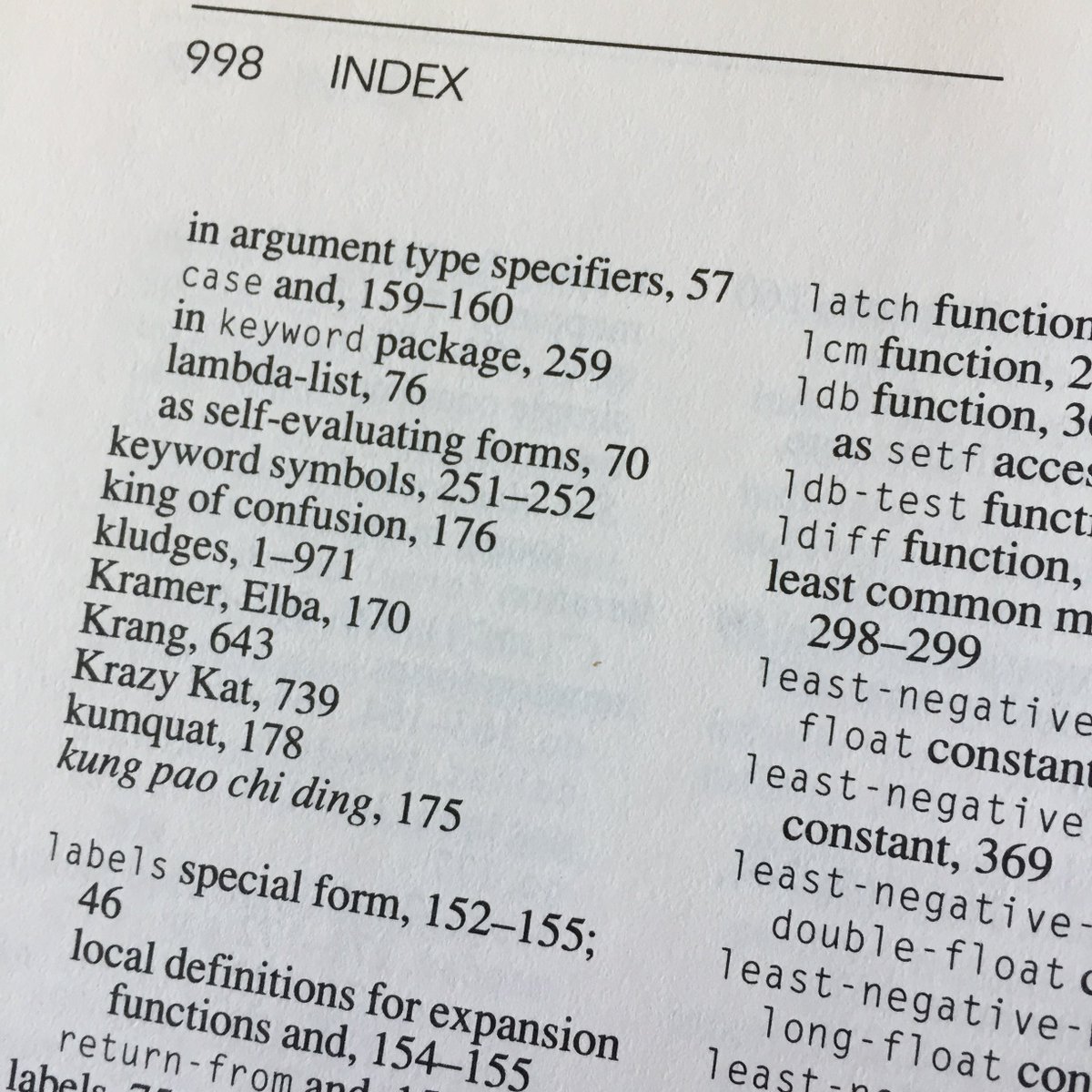
All this isn't to say that CL is a paragon of consistency (see kludges: https://stevelosh.com/static/images/blog/2018/07/lisp-kludge...) and when it comes to syntax you still have to deal with similar issues of interpretation (CL lambda-lists have some rich behavior, the loop macro has many features, format strings too, etc. not to mention stuff in libraries, and custom reader macros doing whatever), but I am saying that I don't think Clojure's introduction of [] and {} for core syntax on top of their roles as data literals actually made things any better.